Best LLM Red Team Tools for Prompt Injection
Test prompt injection before the model talks to tools or mail.
If you ship an LLM feature, test prompt injection before that model talks to tools, mail, or your own APIs. CVE-2025-32711, EchoLeak, was a CVSS 9.3 zero-click prompt injection in Microsoft 365 Copilot. Microsoft disclosed it on 11 June 2025.
Prompt injection is still LLM01 in OWASP’s GenAI LLM Top 10 2026.
Some tools are CI scanners. Some are multi-turn attack frameworks you write. Pasting a jailbreak into production is not a test. HTTP crawlers stay on DAST tools.
How we evaluated
We read first-party docs, source, licenses, and release notes, and we treat a marketing page as a claim, not as proof two products do the same work. For LLM red team we cared about whether you operate the runner, whether a scan can fail CI, whether the target is a model benchmark or an app you own, and whether a commercial layer is documented.
| Tool | Best for | What to check |
|---|---|---|
| Garak | A CLI scanner you point at a model | Apache-2.0 · you run it · probe families |
| Promptfoo | Red team in CI, plus evals | MIT · scanner in CI · OSS + Enterprise |
| PyRIT | An interactive red-team framework you author | MIT · multi-turn · you operate it |
| Giskard | Agent scan in Python, Hub if the team needs a console | Apache-2.0 + Hub · OSS you run or hosted |
| DeepTeam | A Python red_team() you can keep in-repo | Apache-2.0 · you run it · lesser-known |
| CyberSecEval | Scoring a foundation model on a published set | MIT evals · model benchmark · you run it |
Garak
Best for a CLI scanner you point at a model
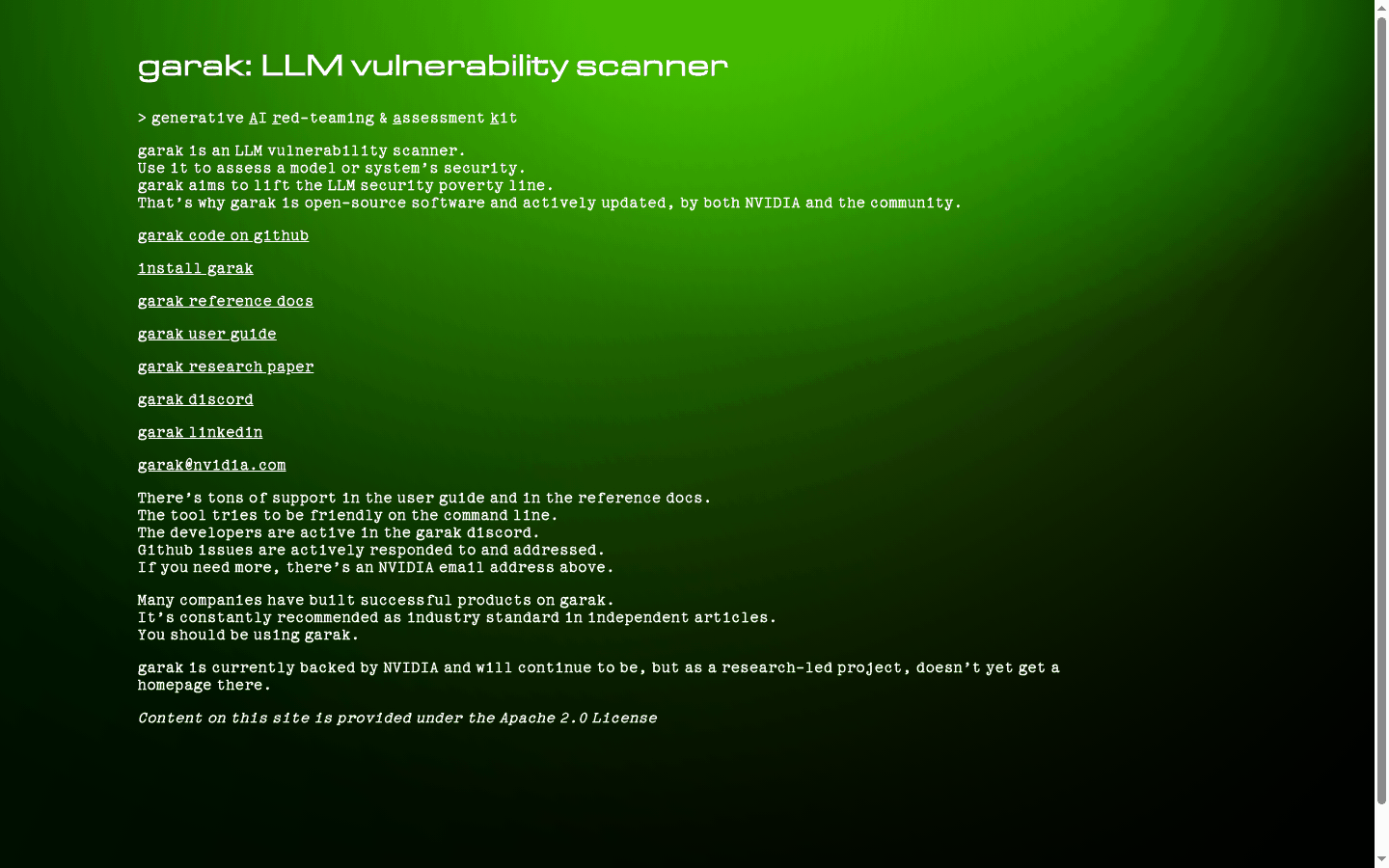
Garak is NVIDIA’s generative AI red-teaming and assessment kit. The README says it checks whether an LLM can be made to fail in a way you do not want: prompt injection, jailbreaks, data leakage, hallucination, and more.
You pick a generator, pick probe families, and you get a JSONL report. REST endpoints are a documented target alongside a hosted model API.
Key features:
- Probe families for injection, jailbreaks, encoding, leakage, and toxicity
- Generators for OpenAI, Hugging Face, Bedrock, NIM, ggml, and REST
- Detectors and a harness; hit log plus JSONL
- Install from PyPI. Docs at docs.garak.ai
Why we like it:
When the job is “scan this model” and you will run the CLI yourself, this is the OSS leader. The report is a file you can keep.
Limits:
It is a model and dialog scanner. It will not crawl your web app the way a DAST does. You still own the generator config and the API spend.
License or pricing: Apache-2.0.
Promptfoo
Best for red team in CI, plus evals
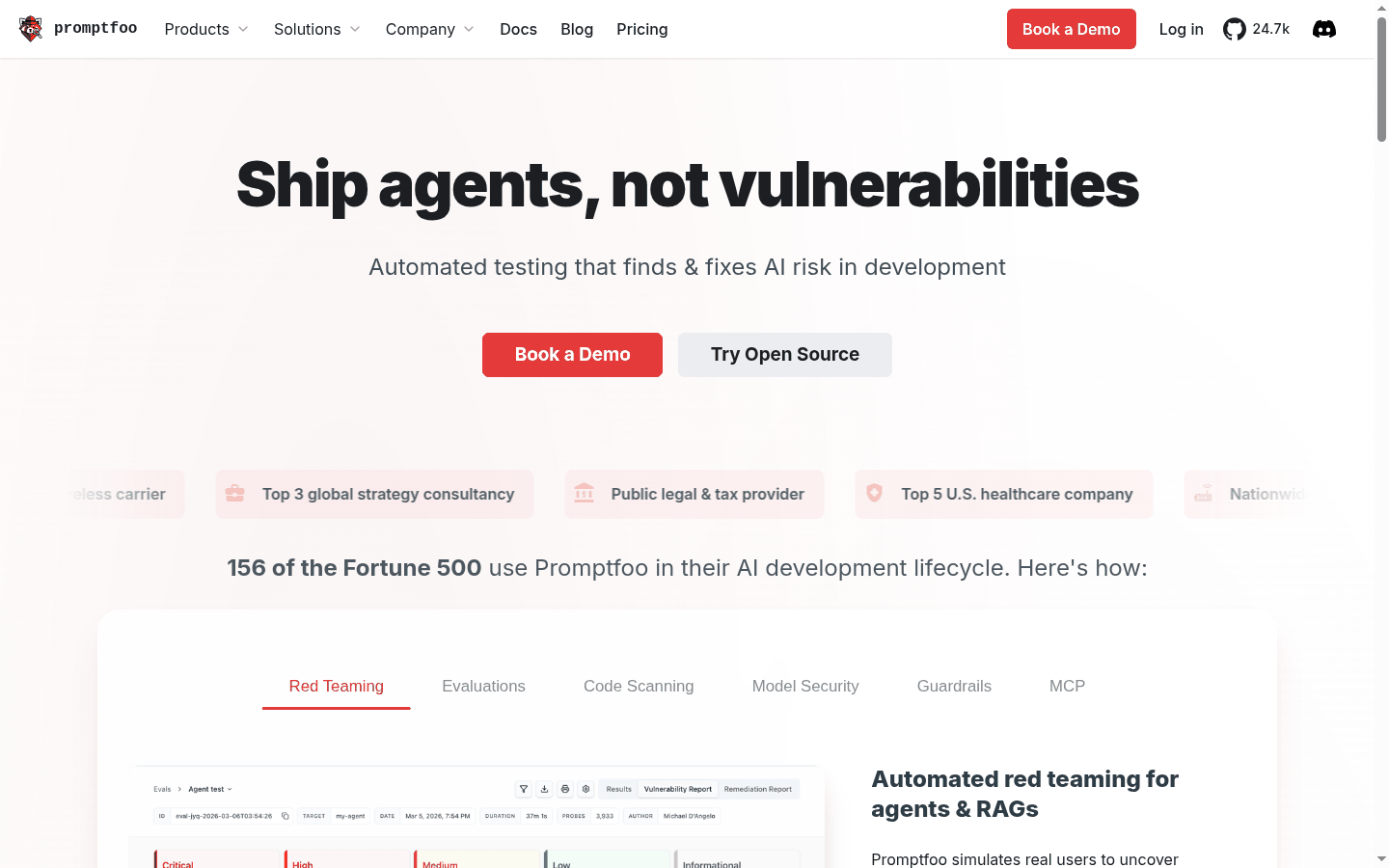
Promptfoo is a CLI and library for evals and red-teaming. The red-team docs put OWASP LLM01 on a plugin preset and document redteam run in GitHub Actions, GitLab, and Jenkins.
OpenAI agreed to acquire Promptfoo in March 2026. Their post says the repo stays public under the same MIT license, and that they will keep supporting multiple providers. Enterprise is a separate SaaS or on-prem layer.
Key features:
- redteam run as a CI job, with JUnit and JSON output
- OWASP LLM Top 10 plugin presets, including LLM01
- Targets via HTTP, browser, or a model provider
- Community CLI plus Promptfoo Enterprise (SaaS or on-prem)
Why we like it:
If a finding has to fail a pull request, Promptfoo is the one with a documented CI job. Evals and red team share one config, which is how most teams actually start.
Limits:
Community red teaming is marked limited on their Enterprise comparison. No public list price.
License or pricing: MIT. Enterprise commercial.
PyRIT
Best for an interactive red-team framework you author
PyRIT is Microsoft’s Python Risk Identification Tool for generative AI. The live tree is microsoft/PyRIT. Azure/PyRIT is archived and points there.
You compose executors, converters, scorers, and memory. Single-turn and multi-turn attacks on the public docs include Crescendo and TAP. SQLite or Azure SQL keeps the transcript.
Key features:
- Executors for single-turn and multi-turn attacks
- Converters across text and other modalities on the public docs
- Scorers (true/false, Likert, classification, custom)
- Memory in SQLite or Azure SQL, with export
Why we like it:
When the target talks back for several turns, a one-shot plugin scan will not cover the conversation. PyRIT is the framework you write, and the transcript stays yours.
Limits:
You write the loop. There is no commercial SKU on the docs. It is not a one-command scan of an HTTP app.
License or pricing: MIT.
Giskard
Best for agent scan in Python, Hub if the team needs a console
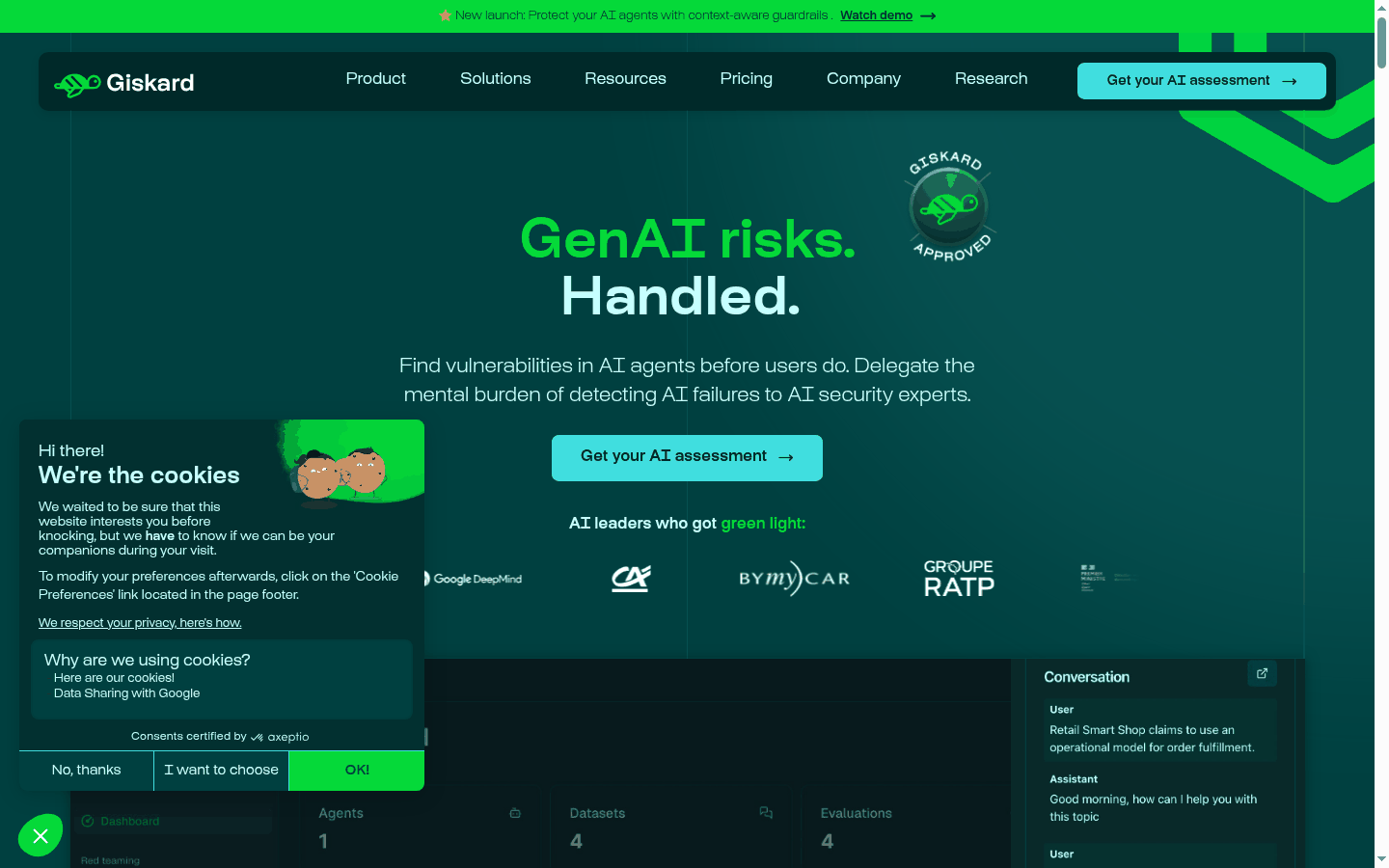
Giskard ships an Apache-2.0 Python library for checks and a vulnerability scan, plus Giskard Hub as the enterprise console. Their comparison page puts continuous red teaming, SSO, and SOC 2 on Hub only.
The Hub FAQ says it tests conversational agents as a black box through an API. Open source is the local, single-user row, including CI in a development pipeline.
Key features:
- giskard-scan for automated agent red teaming
- Scenario checks with an LLM judge on your provider
- Hub: scheduled runs, team RBAC, SSO, audit trails
- On-prem Hub is a documented option for sensitive estates
Why we like it:
When AppSec wants a scan in Python and the business wants a console, one vendor covering both is the honest split. Start OSS. Pay if the team outgrows the library.
Limits:
Hub is commercial. The public pricing page lists Free OSS and Enterprise by contact. No public list price.
License or pricing: Apache-2.0 OSS. Hub commercial, sales-quoted.
DeepTeam
Best for a Python red_team() you can keep in-repo
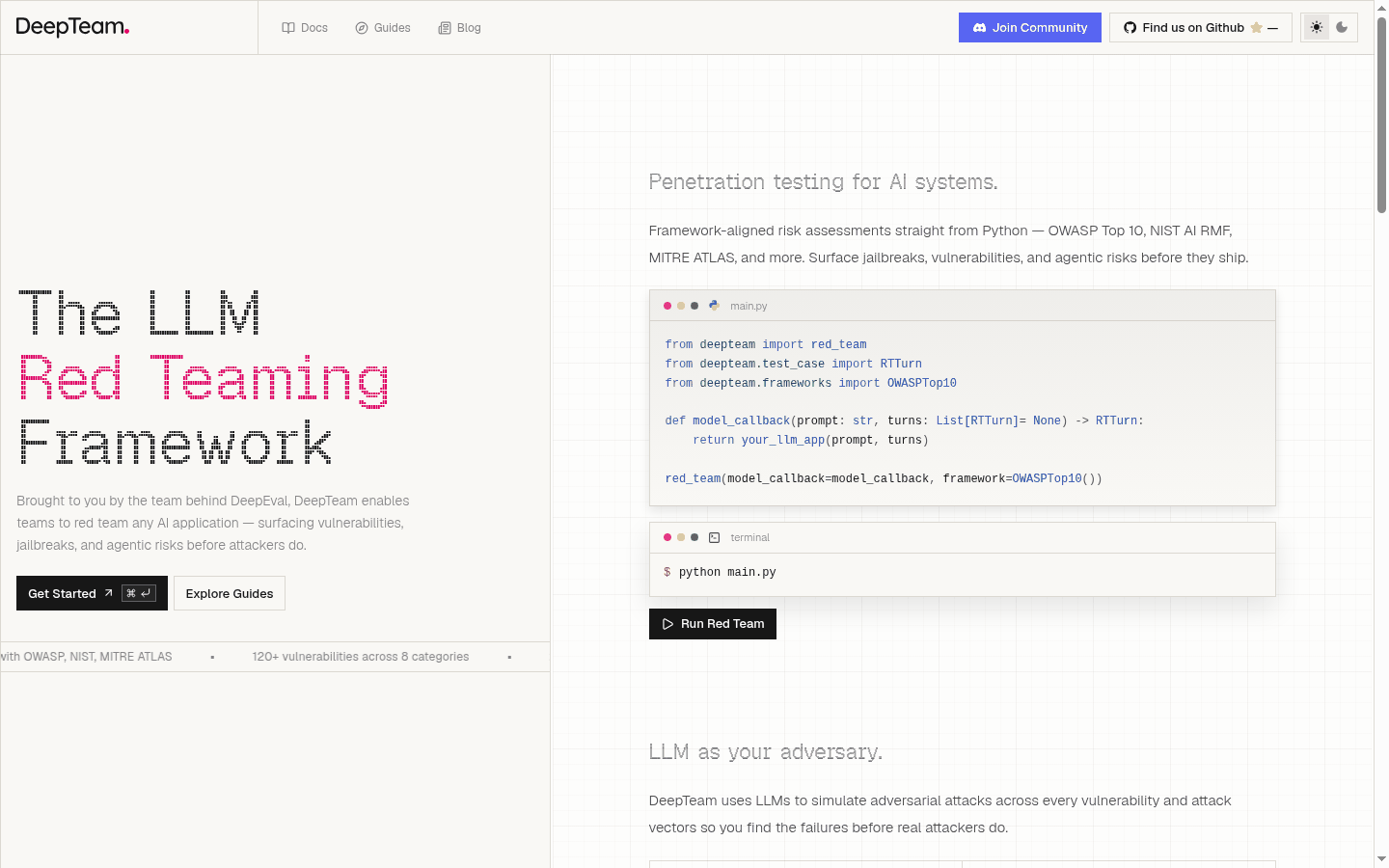
DeepTeam is Confident AI’s open-source LLM red-teaming framework. You pass a model_callback and a framework such as OWASP Top 10. It runs locally and is built on DeepEval.
The site claims 120+ vulnerability types and multi-turn jailbreak methods they name. Confident AI is the separate commercial platform. DeepTeam is the library.
Key features:
- red_team() with documented OWASP, NIST, and MITRE mappings
- Simulator model and evaluation model you choose
- Local runner, CI on the public docs
- Optional Confident AI reporting layer
Why we like it:
When you want a Python function in the same repo as the agent, and you will not buy a console yet, DeepTeam is the lesser-known library that is still maintained. Last push on the public tree was August 2026.
Limits:
A scan needs a simulator LLM and a judge LLM, so inference cost is part of the run. The commercial dashboard is Confident AI. DeepTeam is the library. The library is Apache-2.0. The commercial dashboard is priced separately.
License or pricing: Apache-2.0. Confident AI is a separate commercial platform.
CyberSecEval
Best for scoring a foundation model on a published set
CyberSecEval is Meta’s Purple Llama benchmark suite. CyberSecEval 2 added prompt-injection tests. Version 4 is the live tree, with AutoPatchBench and extra defender evals on the public docs.
Key features:
- Textual and visual prompt-injection benchmarks on the public docs
- Judge LLM plus a model under test
- MIT license on evals and benchmarks
- Runnable from the Purple Llama CybersecurityBenchmarks tree
Why we like it:
When the question is how a base model behaves on a published injection set, a benchmark is more useful than a one-off chat. Do not treat it as a test of your app.
Limits:
CyberSecEval scores the model, not the HTTP wrapper your users hit. Prompt Guard, in the same Purple Llama umbrella, is a safeguard model on a Llama Community license, and it is a different product.
License or pricing: MIT for evals and benchmarks.
How to choose an LLM red-team tool
Answer these four before you pick a runner. The names in the table are the shortlist, not a ranked bake-off.
| Critical question | Why it matters | What to evaluate | Red flag |
|---|---|---|---|
| Are we scanning an app we own, or scoring a foundation model? | A published set does not hit your tools, RAG, or HTTP wrapper. | Garak, Promptfoo, DeepTeam, Giskard on an endpoint you own. CyberSecEval on the model. | A model leaderboard treated as an app pentest. |
| Does a hit fail CI, or is this a scheduled red-team engagement? | A report that never gates a merge does not change what ships. | Promptfoo redteam run. Garak CLI in a job. PyRIT for the multi-turn case you author. | A dashboard with no exit code. |
| Do we operate the runner? | The transcript and the API keys follow the operator. | Garak, Promptfoo CLI, PyRIT, DeepTeam, CyberSecEval you run. Giskard Hub and Promptfoo Enterprise you do not. | A hosted scan of production prompts with no data-flow diagram. |
| Where does the finding live tomorrow? | A chat log in a vendor tenant is not a ticket. | Garak JSONL. Promptfoo JUnit and JSON. PyRIT memory export. Hub or Enterprise if the team needs a console. | No export path. |
Start with Garak or Promptfoo on an endpoint you own, and fail CI on a hit. Keep PyRIT for the multi-turn case. The HTTP scanner is the DAST list.
FAQs
Is Garak a DAST scanner like OWASP ZAP?
No. ZAP speaks HTTP to the app you already run. Garak probes a model or dialog system. Use the DAST list for HTTP crawlers.
Did Promptfoo stay open source after OpenAI bought it?
Yes, on their March 2026 post. The repo stays public under the same MIT license. Enterprise is a separate commercial layer.
Should I run CyberSecEval against my chatbot?
CyberSecEval is a model benchmark suite. Point Promptfoo, Garak, or DeepTeam at the app. Use CyberSecEval when the question is how the base model behaves on a published prompt-injection set.
Is this a scored bake-off?
No. Order is editorial.