Dropzone AI vs Prophet Security: L1 Investigation vs Multi-Agent AI SOC
Choose Dropzone when fast autonomous L1 alert investigation is the product. Choose Prophet when triage plus hunting and detection engineering is the product.
A SOC lead asking for an "AI SOC" usually means one of two buys. Do you need an agent that investigates every queued alert so L1 stops drowning, or a multi-agent platform that also hunts what detections miss and feeds detection engineering?
Between these two, Dropzone AI productizes the first job: an autonomous AI SOC Analyst that runs full L1 investigations across the tools you already run. Prophet Security productizes the broader constellation: alert investigation and response, threat hunting, and closed-loop detection engineering from the same agentic platform.
Shared "AI SOC" language does not mean one interchangeable job. Related shortlists live under AI SOC tools; the SOAR-versus-investigation split is covered in Tines vs Dropzone AI.
| Job | Autonomous AI SOC Analyst for L1 alert triage and investigation across the existing stack | Agentic AI SOC platform: investigate and respond, threat hunt, and improve detections |
|---|---|---|
| How an alert closes | Investigation run returns a verdict plus evidence for analysts or SOAR handoff | Auditable determination from the AI SOC Analyst; optional scoped Agent Actions; hunting and detection agents sit beside triage |
| Playbooks vs agents | No playbook-first model; agents query tools and follow evidence | Agent constellation across triage, hunting, and detection engineering rather than a single investigation SKU |
| Deploy | SaaS agent querying your APIs; no data lift required for API investigation | Dedicated single-tenant; bring-your-own-key option; integrates with the existing stack |
| License/pricing | Investigation capacity (up to 4,000 full investigations per year per AI analyst); Request Pricing; Enterprise/MSSP contact (checked 5 Sep 2026) | Demo / sales quote; no public self-serve dollar table (checked 5 Sep 2026) |
| Who operates it | SOC sets scope and authorization; analysts review finished investigations | SOC and SecOps plus detection engineers who consume hunting and detection feedback |
Recent launches reinforce breadth versus focus rather than erase it. On 8 April 2026 Dropzone announced an Agentic SOC: the AI SOC Analyst plus Threat Hunter and a later Threat Intel Analyst, still centered on investigating your stack. On 29 July 2025 Prophet announced a $30M Series A alongside its Agentic AI SOC Platform expansion from Analyst into Threat Hunter and detection coverage agents.
That queue math is why both vendors show up on the same shortlist. The buyer question is whether clearing L1 investigations is enough, or whether hunting and detection feedback must ship in the same platform.
We reviewed first-party documentation, funding notices, product pages, and live community threads. We did not test the products in paid production environments, so this is not a hands-on benchmark.
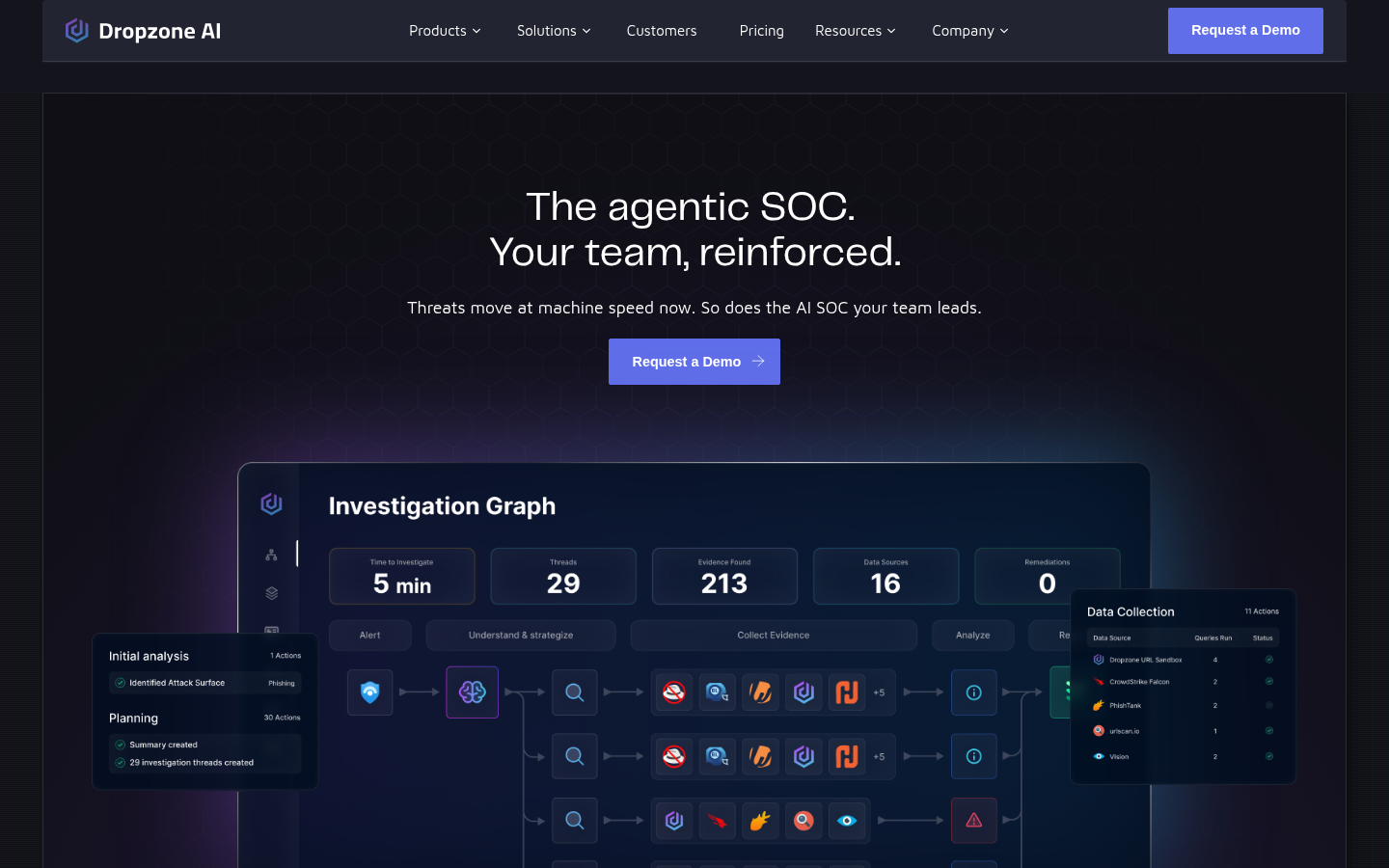
Dropzone AI
Prophet Security
Editions and pricing
Neither vendor publishes a self-serve dollar sticker a spreadsheet can finish without sales. Dropzone meters investigation capacity. Prophet is demo- and quote-gated. Prophet is an independent mid-stage company at about $41M total after an $11M seed and a July 2025 $30M Series A led by Accel.
| Owner (2026) | Independent. AI SOC Analyst for alert investigation | Independent. Agentic AI SOC platform; founders ex-StackRox |
|---|---|---|
| How you buy it now | Request Pricing on investigation capacity. Enterprise and MSSP are contact paths. No public dollar SKU on first-party pricing page (checked 5 Sep 2026) | Request a demo / sales quote. No public self-serve dollar table on first-party site (checked 5 Sep 2026) |
| Public unit | Up to 4,000 full investigations per year per AI analyst; unlimited users; volume discounts documented | None published. Platform sold as a quoted suite |
| Funding signal | About $57M total, including a $37M Series B (Jul 2025, Theory Ventures) | About $41M total ($11M seed + $30M Series A Accel, Jul 2025). Mid-stage independent, not a hyperautomation mega-round peer |
If procurement needs a published monthly license price before the first call, both will stall that spreadsheet until a quote lands.
How investigations start
| Trigger | Alerts already in SIEM, EDR, identity, email, and cloud tools; agent queries via API | Alerts across the security stack into the AI SOC Analyst |
|---|---|---|
| Investigation shape | Full-depth L1 investigation with logged tool queries and reasoning; no new playbook required for a novel alert | Senior-analyst-style investigation with an auditable determination; scoped response actions with or without sign-off |
| Output | Decision-ready investigation report for analysts or SOAR handoff | Plain-language findings plus evidence; response can stay with analysts or Agent Actions |
| What teams argue about | Whether investigation capacity alone clears the queue without hunting and detection loops in-product | Whether platform breadth is worth the quote when the urgent pain is still L1 investigation depth |
Between these two, that audit concern maps to product posture: both sell explainable investigations rather than silent auto-close. Ask for the evidence trail and human review path in the POC either way.
Hunting and detection engineering
| Primary surface | L1 investigation capacity; Threat Hunter available as Agentic SOC expansion | AI Threat Hunter plus AI Detection Engineer / Detection Advisor as platform pillars beside the Analyst |
|---|---|---|
| Hunting shape | Ad-hoc and scheduled hunting as an adjacent capability to the investigation product | Proactive hunts from emerging threats; plain-language questions across disparate systems |
| Detection feedback | Not the center of the commercial story; investigation depth and capacity are | Closed-loop detection coverage from completed investigations; tuned and net-new detections for approval |
| What teams argue about | Whether adding hunting later still leaves detection engineering elsewhere | Whether the constellation replaces separate hunting and detection tooling on day one |
Between these two, do not buy "has a threat hunter" as a unique checkbox. Buy the operating surface: Dropzone when investigation capacity is the job, Prophet when hunting and detection feedback must ship with triage.
Where they overlap
Both sell autonomous alert investigation without a classic SOAR playbook rebuild. Both talk agentic SOC and evidence trails. Both show up when an RFP says "AI SOC analyst" after the queue outgrew human L1. Overlap is category timing, not identical product breadth. Treating them as interchangeable duplicates spend without covering both jobs.
When to use both
Running both is uncommon. Most teams pick focus or breadth. A split only works if jobs stay separate: Dropzone for investigation capacity on the alert queue, Prophet for hunting and detection engineering loops, with clear ownership so two agents do not fight the same ticket.
Skip Prophet for this pair if the urgent buy is L1 investigation depth and detection engineering already has an owner. Skip Dropzone for this pair if the buying committee standardized on a multi-agent AI SOC that must include hunting and detection feedback in one quote.
Decide the job first. If the product must clear L1 investigations fast across the stack you already run, that is Dropzone. If the product must span triage, threat hunting, and detection engineering as one agentic platform, that is Prophet. Only then open the quotes.
FAQs
Are Dropzone AI and Prophet Security the same AI SOC product?
No. Both investigate alerts with agents, but between these two Dropzone leads with focused L1 investigation capacity, and Prophet leads with a multi-agent platform that also covers hunting and detection engineering.
Do either publish list prices?
Dropzone publishes an investigation-capacity unit (up to 4,000 full investigations per year per AI analyst) and routes dollars to Request Pricing. Prophet is demo- and quote-gated with no public dollar table. Both checked 5 Sep 2026.
How funded is Prophet?
About $41M total after an $11M seed and a July 2025 $30M Series A led by Accel. Independent mid-stage. Founders previously worked at StackRox.
Is this a scored bake-off?
No. Order is editorial.