Material Security vs Sublime Security: Which One Fits Your Email Security Stack?
Choose Material when post-compromise mailbox containment and email DLP are the product. Choose Sublime when agentic inbound triage and adaptive detections are the product.
Two queues keep eating email SecOps time. Queue one starts after a mailbox is already owned: forwarding rules quietly siphon mail, password-reset messages stay readable with stolen credentials, and years of sensitive history sit open. Queue two never stops: user reports pile into the abuse mailbox, novel BEC slips past static rules, and waiting on a vendor for the next detection costs hours you do not have.
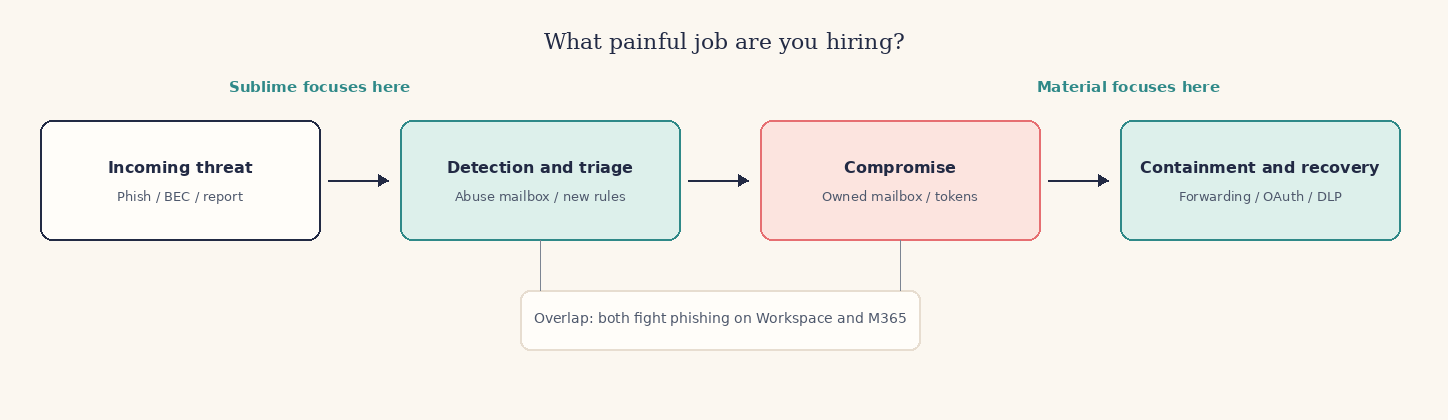
Material Security and Sublime Security both sell into that aisle, but they close different operator mornings. Material: post-compromise / ATO containment, email DLP, and Workspace data/OAuth protection on Google Workspace and Microsoft 365. Sublime: agentic inbound defense, with ASA clearing triage and ADÉ writing and backtesting new coverage. Treat them as interchangeable “API email security” and you buy the wrong morning.
Gateway and MX shortlists: secure email gateways. Broader sensitive-content tooling: DLP tools.
| Job | Phishing protection, ATO prevention/containment, and email/file DLP for Google Workspace and Microsoft 365 | Agentic inbound email security: ASA triage plus ADÉ adaptive detection engineering |
|---|---|---|
| How a bad day closes | Limit blast radius in compromised mailboxes: message-level controls, forwarding/OAuth cleanup, sensitive content locks | Clear user reports fast and deploy org-specific detections without waiting on a vendor queue |
| Deploy | API-based cloud workspace security for Google Workspace and Microsoft 365 | API / journaling-style cloud email security for Google Workspace and Microsoft 365 |
| Agents / AI layer | Automated user-report handling; OAuth Remediation Agent; ATO Resilience controls | Autonomous Security Analyst (ASA) and Autonomous Detection Engineer (ADÉ) |
| License/pricing | Essentials $4 / Advanced $6 per user/mo annual; ATO Resilience +$3 (or $5 stand-alone); Shared Drive fees (checked 5 Sep 2026) | Essential Protection: first 100 mailboxes free; Autonomous Protection enterprise quote / channel (checked 5 Sep 2026) |
| Who operates it | SecOps / IR and data-protection owners for Workspace and M365 | Email security and detection engineers owning abuse-mailbox clearance and coverage |
Recent first-party moves keep that split visible. Material shipped cloud-office protection updates in August 2025 around an overview dashboard, Okta Security Signals integration, faster phishing triage UX, and detection upgrades framed as EDR for email beyond the gateway. On 28 October 2025 Sublime announced a Series C to accelerate ASA and ADÉ as the agentic core of inbound defense.
We reviewed first-party docs, public pricing, funding notices, and live community threads. We did not test paid production environments, so this is not a hands-on benchmark.
Material Security
Sublime Security
Editions and pricing
Material lists Essentials/Advanced/ATO add-on prices on material.security/pricing (checked 5 Sep 2026). Sublime keeps Essential Protection free for the first 100 mailboxes and quotes Autonomous Protection (channel-led as of 2026). Both are well past Series B; funding does not pick the queue.
| Public list lines | Essentials $4/user/mo annual; Advanced $6/user/mo annual; ATO Resilience +$3/user/mo (or $5 stand-alone) | Essential Protection free (first 100 mailboxes); Autonomous Protection: request demo / partner quote |
|---|---|---|
| What the quote usually meters | Users plus Shared Drive storage fees; Advanced vs ATO add-on scope | Mailbox count, agent features, support tier, and channel packaging |
| Self-serve start | Get-started paths on the pricing page; enterprise discounts via sales | Free practitioner path; enterprise via demo / channel |
If procurement needs a published monthly rate before a call, Material fills the spreadsheet first. Full ASA/ADÉ packaging still needs a Sublime conversation.
After compromise and ATO recovery
| Primary recovery job | Contain compromised accounts: message-level controls on sensitive and identity-reset mail, forwarding cleanup, audit of what the attacker touched | Stop and remediate inbound threats; not the dedicated ATO blast-radius product between these two |
|---|---|---|
| Sensitive data at rest | Email DLP and historical sensitive-mail controls; Drive/file exposure on Advanced | Outbound email DLP exists on the platform map; center of gravity remains inbound detection agents |
| Persistence cleanup | Forwarding rules, OAuth grants, delegated access, MFA bypass surfaces | Investigate and remediate malicious messages; persistence inside the tenant is secondary here |
| Operator morning unit | ATO cases, risky shares, OAuth anomalies, sensitive content findings | Abuse-mailbox backlog, novel inbound campaigns, detection backlog |
That is the ATO recovery work Material productizes, including via its OAuth Remediation Agent. An already-owned executive mailbox with sensitive history inside it is Material between these two.
Inbound triage and detection agents
| User-report / abuse mailbox | Automated agent for user-reported phishing inside the workspace platform | ASA triages user-reported mail and clears the abuse mailbox as a named product job |
|---|---|---|
| Detection adaptation | Ongoing heuristic and ML detection upgrades plus analyst hunting tools | ADÉ authors, backtests, and proposes org-specific detections for one-click approval |
| Explainability posture | Case/analysis UX for phishing investigation and remediation actions | Matched detections and evidence for every automated decision marketed as transparent |
| What teams argue about | How far ATO/DLP/OAuth breadth is required vs inbound catch rate alone | How much agent autonomy to trust on quarantine and auto-authored rules |
Between these two, do not buy “AI email security” as a unique checkbox. Buy the queue your operators close every week: recover compromised Workspace/M365 accounts and sensitive mail, or clear inbound triage and adapt detections.
Where they overlap
Both protect Google Workspace and Microsoft 365 without a classic MX gateway story. Both catch inbound phishing and BEC-class attacks, and both automate some user-reported phishing work. An RFP that only says “modern API email security” will shortlist both. Recovery and triage stay on that shortlist because not every phish is stopped before a user sees it.
When to use both
Use both only if you need a dedicated recovery/containment product and a separate inbound triage product. That is two tools and two operating models.
Skip Sublime here if primary pain is post-compromise recovery, sensitive-mail locks, and OAuth/file exposure. Skip Material here if primary pain is abuse-mailbox volume and agents that triage inbound mail and author detections without a vendor bottleneck.
Decide which operational pain owns the budget. Recover and contain ATO plus protect sensitive Workspace mail: Material. Triage inbound threats and adapt detections with ASA and ADÉ: Sublime. Only then open the quotes.
FAQs
Are Material Security and Sublime Security the same email security product?
No. Both cover cloud email for Workspace and M365. Material leads on recovery and sensitive-mail controls; Sublime leads on ASA triage and ADÉ adaptive detections.
Do I need both?
Only if you deliberately want a recovery/containment product and a separate inbound triage product. Most teams pick the queue that hurts more.
Is there a public list price?
Material publishes Essentials $4, Advanced $6, and ATO Resilience +$3 (or $5 stand-alone) per user/month billed annually, plus Shared Drive fees (checked 5 Sep 2026). Sublime offers first 100 mailboxes free on Essential Protection; full Autonomous Protection is quote/channel.
Is this a scored bake-off?
No. Order is editorial.