Semgrep vs SonarQube: Which Static Analysis Gate Fits Your CI Week?
Choose Semgrep when rules-as-code SAST and PR-native policy are the product. Choose SonarQube when a quality gate plus broader first-party static analysis is the product.
Treating Semgrep and SonarQube as the same “SAST SKU” is an expensive mistake. You end up with two CI fail modes, two rule owners, and two false-positive fights for one merge. The weekly cost is not the license line. It is the queue operators close every Monday: which finding blocks the PR, who owns the exception, and what still ships when the dashboard is green.
Between these two, Semgrep productizes rules-as-code SAST and PR-native policy: YAML rules in the registry or your repo, modular Semgrep Code / Supply Chain / Secrets, plus Guardian for agent-written code. SonarQube productizes the quality gate on first-party code: bugs, smells, coverage, duplication, security hotspots and vulnerabilities, secrets, and IaC in one merge gate, with Advanced Security available when you need SCA on top. Related splits: SCA versus that quality gate is Snyk vs SonarQube; a unified developer AppSec platform versus Semgrep rules ownership is Aikido vs Semgrep. Broader shortlists live under Application Security.
| Job | Rules-as-code SAST (+ modular Supply Chain / Secrets / Guardian) | Quality gate + broader static analysis on first-party code |
|---|---|---|
| How a bad day closes | Rule match becomes a PR annotation or CI fail; Assistant triage/fix; Guardian can catch agent-written issues at write-time | Quality gate fails on new code (bugs, smells, coverage, duplication, hotspots, security) when the pipeline is wired to wait for it |
| CI fail | CLI / PR checks on Code (and sibling products) when policy is configured; custom rules can exit non-zero | Dashboard Failed is not a failed Jenkins job until waitForQualityGate / webhook or SCM decoration is configured |
| Deploy | CLI/CI local or managed; Teams cloud; Enterprise on-prem SCM / custom CI | Community Build + Server self-host; SonarQube Cloud SaaS; IDE via SonarQube for IDE |
| Operator morning unit | Rule packs, PR annotations, ignored rules, policy exceptions | Quality gate status, new-code conditions, hotspot reviews, coverage deltas |
| License/pricing | Free to 10 contributors; Teams from $30/contrib/mo (Code / Supply Chain / Secrets modular); Enterprise custom (checked 9 Sep 2026) | Community Build free; Cloud Team from $34/mo (100k LOC); Enterprise / Server / Advanced Security quote (checked 9 Sep 2026) |
| Who operates it | AppSec / platform eng who write and own rules and PR policy | Platform / quality owners of the merge gate; developers via IDE connected mode |
Recent first-party moves keep the centers visible. Semgrep shipped Guardian on 23 June 2026 so AI agents get scanned at write-time, not only at PR time. Sonar published Advanced Security GA (Server May 2025, Cloud Enterprise updated 15 September 2025) for SCA and advanced SAST on Enterprise tiers, still as an add-on to the quality-gate product rather than a rules-as-code platform.
We reviewed first-party docs, public pricing pages, and live community threads. We did not sit in paid production tenants, so this is not a hands-on benchmark.
Semgrep
SonarQube
Editions and pricing
Semgrep publishes a contributor-metered ladder. Free Edition covers Code and Supply Chain for up to 10 contributors and 10 private repos. Teams starts at $30 per contributor per month with modular Code, Supply Chain, and Secrets. Enterprise is custom for on-prem SCM, custom CI, and unlimited contributors.
SonarQube meters private lines of code on Cloud and Server, not Semgrep-style contributors. Community Build stays a free self-host path. Cloud Team starts at $34 monthly for analysis up to 100k private LOC, with a free tier up to 50k private LOC. Enterprise Server/Cloud and Advanced Security are sales-quoted add-ons for deeper SCA and compliance reporting.
| Public list lines | Free $0 (10 contributors); Teams from $30/contrib/mo modular; Enterprise custom | Community Build free; Cloud Team from $34/mo (100k LOC); Enterprise / Server / Advanced Security quote |
|---|---|---|
| What the quote usually meters | Contributors (90-day commits on scanned private repos), chosen products, AI credits | Private LOC analyzed, edition (Team / Enterprise / Server), Advanced Security add-on |
| Self-serve start | Free Edition and Teams checkout on pricing page | Cloud free tier / Team online; Community Build self-host; Enterprise sales-led |
If procurement needs a published monthly rate before a call, both Cloud Team ($34/mo entry) and Semgrep Teams ($30/contrib) fill a spreadsheet. Full Enterprise packaging on either side still needs a sales conversation.
What fails CI
| Primary fail signal | CLI / CI job non-zero on matching rules; PR checks when SCM protection is on | Quality gate Failed on new code; pipeline fails only when waitForQualityGate / webhook / decoration is wired |
|---|---|---|
| What the gate usually includes | Security (and optional SCA/secrets) rule policies you own | Bugs, vulnerabilities, smells, coverage, duplication, hotspots; SCA conditions only with Advanced Security custom gates |
| Operator morning unit | Which rules fire on this PR, nosemgrep / ignore board, policy exceptions | New-code conditions, hotspot review backlog, coverage drop on the branch |
| Buy the queue | Own and tune what security findings block merge | Own one quality-plus-security merge gate the platform team runs |
That is the Semgrep CI shape: a rule you can commit and a non-zero exit when it matches. Sonar’s quality gate can be just as strict, but only after the pipeline waits for the analysis result. A green Jenkins job with a Failed Sonar dashboard is still a wiring miss, not a product miss.
What each tool produces
| Finding shape | Rule match with pattern / taint evidence on code (plus SCA/secrets modules when bought) | Issues across reliability, maintainability, and security; hotspots needing human review; coverage and duplication metrics |
|---|---|---|
| How rules are owned | Public registry, private org rules, YAML in-repo; AppSec authors policies as code | Quality profiles and gate conditions owned by platform/quality; commercial language packs wider on Enterprise |
| IDE / agent loop | IDE plugins; Guardian for AI coding agents at write-time | SonarQube for IDE (connected mode); agent/MCP packaging on Team/Enterprise paths |
| Not the center here | Coverage, duplication, and smell-driven quality gate | Commit-your-own YAML rules-as-code as the primary product between these two |
That offline YAML ownership is the Semgrep job between these two. SonarQube still wins when the painful unit is a single quality gate with coverage and maintainability attached to security, not when AppSec needs to ship a custom rule as a PRable artifact.
Where they overlap
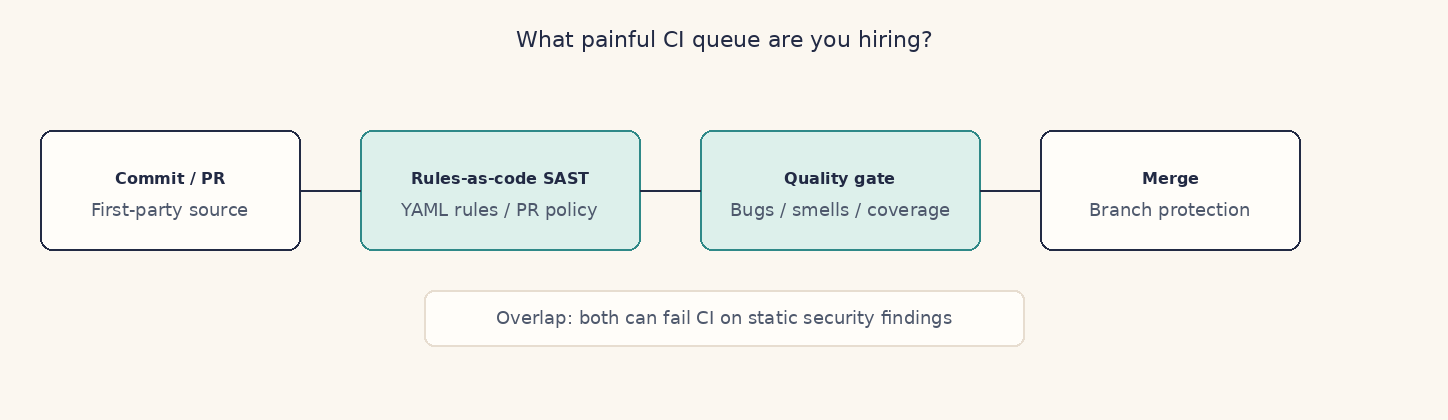
Both scan first-party source, decorate pull requests, and can fail CI on security findings. Both ship IDE feedback and market AI-assisted triage or fixes. An RFP that only says “SAST in CI” will shortlist both. Semgrep does not replace a coverage and smell gate, and Sonar without Advanced Security is not Semgrep-style rules-as-code ownership, so overlap is real and still incomplete.
When to use both
Use both only if you deliberately want AppSec-owned rules-as-code policy and a separate platform-owned quality gate. That is two tools, two exception processes, and two dashboards.
Skip SonarQube here if primary pain is custom security rules, PR-native policy, and modular SCA/secrets around a SAST engine. Skip Semgrep here if primary pain is one quality gate that fails on bugs, smells, coverage, and security hotspots for the whole org.
Decide which operational pain owns the budget. Rules-as-code SAST and PR policy: Semgrep. Quality gate plus broader first-party static analysis: SonarQube. Only then open the quotes.
FAQs
Are Semgrep and SonarQube the same SAST product?
No. Both can find security issues in first-party code and fail CI. Semgrep leads on rules-as-code SAST and PR-native policy. SonarQube leads on a quality gate that also covers bugs, smells, coverage, duplication, and security hotspots.
Do I need both?
Only if you deliberately want AppSec-owned rules policy and a separate platform-owned quality gate. Most teams pick the weekly queue that hurts more.
Is there a public list price?
Semgrep Free is $0 for up to 10 contributors; Teams starts at $30 per contributor per month (checked 9 Sep 2026). SonarQube Cloud Team starts at $34 monthly for up to 100k private LOC, with Community Build free for self-host (checked 9 Sep 2026). Enterprise and Advanced Security are quote-based.
Is this a scored bake-off?
No. Order is editorial.