Pigment vs Planful: Model or Close
A modeling-first FP&A platform against a planning suite built around close, consolidation, and reporting.
Finance teams still drop Pigment and Planful into one generic FP&A bucket. The 12 May 2026 Pigment license article does not. A new member starts as an Explorer, and the member who creates formulas and the model’s logic is an Editor.
The failure shows up when that shortlist is asked to change the model on day one and still finish a global close by working day 12. Pigment’s 10 Sep 2026 announcement is Frames, an interface on the live planning model, with open beta set for 28 Sep 2026. Planful’s 12 Mar 2026 close post names structured workflows, rules-based intercompany eliminations, governed currency translation, and a full audit history.
Overview
| Primary use case | Governed planning models across finance, sales, HR, and supply chain, with scenarios on the live model | Planning, close, consolidation, and reporting in one financial performance platform |
|---|---|---|
| Day-to-day workflow | An Editor changes formulas and model structure. A Contributor imports data and edits list items. Frames builds an interface on that model from a description | Finance runs the close workflow, posts rules-based eliminations, and reports from the same platform. Planner Assistant answers a forecast question and does not write back |
| Main buying consideration | Whether the people who change model logic are Editors, and whether Frames in open beta is on the order | Which modules are on the subscription, and whether Analyst Assistant plus Signals and Projections are included |
Pigment’s platform page describes a web application with hosting in Europe or the US, plus sovereign hosting via S3NS. Planful’s company page, updated April 2026, lists the deployment model as Cloud / SaaS.
We reviewed Pigment’s license article updated 12 May 2026, the 10 Sep 2026 Frames announcement, and the financial consolidation use-case page, and Planful’s company page updated April 2026, the 21 Apr 2026 Planner Assistant post, and the 12 Mar 2026 close and consolidation post.
Pigment
Planful

Pigment was founded in 2019 by Eléonore Crespo and Romain Niccoli and its May 2026 company page still lists that private company with both as co-CEOs, while Planful is the current name of Host Analytics and the April 2026 company page says it is privately held and backed by Vector Capital.
Editions and pricing
On 4 Oct 2026 neither public page showed a price with currency, unit, period, commitment, and included product, so this page states no dollar amount.
| How it is sold | A plan made of a platform fee, a number of licenses, and associated features. The plan name, start and end dates, and license use sit on the in-product Plan and Usage page | A subscription shaped by company size, user count, and selected modules, on the April 2026 company page |
|---|---|---|
| Names on the public page | Explorer, Contributor, and Editor. Legacy v1 and v2 pricing is closed to new customers and cannot be renewed | FP&A, workforce planning, marketing financial management, financial close and consolidation, and operational planning. No public edition grid with a price |
| What moves the license | A new member starts as Explorer. Write access or list and import permissions move that member to Contributor. Permissions past that, including formulas and application configuration, move the member to Editor. Builder, Workspace Admin, Security Admin, and Primary Owner are Editors | Planner Assistant is included only for customers who already have Analyst Assistant and Signals and Projections. It is not a standalone product |
| Main buying consideration | Count Editors separately from people who only view or enter data. The 10 Sep 2026 announcement also describes a free trial in which a description produces a starter model and an interactive board | Ask which modules are on the order, and whether Analyst Assistant plus Signals and Projections are among them |
Modeling
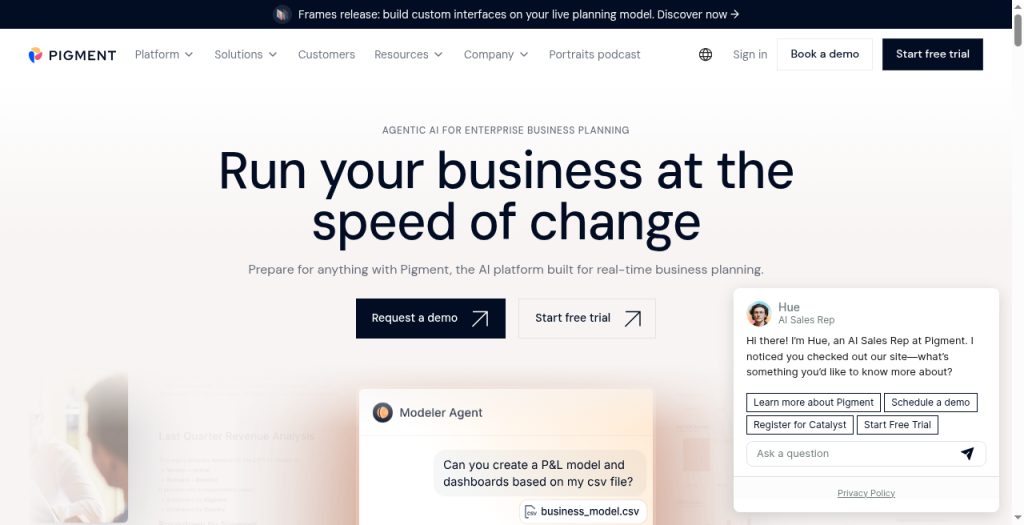
Pigment’s homepage puts the Modeler Agent on the planning model: a description becomes a governed model aligned to the workspace structure, with the logic visible. The platform FAQ says scenarios are what-if cases on the existing model, not a new plan started from scratch. Planful’s homepage names a Planner that builds forecasts from Planful data. The 21 Apr 2026 post is the dated control for that assistant.
| Who changes the model | Editor license: create formulas and define the model’s logic. Contributor: add or remove list items, import data, and open Block Explorer, without those formula permissions | Planner Assistant generates a forecast from existing Planful models and actuals. At launch it is read-only. Write-back is described as later work, not as a current control |
|---|---|---|
| Scenario control | Platform FAQ: several what-if scenarios from the current plan, with Graphite named as the modeling layer underneath | Planner Assistant explores scenarios in the same conversation as Analyst Assistant. It requires Signals and Projections, which flag outliers and build a projection from historical actuals |
| Interface on the model | Frames, announced 10 Sep 2026: a description becomes a form, a what-if planner, or an executive view on the live model, with write-back and the model’s access rights. Open beta date on that announcement: 28 Sep 2026 | The 21 Apr 2026 post keeps planning questions inside the Planful AI conversation. It does not describe a separate interface builder |
| Main buying consideration | Whether model changes are an Editor permission, and whether Frames in open beta is in scope | Whether the order includes Analyst Assistant and Signals and Projections. Without both, Planner Assistant is not available |
Pigment’s 10 Sep 2026 announcement also names Agent Connectors that pull context from Notion, Google Drive, and Slack, plus an MCP server so an external assistant can use Pigment under existing permissions. Planful’s homepage also names an MCP server for bringing an external assistant to Planful data. That shared label is not a shared close workflow.
Close and consolidation
Planful’s homepage connects planning, close, consolidation, and reporting in one platform. The 12 Mar 2026 post names the close controls: structured workflows, rules-based intercompany eliminations, governed currency translation, AI-assisted variance analysis, and a full audit history. Pigment’s financial consolidation use-case page also names multi-entity consolidation, intercompany matching and eliminations, currency translation at period-end and average rates, journal entries, and close workflows. Those shared names are overlap.
| Close path on the page | Use-case page: collect actuals, reconcile and eliminate, generate statements, then analyze. Multi-GAAP starter kits named there include IFRS, US GAAP, UK GAAP, and French GAAP | 12 Mar 2026 post: structured workflows and a repeatable close, with finance-owned low-code configuration called out in the same post |
|---|---|---|
| Eliminations and currency | Intercompany matching and eliminations. FX uses period-end and average rates, on the use-case FAQ | Rules-based intercompany eliminations and governed currency translation, on the 12 Mar 2026 post |
| Audit and adjustments | Use-case page lists auditability, controls, traceability, journal entries, and adjustments. The platform page lists audit logs that can export to a SIEM | 12 Mar 2026 post: full audit history, and adjustments the Alltech example calls visible and traceable |
| Main buying consideration | Whether consolidation has to stay on the same model an Editor changes for planning | Whether the close needs the workflow, elimination rule, and audit history named on the 12 Mar 2026 post. Consolidations Premium, a layer for complex ownership, sub-consolidations, and equity pickup, was still described as coming soon on that date. General availability after that post: Not confirmed in public documentation |
Reporting
Pigment’s platform page names on-the-fly analysis and reporting, and tailored views at any granularity. Frames, on the 10 Sep 2026 announcement, adds an executive view and a presentation-grade deck on the live model. Planful’s company page names real-time reporting, dynamic dashboards, self-service analysis, and drill-down, and the 12 Mar 2026 post puts that reporting on the same platform as close management and consolidation. Neither page is a reason to say the other product cannot report.
Favor Pigment when the documented requirement is the 12 May 2026 license article plus the 10 Sep 2026 Frames announcement: an Editor who creates formulas and the model’s logic, and an interface built on the live planning model. Favor Planful when the documented requirement is the 12 Mar 2026 post: structured close workflows, rules-based intercompany eliminations, governed currency translation, and a full audit history, in the same platform as planning.
FAQs
Which documented requirement favors Pigment?
Favor Pigment when the people who create formulas and model logic must be Editors, as the 12 May 2026 license article defines that license, or when the interface has to be Frames on the live model, as announced 10 Sep 2026 with open beta on 28 Sep 2026.
Which documented requirement favors Planful?
Favor Planful when the close has to include the controls named on the 12 Mar 2026 post: structured workflows, rules-based intercompany eliminations, governed currency translation, and a full audit history, with reporting on that same platform.
Does Pigment’s consolidation page make this the same close product?
No. That page names multi-entity consolidation, intercompany eliminations, currency translation, journal entries, and close workflows. Planful’s 12 Mar 2026 post names structured close workflows and a full audit history as the center of the suite. Shared names are overlap.
Is Planner Assistant on every Planful subscription?
The 21 Apr 2026 post says no. Planner Assistant requires Analyst Assistant and Signals and Projections, and it is not sold on its own. At launch it is read-only.
Who owns each company?
Pigment’s company page, last updated May 2026, lists a private company whose co-CEOs are Eléonore Crespo and Romain Niccoli. Planful’s company page, updated April 2026, says Planful is privately held and backed by Vector Capital. Planful is the current name of Host Analytics.