When to pick Oak over SailPoint for governing human, machine, and AI-agent identities
Oak’s live identity graph with AI-built connectors and autonomous remediation, beside SailPoint Identity Security Cloud and IdentityIQ certifications, role modeling, and separation of duties.
Oak’s manifesto names quarterly access reviews as the failure: they record what happened, never what is happening. SailPoint built the identity governance market on exactly those campaigns, and it now adds AI recommendations, machine identities, and AI agents to them. So this pair is less old against new than two answers to one question: should governance stay campaign-driven with smarter reviewers, or move to continuous decisions on a live graph?
Oak came out of stealth in July 2026 as an identity operating system: one data model and one live graph covering human, machine, and AI-agent identities, built from evidence of what access each identity holds and actually uses. SailPoint sells Identity Security Cloud and self-managed IdentityIQ, with lifecycle automation from HR sources, access requests, certification campaigns, role mining, and separation-of-duties policies. Oak says it is generally available and deployed at enterprise customers. Its capabilities are stated on its own pages, not independently demonstrated.
Buy Oak when connector backlog and stale periodic reviews are the bottleneck and you want continuous, evidence-based decisions across humans, machines, and agents. Buy SailPoint when audit-driven certifications, role models, and separation-of-duties controls across cloud, on-prem, and mainframe systems are the requirement.
Overview
| Primary use case | Identity governance and security on one live graph for human, machine, and AI-agent identities, with continuous reviews and remediation run by built-in agents | Identity governance and administration: lifecycle, access requests, certifications, role modeling, and separation of duties |
|---|---|---|
| Day-to-day workflow | Connect applications through the AI connector framework, review risk decisions drawn from held versus used access, and let platform agents onboard apps and run continuous reviews | Aggregate accounts through connectors, run certification campaigns with AI recommendations, enforce separation-of-duties policies, and provision through workflows |
| Main buying consideration | No public pricing. Qualified Fortune 500 organizations get up to 500 hours of Oak White Gloves implementation with all connectors included | Quote by identity for Identity Security Cloud Standard, Business, and Business Plus tiers, or self-managed IdentityIQ. No public USD price |
We reviewed Oak’s homepage and its July 2026 launch post, plus SailPoint’s lifecycle, access recommendation, and separation-of-duties documentation and the Temple Health customer story, on 14 Oct 2026. We did not run either product.
Oak
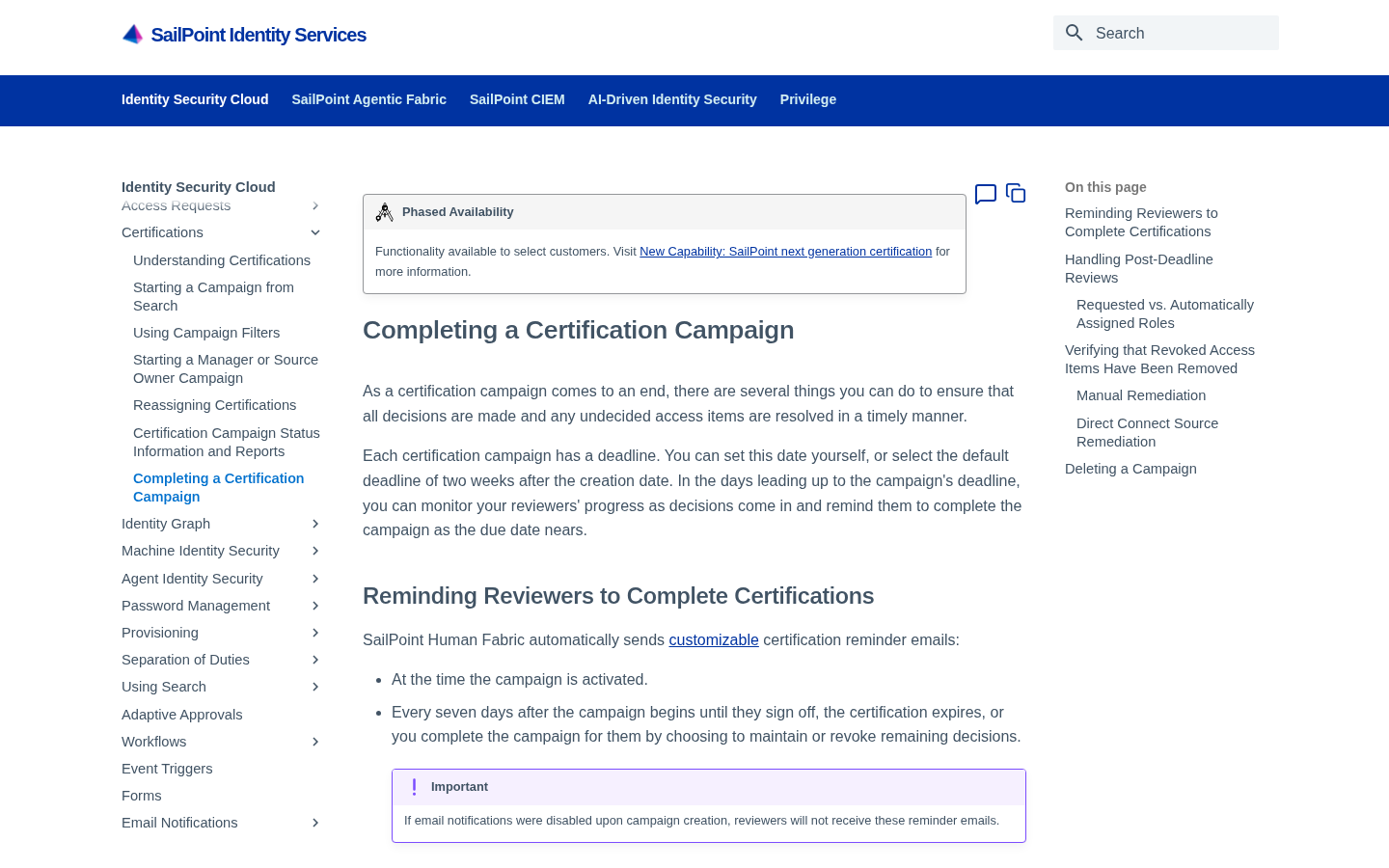
SailPoint
Editions and pricing
Neither vendor prints a price. The difference is what is bundled into the deal: Oak bundles implementation hours and connectors for qualified buyers, while SailPoint sells by tier and add-on.
| How it is sold | One platform built on the Identity Intelligence Layer, with Agentic Identity and Connect Any capabilities | Identity Security Cloud tiers with add-ons for access risk, data access, and machine identities, or IdentityIQ |
|---|---|---|
| Services | Oak White Gloves identity services team for build, migration, and program management | Partner and SailPoint professional services. Terms are not confirmed in public documentation |
| Deployment | SaaS. Self-hosting is not confirmed in public documentation | SaaS Identity Security Cloud or self-managed IdentityIQ |
Access reviews and risk decisions
Both review who should have access. The documented split is a scheduled campaign against a continuous decision.
| Review model | Continuous reviews run by platform agents, with real-time risk decisions | Certification campaigns with recommendations that flag access held by more or less than 70 percent of peers |
|---|---|---|
| Evidence used | Access held compared with access actually used, built from raw evidence rather than static records | Peer-group analysis, entitlement data, and identity attributes from connected sources |
| Policy controls | Separation-of-duties support is not confirmed in public documentation | Separation-of-duties policies that detect existing conflicts and flag conflicting requests |
Connectors and identity types
Both claim coverage beyond SaaS. They describe it differently.
| Connector approach | AI connector framework that reaches on-prem, cloud, SaaS, and homegrown apps, with new connectors in hours | Connectors for cloud, on-prem, mainframe, and custom applications through Identity Security Cloud and IdentityIQ |
|---|---|---|
| Identity types | Human, machine, and AI-agent identities on one graph | Employees, contractors, partners, machine identities, and AI agents, with machine identity as an add-on |
| Remediation | Autonomous remediation at the root cause | Provisioning and deprovisioning through workflows and lifecycle events |
Choose Oak when your governance program is stuck on unconnected and homegrown apps, and you want held-versus-used evidence and continuous decisions for every identity type. Choose SailPoint when auditors expect certification campaigns, documented separation-of-duties policies, role models, and mainframe or self-managed IdentityIQ coverage.
FAQs
Is Oak generally available?
Yes. Oak says the platform is generally available and deployed at enterprise customers. It does not name them publicly.
Does SailPoint govern AI agents?
SailPoint lists AI agents among the identity types its lifecycle automation covers, beside employees, contractors, partners, and machine identities.
Who founded Oak?
Shai Morag and Tal Marom. Morag previously founded Ermetic, acquired by Tenable, where he served as chief product officer.
Can SailPoint run on-premises?
Yes, through IdentityIQ, the self-managed product. Identity Security Cloud is SaaS.