Bay vs Palo Alto Prisma AIRS: session action control or runtime AI security
Security teams want to let AI agents work without losing control of what those agents do next. Here is how Bay and Palo Alto Prisma AIRS approach that job.
Bay came out of stealth on 10 Nov 2026 with USD 50M: a USD 37M Series A led by Battery Ventures and a previously undisclosed USD 13M seed led by YL Ventures and Striker Venture Partners, with Micron Ventures, Microsoft’s venture fund M12, and Assaf Rappaport participating in the Series A. Its bet is that each proposed agent action should be decided in the context of the full session, without first adding a new persistent endpoint agent or a traffic proxy.
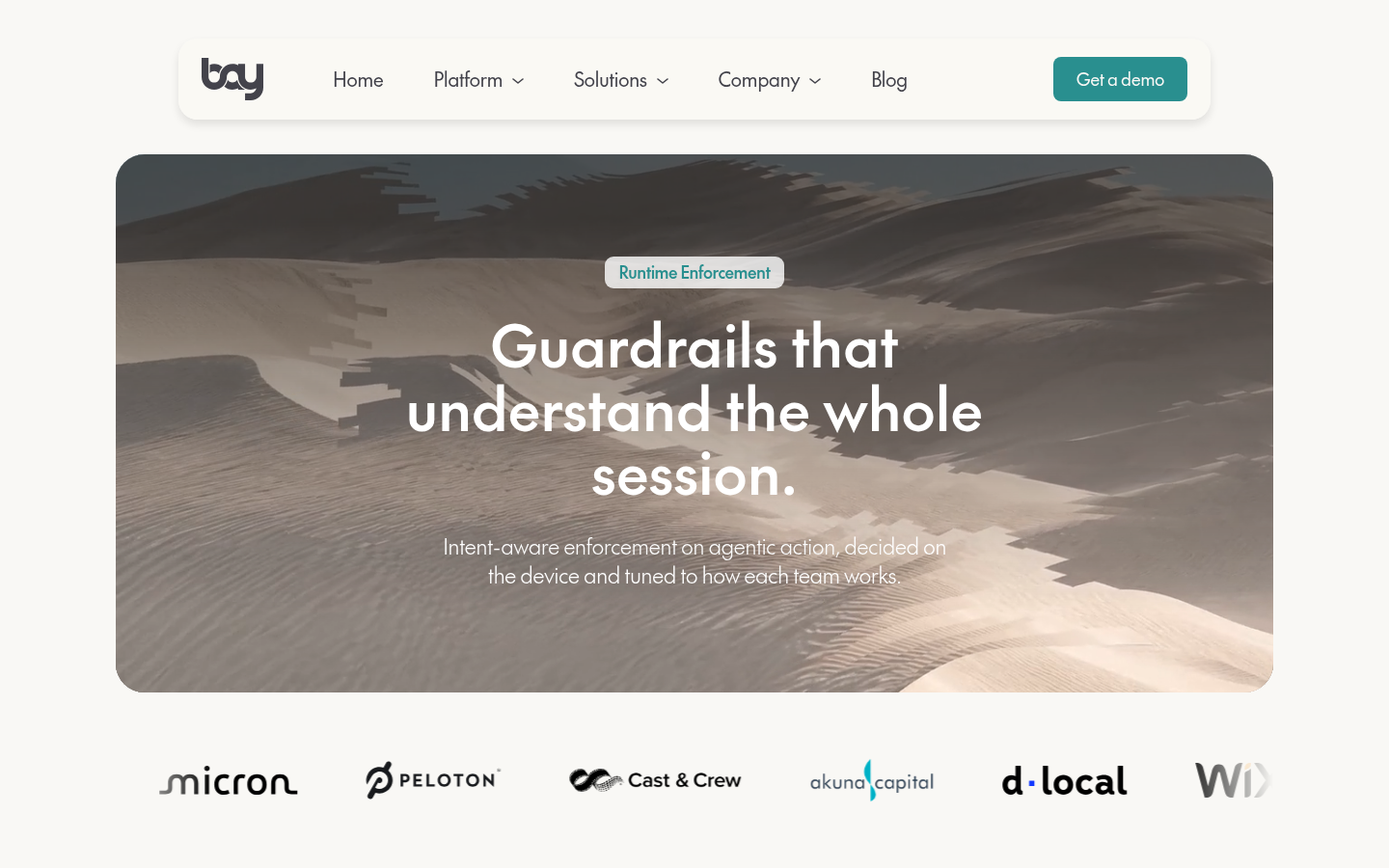
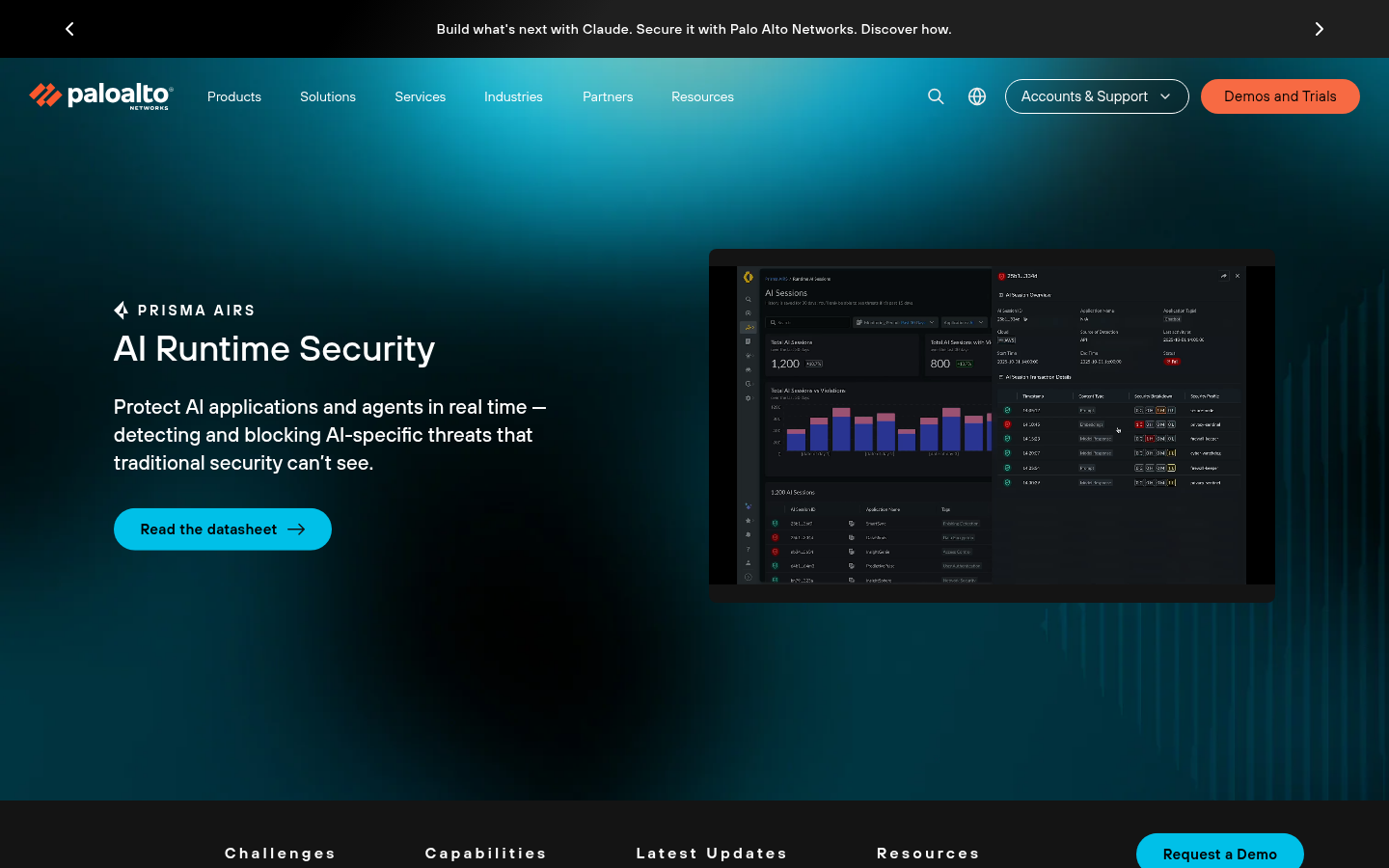
Bay’s runtime enforcement page says it reads the whole session, then allows, asks, denies, or steers each action locally on the device. Prisma AIRS, Palo Alto Networks’ AI security platform, includes AI Runtime Security, which inspects prompts, responses, and data flows through a network-intercept firewall, an in-app API or SDK, or both. The Protect AI acquisition, completed in July 2025, is lineage; the live product name is Prisma AIRS. Bay’s capabilities are launch claims, stated on its own site.
Overview
| Primary use case | Bay’s runtime page says it applies intent-aware enforcement to agentic actions, decided on the device and tuned to how each team works | Detect and block AI-specific threats in live AI traffic as applications and agents run, using network intercept, API intercept, or both |
|---|---|---|
| Day-to-day workflow | Bay’s runtime page says each agent action is decided on the device from the surrounding session, that a policy can be simulated before it affects users, and that Lighthouse, its policy-building system, learns from 30 days of agent history and tunes guardrails by team | AI traffic passes through a Prisma AIRS software firewall, or the application sends prompts, responses, and tool calls to the Prisma AIRS API or SDK. Policies are defined once and applied across both modes |
| Main buying consideration | Sold by demo and sales quote. Billing units are under Editions and pricing | Sold as Prisma AIRS capabilities funded with Software NGFW Credits. Metering for AI Runtime API intercept is under Editions and pricing |
We reviewed Bay’s runtime, platform, endpoint, browser, cloud-workspace, discovery, posture, investigation, governance, about, demo, and launch pages, BusinessWire’s 10 Nov 2026 funding release, Palo Alto’s Prisma AIRS AI Runtime Security product page, Prisma AIRS platform architecture and AI Runtime Security overview docs, token-based licensing docs, and the Software NGFW Credits estimator, on 12 Nov 2026. Bay has no public technical docs, so its capabilities are vendor-stated. Where a public page does not cover a question, we write “not documented”.
Bay
Prisma AIRS
Editions and pricing
Bay is sold as one platform, by demo. Prisma AIRS is a modular platform funded with Software NGFW Credits; this comparison is with AI Runtime Security, the overlapping runtime job.
| How it is sold | One platform covering discovery, posture, runtime enforcement, investigation, and governance, sold by demo and sales quote | AI Runtime Security is enabled with a Prisma AIRS license and a deployment profile, as network intercept, API intercept, or both |
|---|---|---|
| Public price | No public list price with currency, unit, and period, checked 12 Nov 2026 | Funded with Software NGFW Credits. For AI Runtime API intercept, usage is metered in monthly tokens, where one token equals four characters and the quota resets each calendar month, with a minimum of 1 billion tokens per deployment profile. Palo Alto’s Software NGFW Credits estimator, updated October 2026 and checked 12 Nov 2026, lists AI Runtime (API) Security at 182.61 Credits per billion tokens per month. The estimator states it is for planning purposes and that actual costs may vary. A public USD list price for that SKU is not stated |
| Trial | The site offers a demo. A free trial is not stated on Bay’s runtime or platform pages | The AI Runtime Security product page offers a request for a demo |
How each enforces a runtime action
Both aim to stop a risky agent action before it finishes. They differ in what the product inspects, and in where the decision is made.
| How a decision is made | Bay’s runtime page says it reads each agent’s whole session to understand intent, then decides on every action: allow, ask, deny, or steer. It also says any policy can be run in simulation first, and that when intent drifts, Bay can steer the agent back on course instead of only stopping the work | Prisma AIRS AI Runtime Security applies inspection and policy enforcement to live AI interactions: prompts, responses, data flows, and application traffic. Documented protections include prompt injection and jailbreak prevention, memory poisoning and tool-misuse blocking, sensitive-data leakage prevention, and malicious content detection. You can set alert or block actions in security profiles |
|---|---|---|
| Where the decision runs | Bay’s runtime page says every decision is made locally, on the device, in milliseconds, with no cloud round-trip and no proxy. The launch post says enforcement covers employee devices, cloud infrastructure, and SaaS applications without an additional persistent endpoint agent, kernel driver, or network proxy | Network intercept enforces at the network layer through a Prisma AIRS software firewall, with no application code changes, in public cloud, Kubernetes, or a microperimeter model for private and on-premises environments. API intercept enforces at the code layer through a REST API or Python SDK in the AI application or agent |
| Prompt injection and related threats | Bay’s platform page says it can also prevent prompt injection attempts at runtime, and that a metadata-only mode can keep prompts on the device when they must not leave it | Prompt injection and jailbreak prevention are documented as AI Model Protection inside AI Runtime Security, available in the shared policy framework for network intercept and API intercept. Some capabilities, including contextual grounding for RAG applications and in-line data redaction, are documented as available on API intercept only |
Where each deploys, and what else is in the platform
Once the enforcement model is clear, the remaining questions are which surfaces the product covers, and whether you are buying a focused control layer or a modular AI security platform.
| Surfaces and rollout | Bay’s platform and runtime pages say it deploys with one script through an existing MDM, or through MDM or EDR, and does not require users to install anything. Endpoint, browser, and cloud-workspace pages describe the same allow, ask, deny, or steer decisions on employee devices, in browsers, and in cloud workspaces such as virtual machines, Kubernetes, and hosted sessions | Network intercept deploys as a firewall instance in the cloud environment or is managed through Strata Cloud Manager or Panorama. API intercept is embedded in application or agent code. The product page also describes a managed AI Runtime Security option |
|---|---|---|
| Discovery and adjacent capabilities | Bay’s site describes a single control plane that also finds agents, MCP servers, plugins, and skills, maps what each can reach, and surfaces posture issues such as exposed credentials and toxic tool combinations | Prisma AIRS is documented as four independent pillars you can deploy together or separately. AI Runtime Security is the pillar compared here. Adjacent pillars include AI Supply Chain Security, AI Red Teaming, AI Gateway, and Agent Identity Security, which are not required for Runtime Security to function |
| Who it is for | Bay’s site describes security teams that want one policy set for agents on devices, in browsers, and in cloud workspaces, including long-running agents that work when no one is watching. Bay’s site states SOC 2 and ISO 27001 certification | Security teams already on Palo Alto Networks, or buying a modular AI security platform, who need inline or in-app inspection of AI traffic in production applications and agents |
Choose Bay when you need each proposed agent action allowed, asked, denied, or steered in session context, decided locally on the device without a traffic proxy, as Bay’s runtime page states, and can pilot a launch-stage vendor first. Choose Prisma AIRS when you need runtime inspection of AI prompts, responses, and data flows, enforced through a network-intercept firewall or an in-app API or SDK.
FAQs
Does Bay replace Prisma AIRS?
No. Prisma AIRS is a modular platform with several pillars; this page compares the runtime overlap. Bay’s runtime page states allow, ask, deny, or steer decisions made locally on the device without a traffic proxy. Prisma AIRS AI Runtime Security documents inspection of prompts, responses, and data flows through a network-intercept firewall or an in-app API or SDK.
How are Bay and Prisma AIRS priced?
Bay and Prisma AIRS are both quote-sold. Bay has no public list price with currency, unit, and period. Prisma AIRS is funded with Software NGFW Credits, and AI Runtime API intercept is metered in monthly tokens. See the Editions and pricing section for the figures.
Do they require a new endpoint agent or a firewall in the path?
Bay’s launch post says it does not require an additional persistent endpoint agent, kernel driver, or network proxy, and its runtime page says it deploys through an existing MDM or EDR and decides on the device. Prisma AIRS AI Runtime Security documents network intercept as a software firewall in the traffic path, and API intercept as an API or SDK in the application.