Empirical Security vs Tenable: a model built for your org or an exposure platform
Most vulnerability backlogs are larger than the set of flaws attackers will actually use. Here is how Empirical Security and Tenable approach that gap.
Empirical Security announced a USD 25M Series A on 20 Jul 2026, led by Brightmind Partners. Its bet is that a generic exploit-likelihood score is not enough, because the same CVE does not carry the same urgency in every environment.
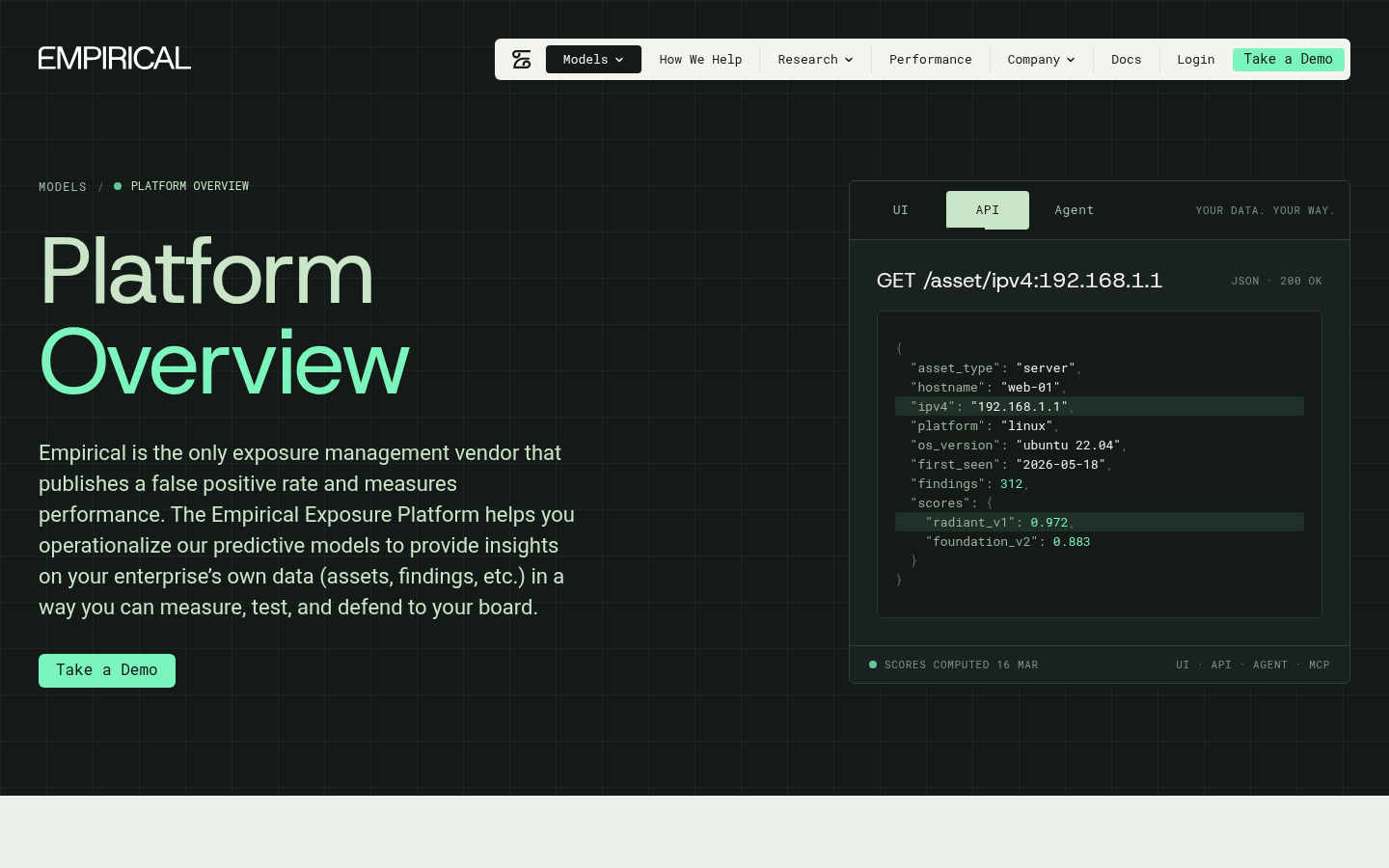
Empirical’s Exposure Platform applies two models: Foundation, a global model the company says monitors more than 19,000 exploited CVEs and refreshes hourly, and Radiant, a local model that adds the organization’s own assets, configurations, and telemetry. The platform FAQ says Empirical does not replace discovery tools; it ingests scanner and inventory output, including from Tenable, and applies model-based scoring. Tenable One is an exposure management platform that discovers assets and prioritizes exposures. Empirical’s capabilities are launch claims, stated on its own site.
Overview
| Primary use case | Prioritize and communicate which vulnerabilities are likely to be exploited in the next 30 days, with a global Foundation model and a Radiant model fitted to the organization | Discover assets across the attack surface and prioritize exposures with VPR, then roll those ratings into asset-level AES and a Cyber Exposure Score on Tenable One |
|---|---|---|
| Day-to-day workflow | Ingest findings from existing scanners and telemetry, review Foundation and Radiant scores (and Critical Indicators on Foundation), and use the UI, API, agent, or MCP to report and track remediation | Scan and inventory assets with Tenable sensors, triage by VPR, review AES and CES by exposure class, and, on Tenable One Advanced, use attack path analysis and workflow integrations |
| Main buying consideration | Sold by demo and sales quote. List price and billing units are under Editions and pricing | Tenable One is sold as Foundation or Advanced, licensed per asset, and quoted on the pricing page. Minimum asset counts are under Editions and pricing |
We reviewed Empirical’s platform, Foundation, Radiant, about, and docs pages (including the Foundation model reference), Empirical’s 20 Jul 2026 Series A post, Tenable One and Tenable One Vulnerability Management product and pricing pages, and Tenable’s VPR, Tenable One scoring, and Tenable One licensing docs, on 12 Nov 2026. Where a public page does not cover a question, we write “not documented”.
Empirical Security
Tenable
Editions and pricing
Empirical is sold by demo. Tenable One Foundation and Advanced are quote-based on Tenable’s pricing page. For prices, contact your Tenable representative.
| How it is sold | One Exposure Platform with Foundation and Radiant models, sold by demo and sales quote | Tenable One Foundation and Tenable One Advanced, licensed per asset, with add-ons such as cloud-native application protection, identity security, and patch management. Tenable uses progressive pricing on asset count |
|---|---|---|
| Public price | No public list price with a defined billing unit | No public list price on the Tenable One pricing page. The licensing guide documents a minimum of 100 assets for Foundation and 300 assets for Advanced |
| Trial | The site offers a demo. A free trial is not documented on Empirical’s product, platform, or about pages checked | The Tenable One Vulnerability Management product page offers a try-for-free option. A free trial of Tenable One Foundation or Advanced is not documented on the Tenable One pricing page checked |
How each scores exploitability and exposure
Both try to tell a team which findings to fix first. They differ in what the score is, and in how much of the organization’s own data goes into it.
| What the score is | A calibrated 30-day probability of exploitation, plus a Threat Score that estimates the expected number of exploitations on an asset or group of assets | VPR, the output of Predictive Prioritization, rates a vulnerability from 0.1 to 10 on technical impact (the CVSSv3 impact subscore) and a threat component. Tenable One then produces an Asset Exposure Score and a Cyber Exposure Score |
|---|---|---|
| What is global vs local | Foundation is a global model the company says monitors more than 19,000 exploited CVEs, with Critical Indicators such as threat intelligence, chatter, exploit code, and vendor disclosures. Radiant adds the organization’s assets, configurations, internal telemetry, and business context, and the company says the local model is continuously retrained | VPR is a global rating for a vulnerability. Org-specific exposure scores come from combining that VPR with a per-asset Asset Criticality Rating (model-generated or user-defined) and the weaknesses present on that asset, including a Global AES and CES across exposure classes. A per-customer exploit-prediction model trained on the organization’s own telemetry is not documented in the VPR, Tenable One scoring, or licensing docs checked |
| How often scores move | Product pages say Foundation scores refresh hourly | Tenable’s scoring overview says asset data is updated every time the asset is seen as part of a scan. A VPR refresh interval is not documented on the VPR best-practices page checked |
Where each product sits in the toolchain
The practical question is often whether you need a scoring layer on tools you already run, or a platform that also discovers the assets.
| Discovery and scanning | The platform FAQ says Empirical does not replace discovery tools. It integrates with existing scanners, agents, cloud inventories, and ITSM, including Tenable, Qualys, Rapid7, and CrowdStrike, then unifies that output and applies model-based scoring | Tenable One includes vulnerability management and other sensors. Tenable’s scoring docs treat an asset assessed by Tenable Nessus as part of the Vulnerability Management exposure class, alongside web app, identity, OT, cloud, and third-party classes |
|---|---|---|
| How you work with the product | UI, API, an agent that answers from the organization’s model, and an MCP server. Foundation model scores are also documented as an API (the Foundation V1 key is global) | Tenable One is a platform with dashboards, reporting, ticketing, and third-party connectors on Foundation, and workflow mobilization plus Attack Path Analysis on Advanced |
| Proof and explainability | Foundation pages describe Critical Indicators that show why a score changed. The platform page says Empirical publishes a false positive rate and measures performance, including a rolling 30-day retrospective. A public performance page was not found at the /performance URL on 12 Nov 2026, and no numeric false-positive rate is cited here | VPR’s threat component is documented with example sources (proof-of-concept research, social media, exploit kits, dark web and forums, malware hashes). Tenable One Advanced includes risk scores and benchmarks. A published false-positive rate for VPR is not documented in the VPR or scoring pages checked |
Choose Empirical Security when the requirement is a calibrated 30-day exploit-probability model, including a local model built on your own assets, configurations, and telemetry, and you can pilot a launch-stage vendor first. Choose Tenable when the requirement is an exposure management platform that discovers assets with its own sensors, scores vulnerabilities with Predictive Prioritization, and rolls those ratings into asset-level exposure scores.
FAQs
Does Empirical Security replace Tenable?
Not as a scanner or as a full exposure platform on the public material. Empirical’s platform FAQ says it ingests output from existing discovery tools, including Tenable, and applies model-based scoring. Tenable One documents asset discovery, VPR, and AES/CES across exposure classes. Teams already on Tenable can evaluate Empirical as an added prediction layer.
How is Tenable One priced?
Tenable One Foundation and Advanced are quote-based and licensed per asset. Minimums and list-price status are under Editions and pricing.
What is the difference between Foundation and Radiant?
On Empirical’s product pages, Foundation is the global exploit-prediction model and Radiant is the local model that adds the organization’s own assets, configurations, telemetry, and business context. Foundation is also documented as an API in Empirical’s docs.