Huntress vs Netwrix: Which One Fits Your Hybrid Identity Threat Queue?
Choose Huntress when managed cloud-identity ITDR with a 24/7 SOC is the product. Choose Netwrix when AD-first threat prevention and identity audit you operate are the product.
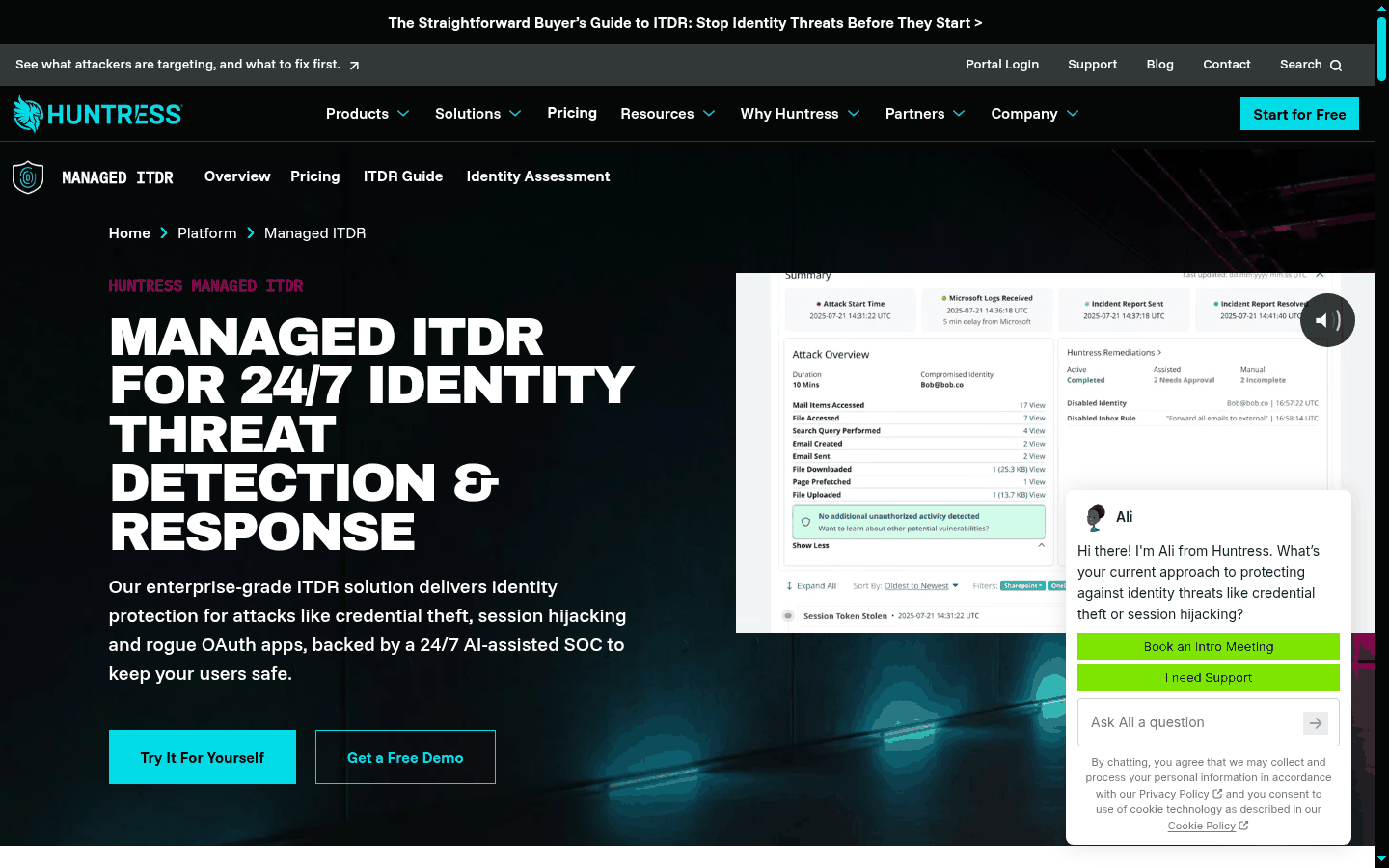
If the RFP says ITDR for hybrid Active Directory and Entra ID, shortlist Huntress and Netwrix in that order only after you name the queue that burns the team this week. Huntress Managed ITDR is the fit when cloud identity attacks (account takeover, BEC, rogue OAuth, session abuse on Microsoft 365 and Google Workspace) need a managed SOC that investigates and remediates. Netwrix is the fit when directory protocol attacks and identity change audit (DCSync, Kerberoasting, Golden Ticket, AdminSDHolder tampering, Entra app-permission drift) need an AD-first platform your operators run.
That is the split. Later sections fill in editions, response shape, and overlap. They do not repeat that fork in new words. Broader identity shortlists still live under identity protection tools.
| Job | Managed ITDR for Microsoft 365 / Entra ID and Google Workspace identities, with hybrid AD sync remediation via the Huntress agent | AD-first identity threat detection, prevention, and audit across Active Directory, Entra ID, and related file systems |
|---|---|---|
| How a bad day closes | SOC-validated alert plus remediation (disable account, kill session paths, remove rogue apps / malicious inbox rules) with an incident timeline | Detect or block directory and Entra attack techniques in-line, then investigate with attack-chain context and audit evidence |
| Deploy | Authorize cloud tenants; hybrid synced identities use the Huntress agent on domain controllers for disable/re-enable | Platform components (Threat Manager, Threat Prevention, Auditor, 1Secure ITDR) deployed for on-prem AD depth plus Entra / SaaS options |
| Cloud identity vs directory center | Stronger on managed cloud-identity ATO / BEC / OAuth response; not the AD protocol-block product between these two | Stronger on AD protocol threats, honeytokens, and identity audit; not the 24/7 managed cloud-identity SOC between these two |
| License/pricing | Per-identity annual subscription; Get Pricing form. No public dollar meter (checked 9 Sep 2026). No Microsoft premium license required | Threat Manager / Prevention quote-led. 1Secure ITDR self-serve from $17 / $27 / $34 per enabled AD + cloud-only Entra user per year (SMB limits; checked 9 Sep 2026) |
| Who operates it | MSPs and lean IT / SecOps teams that want SOC-backed identity response without staffing an identity SOC | Identity / AD / security operators who own directory hardening, blocking policies, and audit evidence |
MFA and IdP packaging still leave identity tradecraft that a managed ITDR watch is built to catch. Huntress first-party packaging also states Managed ITDR does not require premium Microsoft licensing, which matters when the tenant is stuck on Business Standard while attackers are not.
We reviewed first-party documentation, public pricing pages, product announcements, and live community threads. We did not test the products in paid production environments, so this is not a hands-on benchmark.
Huntress
Netwrix
Editions and pricing
Huntress sells Managed ITDR as a single per-identity, per-month subscription billed annually, with Unwanted Access, Rogue Apps, and Shadow Workflows included rather than feature-gated. Pricing is request-led through a Get Pricing form; there is no public dollar table to paste into a spreadsheet (checked 9 Sep 2026).
Netwrix splits the aisle. Enterprise Threat Manager and Threat Prevention are quote-led. For smaller teams, 1Secure ITDR is self-serve SaaS with three published lines: AD and Entra ID risk assessment at $17 per year, ITDR1 at $27 per year, and ITDR3 at $34 per year, each per enabled Active Directory user plus cloud-only Entra ID user, with eligibility caps (up to 150 employees or 250 enabled AD + cloud-only Entra accounts) and community-supported self-deployment.
| How you buy it | Per-identity annual subscription via sales / Get Pricing; MSP PSA billing integrations listed | Quote for Threat Manager / Threat Prevention; self-serve 1Secure ITDR tiers for eligible small teams |
|---|---|---|
| Public dollar table | No public dollar meter (checked 9 Sep 2026) | 1Secure ITDR $17 / $27 / $34 per enabled AD + cloud-only Entra user per year (checked 9 Sep 2026). Enterprise ITDR modules remain quote-led |
| What is included | Unwanted Access, Rogue Apps, Shadow Workflows, 24/7 SOC, one year SIEM retention called out as included | 1Secure lines stack PingCastle risk assessment, monitoring/alerting, and Entra/Okta object recovery; Threat Manager adds behavioral analytics, honeytokens, and response actions |
| 2025-26 product change | March 2026: 10M+ Microsoft 365 identities protected; Managed ITDR expands to Google Workspace | Threat Manager documents real-time AD / Entra / file-system threat models with blocking and attack-chain investigation |
Price shape follows the operating model: Huntress prices the managed identity watch per cloud identity; Netwrix prices either a lightweight SaaS ITDR starter or a quote for the deeper AD prevention stack.
Managed cloud identity response
| Primary surface | Microsoft 365 / Entra ID and Google Workspace identity behavior (logins, sessions, OAuth apps, inbox rules) | Entra ID changes and cloud identity signals appear inside a broader AD-first ITDR and audit platform |
|---|---|---|
| Response model | 24/7 AI-assisted SOC validates and remediates; Incident Report Timeline reconstructs the chain | Your operators configure detections, blocks, and response actions; alerts route to Teams / Slack / SIEM / ticketing |
| Hybrid AD role | Augments Entra; agent on DCs can disable/re-enable AD-synced identities during response | On-prem AD is the center: protocol-level prevention, directory change control, and forest/object recovery narratives |
| What teams argue about | False positives after first tenant onboarding, VPN/location rule flexibility, and how far coverage goes beyond M365/GWS | Whether Entra monitoring without managed SOC staffing covers cloud ATO mornings (between these two, that is Huntress’s job) |
Between these two, buy Huntress when the painful unit of work is a compromised mailbox or session tonight and you need someone else to confirm and close it. Netwrix can watch Entra changes and identity risk, but it is not the managed cloud-identity SOC on this pair.
AD-first threat prevention and audit
| Primary surface | Cloud identity telemetry; hybrid AD support is remediation for synced identities, not full AD protocol blocking | Active Directory attack techniques (DCSync, Kerberoasting, Golden Ticket, DCShadow, AdminSDHolder), Entra app permissions, file-system ransomware patterns |
|---|---|---|
| Control shape | Detect and respond after identity abuse patterns appear in cloud logs; SOC guidance and automated remediation | Threat Prevention blocks risky directory operations at the source; Threat Manager correlates attack chains and can trigger response actions |
| Evidence / audit | Incident timelines and identity assessments for onboarded tenants | Auditor-style identity audit trails and compliance-mapped reporting sit beside detection |
| What teams argue about | Whether managed cloud ITDR substitutes for directory protocol prevention (it does not, between these two) | Policy tuning noise on Kerberoasting/DCSync exclusions and how much professional services the AD stack needs |
Between these two, Netwrix productizes AD-first detection, blocking, and audit for directory attack techniques. Huntress productizes managed response when the identity already looks valid in Microsoft 365 or Google Workspace.
Where they overlap
Both sell into ITDR conversations for hybrid Microsoft environments. Both care about compromised credentials, suspicious logins, and Entra ID adjacent risk. Overlap is the category label and hybrid Microsoft adjacency, not the same operator morning. Treating them as interchangeable leaves either managed cloud ATO response or directory protocol prevention unfinished.
When to use both
Running both can make sense when the jobs stay separate: Huntress for SOC-backed cloud-identity ITDR on Microsoft 365 / Google Workspace, Netwrix for AD protocol prevention, honeytokens, and identity audit evidence. That is complementary coverage, not two copies of the same control.
Skip Netwrix for this pair if the buying committee needs managed cloud-identity response first and directory protocol blocking is already covered by another AD specialist. Skip Huntress for this pair if operators need AD-first prevention and audit evidence first and cloud ATO response is already staffed elsewhere.
Decide the job first. If the product must watch and remediate cloud identity attacks with a managed SOC, that is Huntress. If the product must prevent and audit Active Directory attack techniques your team operates, that is Netwrix. Only then open the quotes.
FAQs
Are Huntress and Netwrix the same ITDR product?
No. Both use ITDR language for hybrid Microsoft environments, but between these two Huntress leads with managed cloud-identity detection and response, and Netwrix leads with AD-first threat prevention, detection, and identity audit.
Does either vendor publish list prices?
Huntress Managed ITDR is a per-identity annual subscription sold through Get Pricing (no public dollar meter checked 9 Sep 2026). Netwrix publishes 1Secure ITDR self-serve lines at $17 / $27 / $34 per enabled AD + cloud-only Entra user per year for eligible small teams; Threat Manager and Threat Prevention remain quote-led.
Does Huntress replace AD protocol prevention?
Not between these two. Huntress can remediate AD-synced identities during cloud-identity incidents via an agent on domain controllers. Purpose-built AD protocol blocking and directory attack models on this pair sit with Netwrix.
Does Netwrix replace a managed identity SOC?
Not between these two. Netwrix gives operators detections, blocks, and audit tools for AD and Entra. 24/7 managed cloud-identity investigation and remediation on this pair sit with Huntress.
Is this a scored bake-off?
No. Order is editorial.