Mave vs Dropzone AI: federated SecOps or an AI SOC analyst
SOC teams want AI that can investigate and hunt across the tools they already run. Here is how Mave and Dropzone AI approach that job.
Mave came out of stealth on 22 Oct 2026 with USD 34M: a USD 28M Series A led by Red Dot Capital Partners, with Lumir Growth Partners, and a USD 6M seed led by Dell Technologies Capital and Emerge Ventures. Its bet is that security operations should query the tools an organization already runs, rather than first standing up a new store for the telemetry those tools already hold.
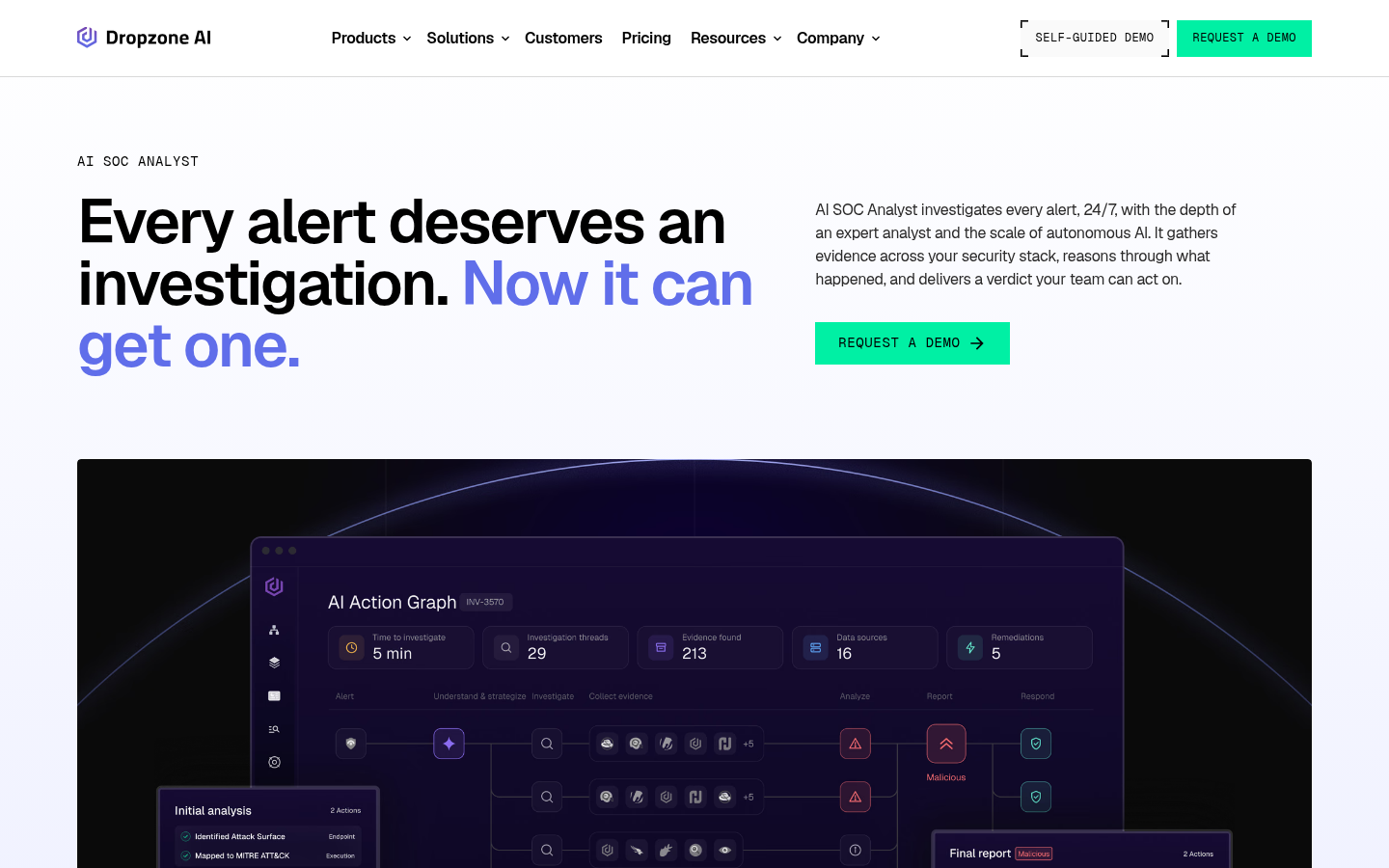
Mave’s platform page says it is a federated SecOps decision layer: agents query connected systems in their native languages, gather live context where it lives, and run investigations, hunts, detection work, and governed responses from one place. Dropzone AI is an AI SOC Analyst that investigates alerts from the tools you already run, with a documented workflow that starts when an alert is ingested from a connected source and is then enriched from other data sources. Mave’s capabilities are launch claims, stated on its own site.
Overview
| Primary use case | Mave’s platform page says it investigates alerts, answers plain-language questions, hunts activity that never alerted, hardens detections, and triggers governed responses across the existing stack | Investigate alerts from connected SIEM, EDR, cloud, identity, and email tools, around the clock, and return a verdict with the evidence trail behind it |
|---|---|---|
| Day-to-day workflow | Mave’s platform page says integrations connect through APIs, start read-only, and query each tool where the data already lives. Teams ask in plain language; the page says every action still runs as an inspectable step, with an audit trail of what was queried and why | An investigation is created when an alert arrives from a connected alert source. The AI SOC Analyst enriches it from connected data sources, writes a reviewable case, and can take a follow-up question or a scoped containment action the team has allowed |
| Main buying consideration | Sold as Essentials or Advanced, by custom quote. Billing units and add-ons are under Editions and pricing | Sold as Enterprise, Federal, or MSSP packages, by quote. Capacity rules are under Editions and pricing |
We reviewed Mave’s platform, pricing, about, launch, AI SOC, threat-hunting, detection-engineering, multi-SIEM, on-prem, and MSSP pages, SiliconANGLE’s 22 Oct 2026 funding report, Dropzone’s AI SOC Analyst and AI Threat Hunter product pages, pricing page, and integrations catalog, and Dropzone docs for investigations, alert sources, and data sources, on 12 Nov 2026. Mave has no public technical docs, so its capabilities are vendor-stated. Where a public page does not cover a question, we write “not documented”.
Mave
Dropzone AI
Editions and pricing
Mave is sold as Essentials or Advanced, priced by protected endpoints and team size. Dropzone AI is sold as Enterprise, Federal, or MSSP packages, priced on the size of the organization.
| How it is sold | Essentials includes Ask Mave, agentic threat hunting, threat intelligence, and agentic workflows. Advanced adds investigation of alerts to a verdict, governed response, reasoning-based detections, and ITSM and knowledge-base integrations. Optional add-ons are Lake, an on-premises Broker, SECTEAM managed services, and a fixed-price bundle for smaller teams | Enterprise is an all-inclusive package sized to the organization, covering investigation, hunting, intel, and detection engineering. Federal and MSSP packages are assembled per agent and capacity level, with client environments separated on the MSSP plan, and Federal sold on federal terms |
|---|---|---|
| Public price | Priced by the number of endpoints you protect, described as servers, workstations, and cloud instances, and by the size of the security team, not by data volume. No public list price with currency, unit, and period, checked 12 Nov 2026 | No public list price with currency, unit, and period, checked 12 Nov 2026. Enterprise is sized on employees; Federal and MSSP are priced to how you run. The pricing page describes unlimited investigations under a fair-use cap |
| Trial | The platform page offers a demo, and the pricing page offers a custom quote. A free trial is not stated on Mave’s pricing or platform pages | The pricing page offers a self-guided demo and a request for pricing |
How each reaches the data and closes an investigation
Both work against the security tools you already run, and both say you do not have to migrate a new data lake first. They differ in how an investigation starts, and in how that work is documented.
| Where the data is reached | Mave’s platform, pricing, and multi-SIEM pages say agents connect through scoped APIs, query data where it lives in each tool’s native capabilities, and do not require telemetry migration, a duplicate data lake, or a central index. An optional Lake add-on is sold for managed, searchable retention, with hot and cold tiers set per source | Dropzone’s pricing and product pages say it deploys against the SIEM, EDR, cloud, and identity tooling you already run, with no data migration and no new endpoint agent. Dropzone’s docs describe a split model: investigations are created when an alert is ingested from a connected alert source, then enriched from data sources you already have, such as identity, directory, SIEM, and threat-intel tools |
|---|---|---|
| How an investigation runs | Mave’s platform and AI SOC pages say it pulls alerts, gathers context from every connected tool, and returns an evidence-backed verdict, with an audit trail of what was queried, how it was correlated, and why. Ask Mave lets the team query the stack in plain language | Dropzone’s docs say the AI SOC Analyst collects data from integrated tools, enriches the alert, and produces a conclusion of malicious, suspicious, benign, or inconclusive, plus findings, evidence, and a review state. The product page says every verdict stays open to steer, and that an analyst can correct it so that context shapes later investigations |
| Hunt and detection | Mave’s threat-hunting page says a hunt can start from a campaign, actor, vulnerability, indicator, technique, or analyst hypothesis, check relevance against the environment, query each connected system, and turn findings into detections, scheduled agents, or authorized responses. Its detection-engineering page says agents can review, create, translate, test, and tune detections across languages including SPL, KQL, YARA-L, Sigma, EQL, Lucene, and SQL-based rules, and can use detection-as-code repositories | Dropzone’s AI Threat Hunter product page describes hypothesis-driven hunts across connected tools, using prebuilt hunt packs or a hypothesis the team brings, and working each lead to a verdict. The pricing page still labels that agent in beta, includes threat intel that can turn a new CVE or campaign into a hunt pack, and labels AI Detection Engineer as arriving in 2027 |
Control, packaging, and where each sits in the SOC
Once the investigation model is clear, the remaining questions are how much control you keep over response, and whether you need federal or multi-tenant operations.
| Relationship to the rest of the stack | Mave’s about and platform pages describe a platform-agnostic federated layer over existing tools, including multi-SIEM and post-merger environments, with an optional on-premises Broker so internal tools need not expose their APIs externally | The pricing page lists 100+ integrations against the SIEM, EDR, cloud, and identity tools you already run. Dropzone’s docs also describe a private network connector for reaching internal systems |
|---|---|---|
| Response and governance | Mave’s homepage and platform page say you set what runs automatically and what waits for a human, including notify, ticket, document, or remediate, that destructive actions stay behind approval by default, that integrations start read-only, and that every step is scoped by least-privileged, per-platform API permissions, with a full action trail | The pricing page says automated containment is included at no extra cost, scoped to blocking malicious IPs and disabling compromised accounts, and fires only on threats the agents have confirmed. Consent profiles decide what Dropzone can do in the tenant, and actions land in System Events |
| Who it is for | Mave’s site describes security teams and MSSPs that want a federated layer over the tools they already run, including on-premises and multi-SIEM environments. A FedRAMP authorization is not documented on Mave’s platform, pricing, or about pages | SOC and security teams that want a documented AI SOC Analyst on the existing stack, including federal programs: FedRAMP High (Class D) authorized, with SOC 2 Type II and single-tenant deployment in the customer’s region also stated on the product page |
Choose Mave when you need plain-language queries and detection work across several SIEMs or on-prem tools through one federated layer, as stated on Mave’s platform and solutions pages, and can pilot a launch-stage vendor first. Choose Dropzone AI when you need FedRAMP High authorization, containment included at no extra cost, or alert investigations with documented verdict states.
FAQs
Does Mave replace Dropzone AI?
No. Both are aimed at investigating and hunting across tools you already run, without a new data-migration project. The tables show the differences that decide a pick: Mave’s pages state plain-language queries and detection work across several SIEMs or on-prem tools through one federated layer; Dropzone documents FedRAMP High authorization, containment included at no extra cost, and alert investigations with named verdict states.
How are Mave and Dropzone AI priced?
Mave and Dropzone AI are each sold by quote. Mave is priced by protected endpoints and team size, as Essentials or Advanced. Dropzone AI’s Enterprise package is sized on employees; Federal and MSSP are priced to how you run. Those terms are under Editions and pricing.
Do they require a new data lake?
Mave’s pricing FAQ says neither Essentials nor Advanced requires moving your data into another store, and it sells an optional Lake add-on for managed retention. Dropzone’s pricing page says there is no data migration and no new endpoint agent. Dropzone’s docs describe ingesting alerts from connected sources and enriching them from data sources you already have, which is not the same as standing up a new telemetry lake.