Best Cyber Recovery Platforms in 2026: 8 Tools for a Clean Restore
Eight tools that isolate, validate, and restore a clean copy after ransomware or a destructive change, when production itself cannot be trusted.
When production cannot be trusted after ransomware or a destructive change, a recovery point from 24 hours ago is only useful if you can isolate it, validate that it is clean, and restore from it without putting the same compromise back. That work is cyber recovery: validating and restoring a clean copy when the original environment cannot be trusted.
Backup proves you have a copy. Disaster recovery proves you can fail a replica over. DSPM inventories sensitive data at rest. ITDR detects identity abuse. None of those, on their own, answers whether a clean copy can be validated and restored after the original environment cannot be trusted.
The platforms below take that job on different paths: an isolated vault or clean room, a continuously updated replica, or a dependency-mapped rebuild of a whole cloud application. Dreeze, which came out of stealth on 10 Nov 2026 with USD 33 million in seed funding, is one approach within that last path, as its platform pages state, not the definition of the category.
How we evaluated
We read each vendor’s product pages, documentation, and pricing pages on 12 Nov 2026, and checked each one against the same questions: what it brings back, where the recovered system runs, whether it offers an isolated clean room or a continuously updated replica, and whether identity and configuration are in the recovery set. Capabilities are vendor-stated unless noted.
| Tool | Best for | What to check |
|---|---|---|
| Rubrik | Recovery plans tested in isolated environments | Quote; Cloud Vault is a separate add-on |
| Cohesity | FortKnox vault and clean room for DataProtect and NetBackup | Quote |
| Dell PowerProtect Cyber Recovery | Isolated air-gapped vault with CyberSense analytics | Quote |
| Commvault | On-demand cloud cleanroom for test, forensics, and restore | Cleanroom add-on in 10 TB increments |
| Veeam | SureBackup verification and, in Premium, orchestration | Licensed per workload; trial available |
| HPE Zerto | Journal-based continuous replication and failover | Quote |
| AWS Elastic Disaster Recovery | Continuous replication into a chosen AWS Region | USD 0.028 per replicating server per hour |
| Dreeze | Rebuilds the cloud app, not only its data | Came out of stealth 10 Nov 2026 · quote |

Rubrik
Cohesity
Dell
Commvault
Veeam
Zerto
Dreeze
Capability matrix: what actually comes back
Each cell restates what the vendor documents on the product or documentation pages cited in its entry. Uncited claims are omitted; if a product does not document a capability, the cell says so in a full sentence.
| Rubrik | Cohesity | Dell | Commvault | Veeam | HPE Zerto | AWS DRS | Dreeze | |
|---|---|---|---|---|---|---|---|---|
| What it brings back | Data, files, objects, or applications from recovery plans | Vaulted snapshots and Digital Jump Bag assets | Vaulted backup copies from the isolated Cyber Recovery vault, after CyberSense analysis as Dell describes | Data, applications, and infrastructure into the cleanroom, including a recovered control plane | VMs, files, and applications from backups | Protected workloads and applications from a journal checkpoint | Source servers launched as EC2 instances from replicated disks | Data plus infrastructure, configuration, identity, keys, and secrets, rebuilt in dependency order |
| Where the recovered system runs | Isolated recovery environments, then original or alternate production targets | Original or alternate location, or a FortKnox clean room | An air-gapped vault on-premises or in a public cloud, then a recovery host or restore target you choose | An on-demand isolated cloud environment in AWS or Azure | An isolated virtual lab for tests; production or a failover site for restores | A recovery site or cloud target you have configured for the journal | Recovery instances in a staging or recovery subnet in your AWS account | A customer-owned account or region, including a clean room in the customer’s tenant |
| Isolation model | Isolated recovery environments; Cloud Vault uses a Rubrik-managed identity domain | Logically air-gapped vault under separate administrative control, plus a clean room | Automated air gap; the vault stays separated from production except during controlled replication | On-demand cloud cleanroom, with Air Gap Protect as a prerequisite | Isolated virtual lab or DataLab; hardened repositories for the backup copies | Replica and journal at the recovery site; a separate vault is an architecture choice | Staging subnet in your account; not a separate identity-domain vault | Immutable vault account the customer owns, with optional compliance locks |
| Identity, config, and secrets | Application, file, and object restore; a full cloud IAM rebuild is not documented | Vaulted data and Digital Jump Bag assets; a full cloud IAM rebuild is not documented | Vaults and analyzes backup copies; a full cloud IAM rebuild is not documented | Control-plane recovery into the cleanroom is documented; a general cloud IAM mapper is not | VM, file, and application restore; a cloud IAM rebuild is not documented | Workload and application failover; a cloud IAM rebuild is not documented | Disks and the guest OS they contain; IAM and config outside those disks are out of scope | Backed up with the data and rebuilt in order, as the platform page states |
| How you rehearse | Create, test, and validate recovery plans in isolated environments | Clean-room recovery of vaulted copies for investigation and validation | Analyze vaulted copies with CyberSense and recover from a known-good point in the vault; a productized isolated lab like a DataLab is not documented | On-demand cleanroom used to test plans and run forensics | SureBackup in a virtual lab; plan testing in DataLabs on Premium | Non-disruptive testing of orchestrated recovery | Non-disruptive recovery drills that launch instances, then optional cleanup | Automated whole-app tests in an isolated account, then cleanup and a report |
Cells come from each vendor’s product page or documentation cited in its entry, read on 12 Nov 2026.
Worked example: production is untrusted, and you have a copy from 24 hours ago
A ransomware event or a destructive agent has made the production application untrusted. Identity may also be compromised. You have a recovery point from 24 hours ago. Here is what each product documents that it would actually bring back, and where that recovered system would run.
None of the vendors publishes this exact scenario; the cells restate capabilities from the entries below.
| What it brings back | Where that recovered system runs | |
|---|---|---|
| Rubrik | The files, objects, applications, or systems in the recovery plan, from a clean point, with infected snapshots isolated | An isolated recovery environment used to test and validate the plan, then a restore target you choose |
| Cohesity | Vaulted snapshots and Digital Jump Bag assets from FortKnox, after threat scanning | A FortKnox clean room for investigation and validation, then an original or alternate production location |
| Dell PowerProtect Cyber Recovery | Isolated vault copies of protected data, after CyberSense analysis for corruption or anomalies as Dell describes | An air-gapped Cyber Recovery vault, on-premises or in a public cloud, then a recovery host or restore target outside the vault |
| Commvault | Data, applications, and infrastructure, with a recovery control plane brought up in the cleanroom | An on-demand isolated cloud cleanroom in AWS or Azure, separate from production |
| Veeam | VMs, files, or applications from a verified backup restore point | An isolated virtual lab or DataLab for verification, then a production or failover target for the restore |
| HPE Zerto | Protected applications and workloads from a journal checkpoint just before the disruption | The configured recovery site, after non-disruptive testing, then failback or cutover as you choose |
| AWS Elastic Disaster Recovery | Source servers as EC2 instances launched from replicated disks, from the latest state or a prior point in time | A recovery subnet in your AWS account, in the Region you chose for the replica; IAM and networking around those instances are still yours to design |
| Dreeze | Infrastructure, configuration, identity, keys, secrets, and data, rebuilt in dependency order from the mapped application | An isolated clean room in a customer-owned account or region, where you can scan before anything reconnects to production |
This is our illustration of a common cyber recovery day, not a vendor-published walkthrough of this incident.
Rubrik
Best for rehearsed recovery plans and isolated snapshot handling at enterprise scale
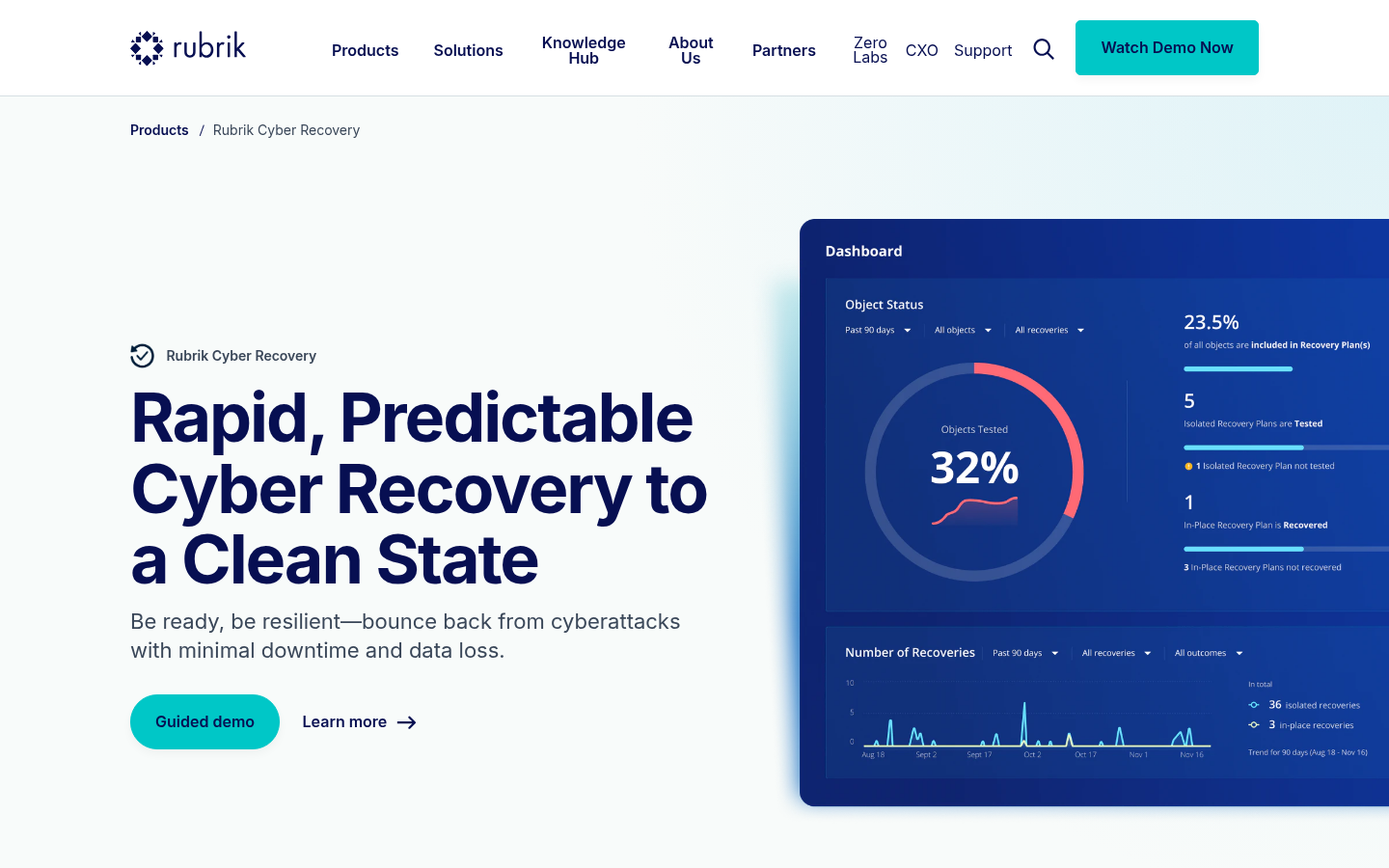
Rubrik’s cyber recovery page describes recovery plans that you can create, test, and validate in isolated environments, then use to restore files, objects, applications, or a wider set of systems. It also describes isolating infected snapshots so a restore does not put malware back into production, and using attack-scope insights to pick a clean recovery point.
Forensics can run in those isolated environments, and progress is tracked against the plan. Rubrik Cloud Vault is a separate add-on: a managed vault Rubrik provisions in an isolated, Rubrik-managed identity domain, so production credentials do not work there. Workload coverage and edition details sit in the Security Cloud packaging, not on the cyber recovery page alone.
Key features:
- Recovery plans that can be tested and validated in isolated environments
- Isolation of infected snapshots before a restore
- File-level, object-level, application-level, or system-wide restore workflows
- Cloud Vault add-on in a Rubrik-managed identity domain, sold separately
Why we like it:
You can rehearse an application recovery plan in isolation and keep an infected snapshot out of the restore path.
Limits:
The cyber recovery workflow is built around recoverable snapshots of data, VMs, files, and applications. Rebuilding surrounding cloud IAM, secrets, and network configuration the way an application-revival product claims to is not documented here.
License or pricing: Rubrik Security Cloud is quote-based. Cloud Vault is an add-on licensed per backend terabyte, with price varying by storage tier and redundancy, per Rubrik’s licensing guide effective 15 Oct 2026, checked 12 Nov 2026. No public USD list price for Security Cloud itself.
Cohesity
Best for vaulting DataProtect or NetBackup copies into a FortKnox clean room
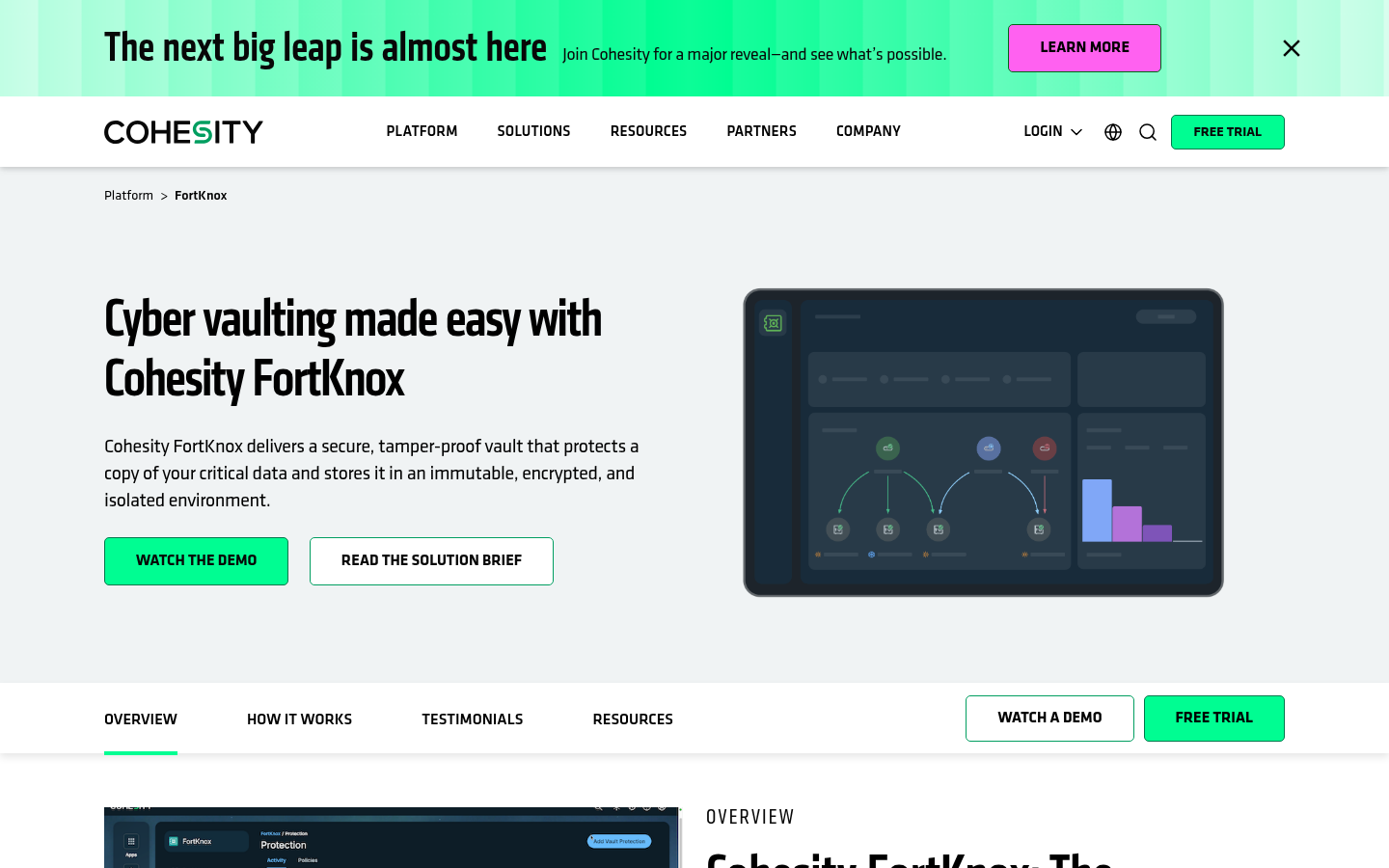
Cohesity FortKnox keeps an immutable, logically air-gapped copy outside the everyday backup environment, under separate administrative control. Recovery actions use MFA, role-based access, and quorum approval. You can restore to the original or an alternate location, or stage vaulted snapshots and Digital Jump Bag assets in an isolated clean room, then investigate and validate before production is touched.
FortKnox SaaS is a Cohesity-managed vault on AWS, Azure, and GCP and protects both DataProtect and Cohesity NetBackup (formerly Veritas NetBackup) data, which is why those two engines are covered in this one entry. A self-managed FortKnox option runs on your own infrastructure. Anomaly detection and threat scanning are described as part of confirming cleanliness before restore.
Key features:
- Immutable, logically air-gapped vault under separate administrative control
- Clean-room recovery of vaulted snapshots and Digital Jump Bag assets
- Quorum approval, MFA, and role-based access on recovery actions
- Protects both Cohesity DataProtect and Cohesity NetBackup data, as SaaS or self-managed
Why we like it:
A DataProtect or NetBackup copy can be vaulted and then opened in a clean room before anyone points it at production.
Limits:
FortKnox is a vault and clean-room path for protected data, not a mapper that rebuilds live cloud IAM and secrets from a dependency graph. You still need a recovery design for everything the snapshot does not contain.
License or pricing: Pricing is quote-based. Checked 12 Nov 2026. No public USD list price on the FortKnox product page.
Dell PowerProtect Cyber Recovery
Best for an isolated, air-gapped vault with vault-side analytics on the recovery copies
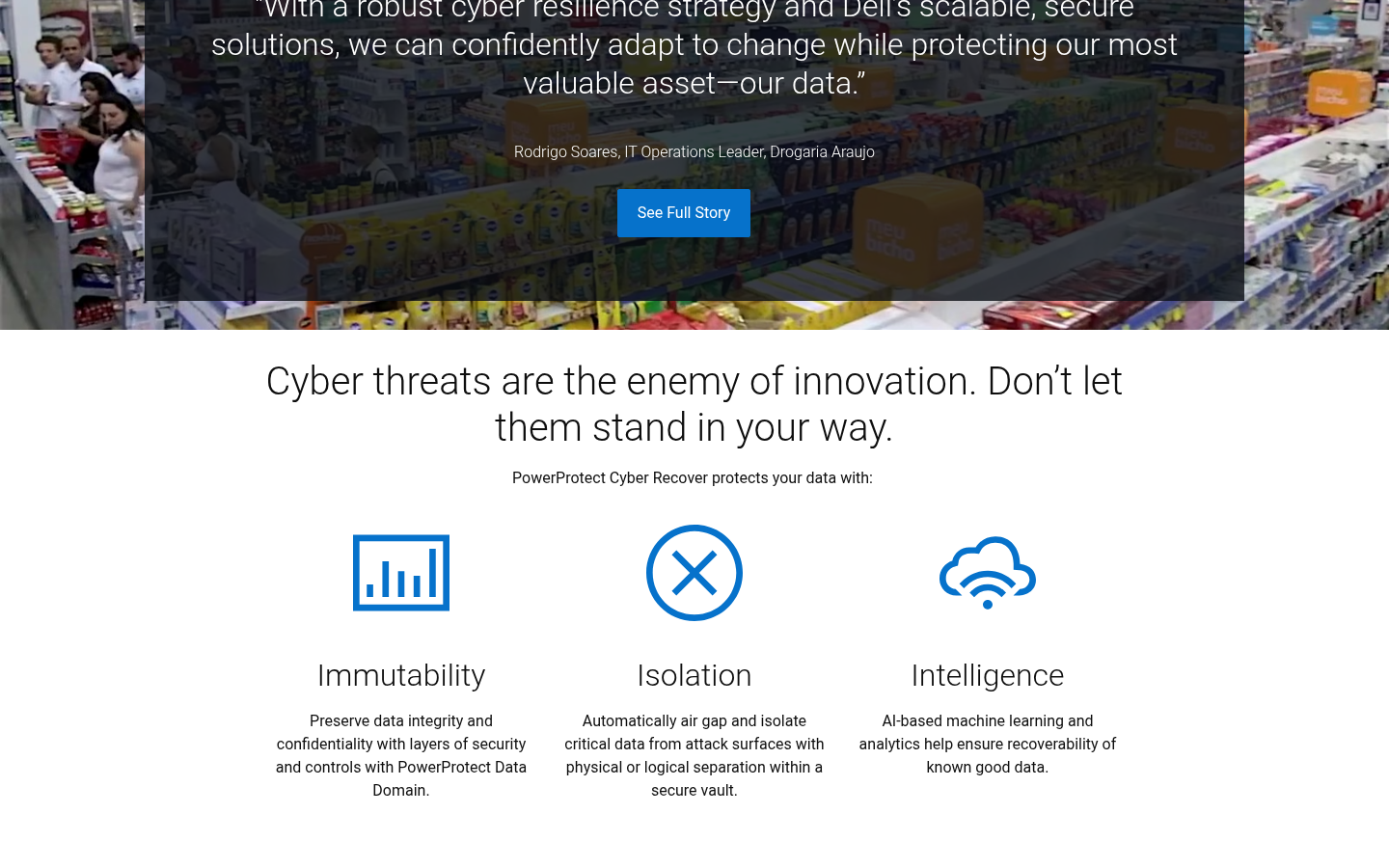
Dell PowerProtect Cyber Recovery keeps recovery copies in an isolated vault with an automated air gap, on-premises or in a public cloud, and uses PowerProtect Data Domain for immutability. Dell’s product page says CyberSense applies machine learning to those vaulted copies and detects corruption with 99.99% confidence, a vendor figure, so you can identify a known-good point before you restore.
The vault is designed to stay separated from production except during controlled replication. Recovery is described as a set of options after an attack, including restoring from the isolated copy with confidence. This is a vault and analytics architecture for copies you already protect, not a mapper that rebuilds cloud IAM, secrets, and dependencies from a live application graph.
Key features:
- Isolated Cyber Recovery vault with an automated air gap, on-premises or in a public cloud
- Immutability and tamper protection with PowerProtect Data Domain
- CyberSense machine-learning analytics on vaulted copies, as described on Dell’s product page
- Endorsed against the Sheltered Harbor data-vaulting standard for U.S. financial institutions
Why we like it:
An automated air gap and vault-side analytics give you a copy that production credentials should not be able to reach or quietly corrupt.
Limits:
This is a PowerProtect and Data Domain vault architecture, not a dependency-mapped rebuild of cloud IAM and secrets. CyberSense is a vault-side analytics component, and some cloud deployments have limits you need to confirm for the region and configuration you would buy.
License or pricing: Pricing is quote-based. No public USD list price appeared on the product page, checked 12 Nov 2026.
Commvault
Best for an on-demand cloud cleanroom on top of an existing Commvault environment
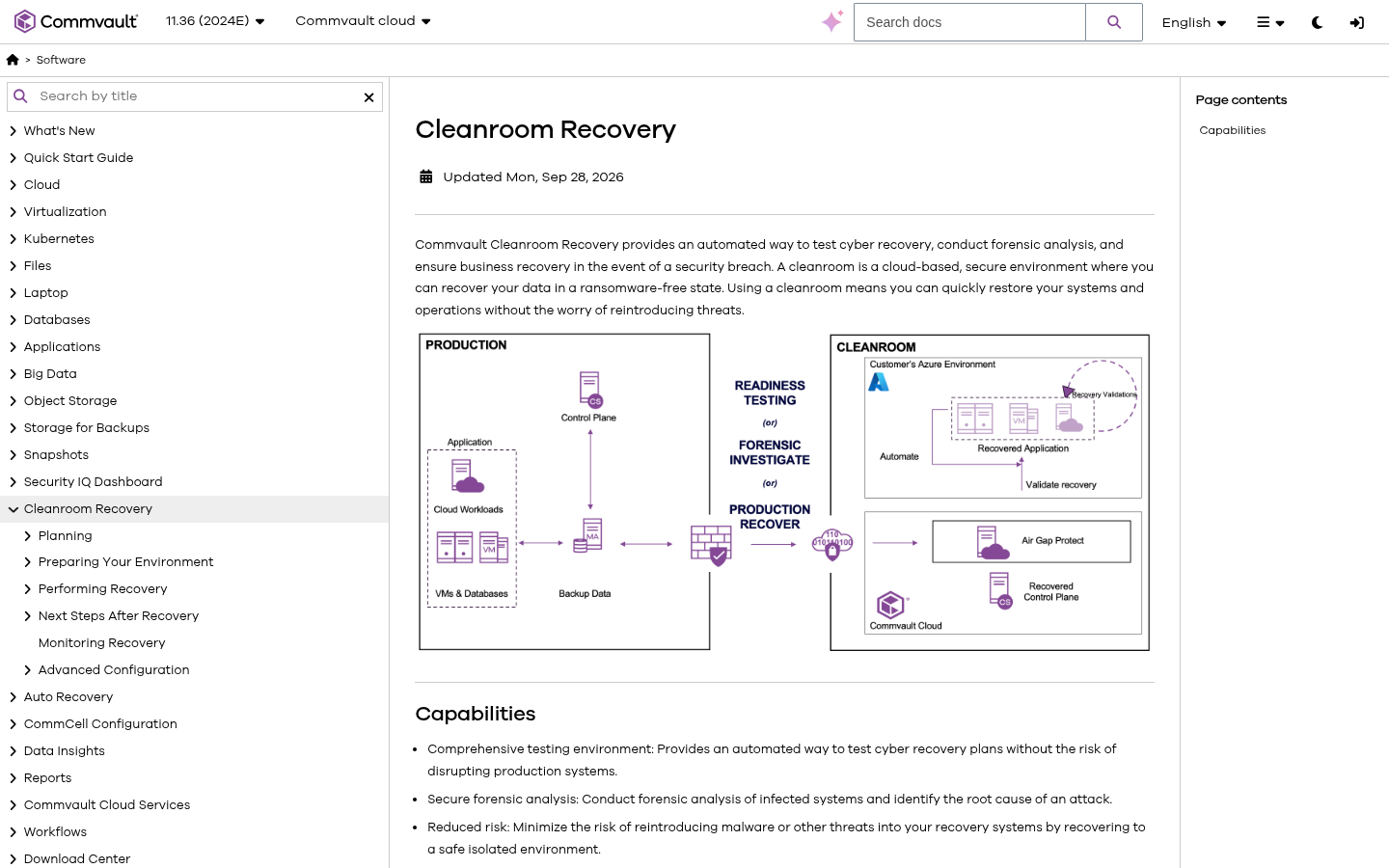
Commvault Cleanroom Recovery is documented as a cloud-based, isolated environment where you can test cyber recovery plans, do forensic analysis, and recover data, applications, and infrastructure after a breach without using production as the test bed. Documentation describes deploying the isolated environment, restoring a recovery control plane, then investigating and restoring inside the cleanroom.
The offering is available to software and SaaS customers and is designed to work with a tertiary copy in Air Gap Protect. Supported clouds include AWS and Microsoft Azure. A packaging sheet describes Cleanroom Recovery as a standalone add-on, like Air Gap Protect, and not automatically included in every Backup & Recovery bundle.
Key features:
- On-demand isolated cleanroom in AWS or Azure, separate from production
- Automated recovery of a control plane into the cleanroom
- Support for recovery-plan testing, forensic analysis, and restore
- Integration with Air Gap Protect as a prerequisite for the add-on
Why we like it:
You can spin up an isolated cloud cleanroom when you need it, instead of maintaining a permanent dark site, and rehearse recovery there.
Limits:
Cleanroom Recovery is an add-on that expects Commvault Backup & Recovery and Air Gap Protect already to be in place. It is not a standalone application-revival product for teams with no Commvault environment.
License or pricing: Commvault Backup & Recovery is quote-based. Cleanroom Recovery is a standalone add-on sold in 10 TB front-end increments based on the data configured into Recovery Groups, and it requires Air Gap Protect plus Backup & Recovery. The packaging sheet we read is dated Aug 2024, checked 12 Nov 2026, and does not list a public USD unit price.
Veeam
Best for verifying backups in an isolated lab and orchestrating recovery if you already run Veeam
Veeam Data Platform protects virtual, physical, and cloud workloads and is licensed per workload through the Veeam Universal License. SureBackup, part of Backup & Replication, can boot VMs from a backup in an isolated virtual lab and run heartbeat, ping, and application tests so you learn whether a restore point actually comes up before you need it in an incident.
The Premium edition adds recovery orchestration and compliance reporting, including DataLabs used by Veeam Recovery Orchestrator to test plans without touching production. Foundation focuses on backup and recovery; Advanced adds monitoring, analytics, and threat insights. Microsoft 365, Salesforce, and Kasten for Kubernetes are licensed separately.
Key features:
- SureBackup verification in an isolated virtual lab
- Hardened repository options for immutable backup copies
- Recovery orchestration and DataLab plan testing in the Premium edition
- Portable per-workload licensing across virtual, physical, and cloud workloads
Why we like it:
SureBackup can prove a backup actually boots in a lab, catching a bad restore point before an incident.
Limits:
Cyber recovery depth depends on the edition, and orchestration is a Premium capability. Veeam recovers VMs, files, and applications from backups; rebuilding surrounding cloud IAM and secrets is not documented as part of Data Platform.
License or pricing: Veeam Data Platform is licensed per workload through the Veeam Universal License, in Foundation, Advanced, and Premium editions. A free trial is offered on Veeam’s packaging page. No official Data Platform USD list price appeared on that page, checked 12 Nov 2026. Microsoft 365, Salesforce, and Kasten are sold separately.
HPE Zerto
Best for failing applications over to a journal checkpoint seconds before the disruption
HPE Zerto Software is built on continuous data protection rather than periodic backup. The product page describes continuous replication, journal-based recovery to a point just before a disruption, and data loss measured in seconds rather than hours, with orchestrated recovery and non-disruptive testing so you can validate workloads before they return to production.
Supported environments include VMware, Microsoft Hyper-V, Microsoft Azure, AWS, and the HVM hypervisor as part of HPE Morpheus Software. Encryption detection is described as part of the ransomware path. HPE also publishes a Cyber Resilience Vault reference architecture that uses Zerto together with HPE storage, compute, and networking; that vault is a broader architecture, not a feature that every Zerto license automatically includes.
Key features:
- Continuous replication with journal-based recovery to a point just before disruption
- Orchestrated application recovery and non-disruptive testing
- Encryption detection as part of the ransomware response path
- Protection across VMware, Hyper-V, Azure, and AWS
Why we like it:
A journal checkpoint a few seconds before encryption lets you fail the application over without waiting on a nightly backup window.
Limits:
This is a replica and failover product. It shines when the recovery site can run the same workloads. It does not replace an isolated vault unless you design one, for example with HPE’s separate Cyber Resilience Vault architecture.
License or pricing: Pricing is quote-based. The HPE product page does not publish a public USD list price, checked 12 Nov 2026.
AWS Elastic Disaster Recovery
Best for failing source servers over into a chosen AWS Region at a published hourly rate
AWS Elastic Disaster Recovery continuously replicates source servers to a staging-area subnet in your AWS account, in a Region you choose, then lets you launch recovery instances from the latest state or from a previous point in time. AWS says this supports RPOs of seconds and RTOs of minutes, with non-disruptive drills and an optional failback to the primary site.
The same process can protect on-premises servers, other clouds, or an AWS Region-to-Region pair, and it converts source workloads to run as EC2 instances. Replication uses staging EBS volumes and lightweight replication servers. Surrounding IAM, secrets, and network design outside those server disks are not what DRS itself rebuilds; you still have to design the account, networking, and identity the recovered instances will join.
Key features:
- Continuous block-level replication into a staging subnet in your AWS account
- Launch recovery instances from the latest state or a previous point in time
- Non-disruptive recovery drills and optional failback
- Published per-server hourly rate, plus the AWS resources the replica uses
Why we like it:
You get a cloud failover site without a second idle data center, at a public hourly rate, and you can launch recovered servers in minutes.
Limits:
DRS recovers source servers as EC2 instances from replicated disks. It is not a clean-room vault with a separate identity domain, and it does not map and rebuild the rest of a cloud application’s IAM, secrets, and managed services.
License or pricing: USD 0.028 per replicating source server per hour, with no minimum fee and no upfront commitment, including continuous replication, test launches, recovery launches, and point-in-time recovery. Additional Amazon EBS, EC2, and snapshot charges apply in the account for staging disks, replication servers, and any launched recovery instances. From the AWS Elastic Disaster Recovery pricing page, checked 12 Nov 2026.
Dreeze
Best for rebuilding a whole cloud application in a customer-owned clean room
Dreeze’s platform page states that Application Revival maps a live cloud application, including infrastructure, configuration, identity, keys, and secrets, and backs those up with the data in an immutable vault account the customer owns. A recovery plan is generated from the live dependency graph, not from tags or infrastructure-as-code, though those can be optional inputs.
On recovery, Dreeze says it rebuilds those pieces in dependency order into any account or region, including a clean room in the customer’s tenant, and can run the whole plan as an automated test that cleans up afterward. Dreeze for AWS is generally available. Dreeze for Azure is in early access, with general availability planned for early 2027. Discovery uses a read-only role, and the company says customer data never leaves the customer’s accounts.
Key features:
- Autonomous dependency mapping from the live environment, including 265+ connection types as stated on the platform page
- Vaulted backup of data, infrastructure, configuration, identity, keys, and secrets
- Automated rebuild in dependency order, including clean-room recovery in a customer-owned account
- Non-disruptive whole-app recovery tests that leave a report and then clean up
Why we like it:
It captures and rebuilds the identity, keys, and configuration around the data, so you are not hand-wiring secrets after a restore.
Limits:
It is new, generally available only for AWS, and aimed at cloud applications rather than a broad on-premises VM install base. The capabilities above are as stated on Dreeze’s platform pages.
License or pricing: Pricing is quote-based. The platform page offers a read-only scan of one AWS account or Azure subscription. Checked 12 Nov 2026.
How to choose a cyber recovery platform
- Start from what has to come back. If the application will not run until IAM, secrets, and dependencies are rebuilt with the data, you are looking at a whole-app revival path. If you need VMs, files, or databases back into a clean place, you are looking at a vault or backup platform with a clean room.
- Decide whether isolation or failover is the first move. When production identity may be compromised, a vault or clean room gives you a place to validate a copy. When the need is a very short RPO and a running replica, a journal or block-replication product is the closer fit.
- Count the install base you already have. Cohesity FortKnox can vault DataProtect or NetBackup copies. Commvault Cleanroom Recovery and Veeam orchestration assume you already run those platforms. AWS DRS assumes the recovered servers can run on EC2.
- Rehearse the same path you would use in an incident. Every platform on this page describes some form of non-disruptive test, isolated lab, or drill. Ask to see that test against a real application, not only a slide.
What we left out
- Druva Resilience Cloud: a frequently ranked SaaS backup and cyber-resilience platform with air-gapped, immutable copies and sandbox recovery. We left it out to keep the list to eight; its air-gapped copies and sandbox recovery overlap with the vault and clean-room entries above. See Druva Resilience Cloud.
- Microsoft Azure Site Recovery: the Azure counterpart to AWS Elastic Disaster Recovery, used to fail workloads over into Azure. We already include AWS DRS as the public-cloud failover pattern. See Azure Site Recovery.
- IBM Storage Defender: enterprise resilience software with recovery testing and optional cyber vaulting, often shortlisted in large storage environments. It is a broader storage-resilience suite than the isolated-copy recovery question asked here. See IBM Storage Defender.
What the internet thinks about cyber recovery
Published customer results, quoted for the argument, not the score. These appeared on vendor pages, so read them as vendor-selected.
HPE customer story · TenCate Protective Fabrics
“After implementing HPE Zerto Software, TenCate reduced its data loss from 12 hours to 10 seconds and recovery time from two weeks to under 10 minutes following a ransomware attack.”
From HPE’s Zerto product page. It is a named customer result published by the vendor, and it speaks to journal-based failover, not to an isolated vault.
Cohesity customer story · Blaine County School District
“After the cyberattack, we recovered critical systems from Cohesity FortKnox in 48 hours and resumed normal operations just six days later.”
A named quote published on Cohesity’s FortKnox page. The same story also says there was no data loss and no ransom paid, which you should treat as a vendor-selected reference.
Choose Rubrik when you need recovery plans that you can test in isolated environments and can isolate infected snapshots before a restore. Choose Cohesity when DataProtect or NetBackup copies should be vaulted in FortKnox and opened in a clean room before production uses them. Choose Dell PowerProtect Cyber Recovery when you need an isolated, air-gapped vault with vault-side CyberSense analytics on the recovery copies. Choose Commvault when you already run Backup & Recovery and need an on-demand cloud cleanroom for rehearsal and restore. Choose Veeam when SureBackup verification and recovery orchestration should sit on an environment you already protect with Veeam. Choose HPE Zerto when you need journal-based failover of applications to a point just before the disruption, with data loss measured in seconds. Choose AWS Elastic Disaster Recovery when source servers should fail over into a chosen AWS Region at a published hourly rate. Choose Dreeze when you need a dependency-mapped rebuild of infrastructure, configuration, identity, keys, and data into a customer-owned clean room, as Dreeze’s platform page states, and can pilot a launch-stage vendor first.
FAQs
What is the difference between backup, disaster recovery, and cyber recovery?
Backup keeps a copy you can restore after deletion or corruption. Disaster recovery keeps a replica you can fail over, which is the path HPE Zerto and AWS Elastic Disaster Recovery take with continuous replication. Cyber recovery assumes the production environment, and sometimes the identity plane, cannot be trusted, so a copy is isolated and validated before anything returns to production, as with a Dell PowerProtect Cyber Recovery vault, Rubrik’s isolated recovery plans, Cohesity FortKnox, Commvault Cleanroom Recovery, or a Veeam lab.
Does restoring a database bring the application back?
Only if the infrastructure, configuration, identity, keys, and connections the application needs are still intact and trustworthy. Dreeze’s platform page states that it backs those up with the data and rebuilds them in dependency order. Rubrik, Cohesity, Dell, Commvault, and Veeam restore VMs, files, or application data from protected copies. HPE Zerto and AWS DRS fail servers or applications over from a replica. Surrounding cloud identity and configuration still have to be in that recovery set, or in your runbook, or the application will not run.
When does a clean room or vault matter more than a replica?
A replica such as a Zerto journal or an AWS DRS recovery instance is built for a short recovery-point objective and a fast fail-over of servers that are still shaped like production. An isolated vault or clean room, such as Dell PowerProtect Cyber Recovery, Rubrik’s isolated recovery environment, Cohesity FortKnox, Commvault Cleanroom Recovery, or a Veeam DataLab, is built for the case where you must inspect and validate a copy before production can use it, especially if admin credentials may also have been compromised.
Why are Cohesity DataProtect and Cohesity NetBackup covered together?
They are two data-protection engines under Cohesity. FortKnox can vault and open DataProtect and NetBackup data in a clean room, as Cohesity’s FortKnox page states, so they answer this page’s recovery question as one platform family rather than as two separate products.