Network Security
6 DNS Security Tools for Filtering and Resolver Protection in 2026
Does this name get an authentic answer, or do you refuse it? A phishing name can still resolve if it authenticates as itself.
Expertise: Network Security · Level: Intermediate · 6 min read
Does this name get an authentic answer, or do you refuse it? DNSSEC authenticates. A filter refuses. 1 phishing name can still resolve if it authenticates as itself.
The recursive the team already runs can be green on uptime and still answer a newly registered lookalike. Opening an application by identity is still access policy, not a DNS filter.
A recursive resolver you operate, a filtered DNS service you subscribe to, and an edge resolver you already pay for are different switches. Mixing authenticate and refuse is how a signed bad name still loads.
Pick authenticate when the job is integrity of your zone. Pick refuse when the job is blocking a category of names. Do not expect one switch to do both.
How we evaluated
We read first-party docs, source, licenses, and release notes, and we treat a marketing page as a claim, not as proof that two products do the same work.
We cared about whether you run a recursive or subscribe to a filtered resolve, whether you operate it, whether DNSSEC and filtering are named as different jobs, and whether the docs treat this as resolution, not an HTTP edge filter.
We read first-party docs, licenses, and release notes. Unless a write-up says otherwise, we did not run a paid tenant.
| Tool | Best for | What to check |
|---|---|---|
| Unbound | Validating recursive you can host | Validating recursive · BSD · you host it |
| Knot Resolver | Modern open recursive with policy modules | Policy modules · GPL-3.0 · you host it |
| Pi-hole | Blocklist recursive for a lab you own | Blocklists · EUPL-1.2 · lab or home you operate |
| NextDNS | Hosted filtered DNS you can still read | Hosted filter · free / paid · profiles on the public docs |
| Cloudflare Gateway | Filtered DNS on a Zero Trust tenant you already have | DNS policies · Cloudflare One · same Zero Trust tenant |
| Cisco Umbrella | Known enterprise recursive filter | Roaming resolver · commercial · Cisco estate neighbor |
Unbound
Best for validating recursive you can host
Unbound is a validating recursive resolver. DNSSEC. Access lists. You run it for networks you own.
When the hole is a resolver you can read, not a logo, this is the open recursive. You staff it. Filtering is extra config. Not a SaaS console.
Key features
- DNSSEC validation
- You host it
- BSD
- Access control on the public docs
Why we like it
A recursive you can read is the DNS control you can actually read when the logo was the product.
Limits
You staff it. Filtering is extra config. Not a SaaS console.
Knot Resolver
Best for modern open recursive with policy modules
Knot Resolver is a recursive with a policy module story. Lua. You operate it.
Second open recursive so Unbound is not a one-row open option. You staff it. GPL-3.0. Not Umbrella.
Key features
- Policy modules
- DNSSEC
- GPL-3.0
- You host it
Why we like it
Policy modules on a recursive you host are the other open door.
Limits
You staff it. GPL-3.0. Not Umbrella.
Pi-hole
Best for blocklist recursive for a lab you own
Pi-hole is a DNS sinkhole people actually finish installing. Fine on a home or lab net you operate. Not an enterprise SEG.
A lot of engineers learned filtered DNS here, so say it is a lab tool when the estate is a company. List quality is the product. Easy to break apps.
Key features
- Blocklists
- You host it
- Dashboard
- EUPL-1.2
Why we like it
Honesty. The lab filter is how a lot of people learned the job. It is still a lab tool at work.
Limits
List quality is the product. Easy to break apps. Not a compliance control by itself.
NextDNS
Best for hosted filtered DNS you can still read
NextDNS is hosted resolution with allow and block lists. Config as a page. Good for a small fleet that will not run Unbound.
When you want Pi-hole without the Raspberry Pi, this is the pick. You trust their resolve path. Logs are a privacy decision. Not a full SASE.
Key features
- Hosted resolver
- Profiles
- Analytics on the public docs
- Free and paid
Why we like it
A profile you can read without hosting a recursive is the small-fleet job.
Limits
You trust their resolve path. Not a full SASE. Logs are a privacy decision.
Cloudflare Gateway
Best for filtered DNS on a Zero Trust tenant you already have
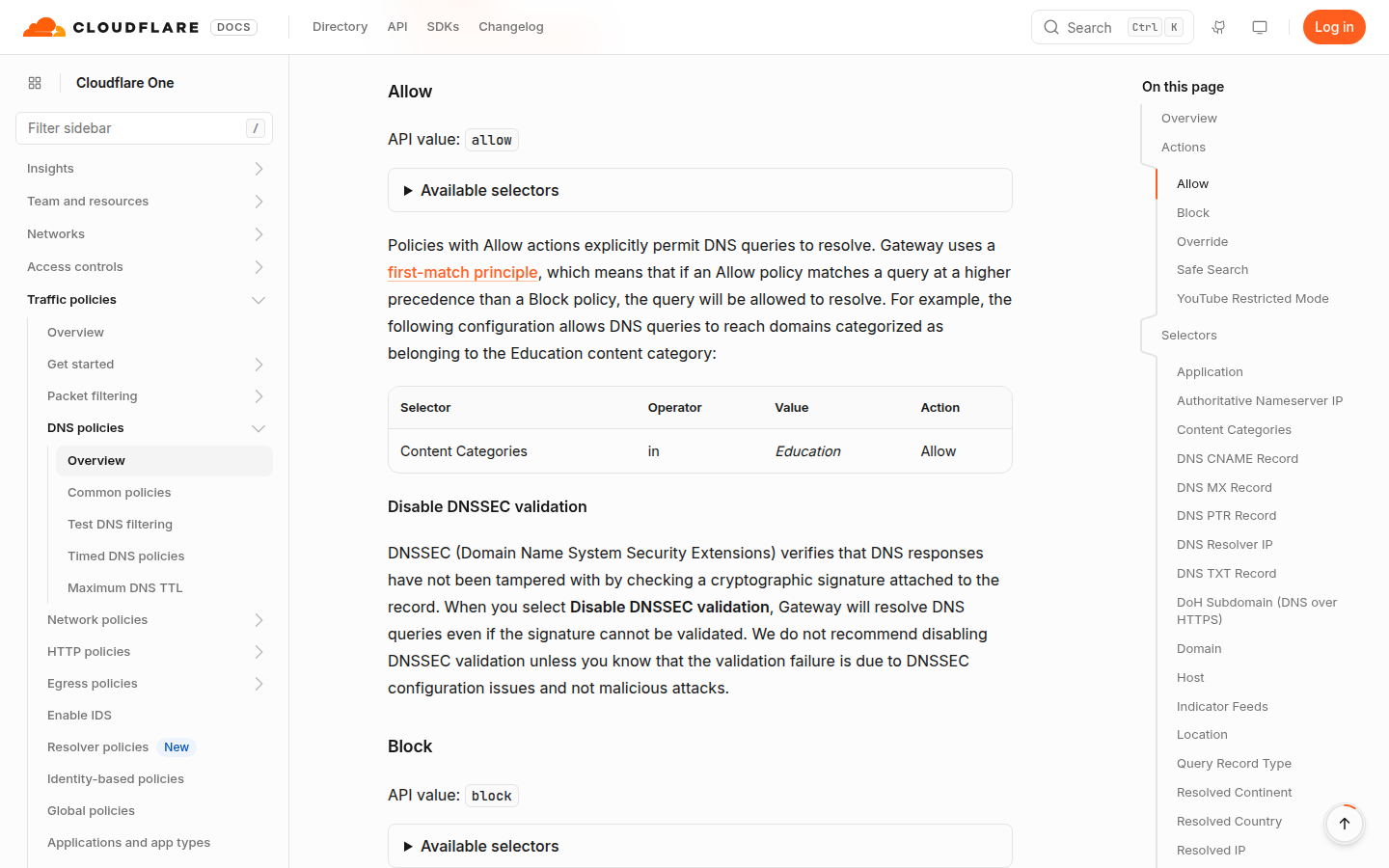
Gateway DNS policies sit in Cloudflare One. Overlap with ZTNA and the WAF estate is declared. Do not buy it twice.
If WARP is already on the laptop, start here. A category block is not malware analysis. Paid SKUs apply.
Key features
- DNS policies on the public docs
- Same Zero Trust tenant
- Categories
- Paid SKUs
Why we like it
The tenant already on the laptop is the first enterprise filter.
Limits
Cloudflare-shaped. Paid SKUs. A category block is not malware analysis.
Cisco Umbrella
Best for known enterprise recursive filter
Umbrella is the OpenDNS product under Cisco. Roaming client. Categories. Long enterprise memory.
If it is already the resolver, tune lists before you add NextDNS on the side. Another agent is the catch.
Key features
- Roaming resolver
- Categories they sell
- Cisco estate neighbor
- Commercial
Why we like it
The known enterprise recursive is the option a lot of fleets already point at.
Limits
Commercial. Another agent.
What we left out
- Quad9. People want a free public resolver with a blocklist and no box to staff. You do not operate the policy, so it failed the you-run-or-subscribe-with-a-profile check.
- AdGuard Home. Teams want another self-hosted filter they already run at home. Pi-hole already covers the lab filter job on this page.
Questions before you buy
If a first-party page cannot answer these, keep shopping.
- Does a known-bad fixture name I control fail to resolve on a laptop I own?
- Do we run the recursive, or are we buying a profile on someone else’s resolve path?
- Is the hole authentication of answers, refusal of names, or both?
Validate if you need authenticated answers. Filter if you need to refuse a name. They can sit on the same resolver.
FAQs
Does DNS filtering replace ZTNA?
No. DNS can refuse a name. ZTNA opens an app. Those are different jobs. Open the matching list for the other one.
Is Pi-hole enough at work?
For a lab, maybe. For a company fleet, you want logging, policy, and a support path.
Do I need DNSSEC if I filter?
Different jobs. DNSSEC authenticates answers. Filtering refuses names. You can want both.
Is this a scored bake-off?
No.