Best Security Data Pipeline Tools in 2026: 7 Compared
Seven tools that route, reduce, and reshape security telemetry before it reaches a SIEM or a data lake, without replacing either.
Cribl Stream’s pricing page, checked 12 Nov 2026, lists 0.32 credits per GB ingested on an Enterprise Cloud Worker, and states that one credit equals USD 1. That second meter is why teams put a pipeline in front of a SIEM or a lake: to change what arrives, not to replace the console they already query.
A security data pipeline, on this page, sits between telemetry sources and the SIEM or the data lake. It collects, reduces, reshapes, and routes events so the destination receives less volume, a cleaner schema, or both. It is not the SIEM, and it is not the log store. Those jobs are covered on our SIEM alternatives and log management tools pages.
Cribl and Tenzir are vendor-neutral routers. Splunk Edge Processor and Datadog Observability Pipelines are platform-native processors. DataBahn, Beacon, and Abstract Security are security data layers. Beacon announced a USD 13M seed round on 16 Jul 2026. Abstract announced a USD 25M Series A extension on 23 Jul 2026. Beacon and Abstract are launch-stage; their pipeline capabilities are launch claims, stated on their own sites rather than independently demonstrated.
How we evaluated
We read each vendor’s product pages, pricing or licensing pages, and public documentation on 12 Nov 2026, and checked each one against the same questions: where the pipeline sits, which destinations it documents, what reduction or schema work it performs, and how it is sold. Where public material does not cover a question, we write “not documented”.
| Tool | Best for | What to check |
|---|---|---|
| Vendor-neutral routers | ||
| Cribl | A vendor-neutral router in front of many destinations | 0.32 credits/GB Enterprise Cloud Worker; 1 credit = USD 1, plus infra |
| Tenzir | A vendor-neutral router you program on your own nodes | Community free, 1 TB/day ingress · paid editions by quote |
| Platform-native processors | ||
| Splunk Edge Processor | A platform-native processor at the edge when you already run Splunk | Included with Splunk Cloud Platform and Splunk Enterprise |
| Datadog Observability Pipelines | A platform-native processor that can dual-ship to a SIEM and to storage | USD 0.095 per ingested GB per month on annual billing |
| Security data layers | ||
| DataBahn | A security data layer that tiers high-value events to a SIEM and other data to cheaper storage | Quote |
| Beacon | A security data layer that normalizes telemetry and can detect in stream | Quote |
| Abstract Security | A security data layer for no-code collection, schema mapping, and routing | Quote |
Cribl
Tenzir
Splunk EP
Datadog OP
DataBahn
Beacon
Abstract
What each pipeline actually does
Each cell reflects what the vendor documents publicly. A gap means the public material does not name it, not that the product cannot help.
| Question | Cribl | Tenzir | Splunk EP | Datadog OP | DataBahn | Beacon | Abstract |
|---|---|---|---|---|---|---|---|
| Buying group | Vendor-neutral router | Vendor-neutral router | Platform-native processor, SIEM path | Platform-native processor, observability path | Security data layer | Security data layer | Security data layer |
| Where the control runs | Cloud Workers, or Hybrid Workers you run | Nodes in your environment in every edition | On-premises processors at the edge of your network | Observability Pipelines Worker in your infrastructure | SaaS, self-managed cloud, hybrid, or on-prem, as documented on DataBahn’s platform page | Documented as able to run engines in your cloud | SaaS, with a self-hosted offer on Abstract’s site |
| Destinations beyond one platform | Many destinations, any source, as documented | SIEM, data lake, object storage, and message buses | Splunk Cloud or Enterprise, S3, and Azure storage | Datadog, SIEM tools, and cloud storage, including Splunk HEC and S3 | SIEMs, UEBAs, analytics platforms, and data lakes or warehouses, as documented | SIEMs, data lakes, and agents, as stated | A SIEM, a data lake, or both, as stated |
| Security schema mapping | OCSF, ECS, UDM, and custom schemas | OCSF, plus ECS, CIM, UDM, and ASIM | SPL2 pipelines; a built-in OCSF map is not documented | OCSF streaming to security vendors or lakes, as documented | CIM, OCSF, CEF, UDM, or a custom format, as documented on Highway | Schema normalization across 150+ sources | OCSF, ECS, Splunk CIM, or a custom schema |
| Detection in the pipeline | Cribl Guard for sensitive data in motion, not a SIEM detection engine | Streaming detections, including Sigma rules, on moving data | Processing and routing, not a detection engine | Redaction, enrichment, and volume control, not a detection engine | Highway is documented for filter, normalize, and route; Autonomous In-Stream Data Intelligence was in private preview as of 24 Mar 2026 | Detection can run during the event, before the SIEM | In-stream detections are documented on the broader platform |
| Public price with a unit | 0.32 credits/GB Enterprise Cloud Worker; 1 credit = USD 1 | Community free up to 1 TB/day; paid editions by quote | Included with Splunk Cloud Platform and Splunk Enterprise | USD 0.095 per ingested GB per month on annual billing | Quote only | Quote only | Quote only |
Worked example: noisy flow logs, a copy in storage, and a reduced SIEM stream
A team has high-volume VPC flow or firewall logs plus EDR events. It wants to drop or aggregate the noisy flows, keep a copy in object storage, and send a reduced stream to the SIEM it already runs. Each cell is what the vendor documents for that step.
| Step | Cribl | Tenzir | Splunk EP | Datadog OP | DataBahn | Beacon | Abstract |
|---|---|---|---|---|---|---|---|
| Buying group | Vendor-neutral router | Vendor-neutral router | Platform-native processor, SIEM path | Platform-native processor, observability path | Security data layer | Security data layer | Security data layer |
| Reduce or filter volume before the SIEM | Strip unneeded fields or events before the destination meter | Deduplicate, sample, filter, and aggregate upstream of metered tools | SPL2 pipelines specify what to process before data leaves the network | Log Volume Control template filters low-value logs before they are stored | Filter or suppress irrelevant logs before they reach a SIEM, as documented on Highway | Cost optimization identifies what to optimize, aggregate, or keep | Pipeline and edge filtering drop, deduplicate, and aggregate, as stated |
| Keep a copy in object storage or a lake | Many destinations, including object storage, as documented | Route to data lakes and object storage, as documented | Amazon S3 (JSON and Parquet) and Azure Blob or Data Lake Storage | Archive Logs template to Amazon S3, Google Cloud Storage, or Azure Storage | Smart data tiering sends compliance or high-volume logs to cost-efficient storage, as documented | Routes to data lakes, as stated; a named object-storage destination is not documented | Route to a data lake; Abstract Lake is an adjacent store in your cloud, as stated |
| Send a reduced stream to a SIEM | Route processed data to any destination, including a SIEM | Route streams to SIEM and detection tools, including Splunk and Sentinel | Send processed data to Splunk Cloud Platform or Splunk Enterprise | Dual Ship and Split Logs templates, including Splunk HEC as a destination | Route high-value data to a SIEM or SOAR, as documented | Route to a SIEM, and detection can run before data lands there | Route high-signal events to a detection engine or SIEM, as stated |
Cribl
Best for a vendor-neutral router in front of many destinations
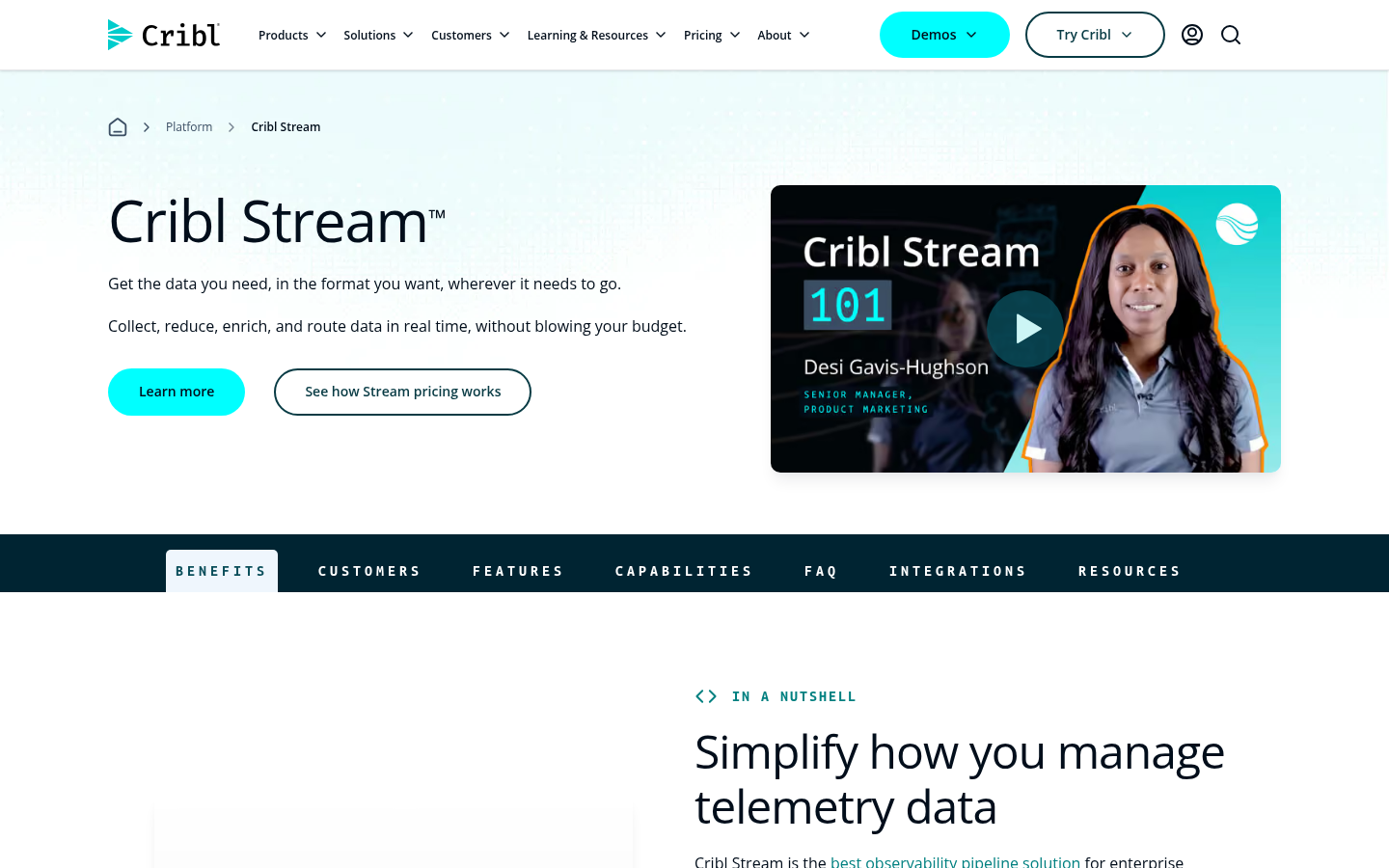
Cribl Stream collects, reduces, enriches, and routes telemetry from any source to any destination. The Stream pricing page states that you pay for ingress, not egress, so processed data can be sent to as many destinations as you need. The product page documents 80+ sources and destinations, portable Packs, and mapping to schemas including OCSF, ECS, and UDM.
Stream can run as Cloud Workers that Cribl manages, or as Hybrid Workers that you run. Cloud Workers also incur a separate, region-based infrastructure charge, published in credits per hour.
Key features:
- Any-source to any-destination routing
- Reduction by stripping unneeded fields or events before a SIEM or lake meter
- Schema mapping to OCSF, ECS, UDM, and custom schemas
- Cloud Workers or Hybrid Workers you run yourself
Why we like it:
Portable Packs and mapping to OCSF, ECS, and UDM let a team shape telemetry once and send it to the destinations it already runs.
Limits:
Stream is a router, not the SIEM or the lake you query. Cribl also sells Edge, Search, and Lake as adjacent products.
License or pricing: On Cribl Stream’s pricing page, checked 12 Nov 2026, Enterprise Cloud Workers are 0.32 credits per GB, Standard Cloud Workers are 0.27 credits per GB, and Enterprise Hybrid Workers are 0.26 credits per GB. One credit equals USD 1. Cloud Workers also incur infrastructure in credits per hour, which varies by region; AWS US East (N. Virginia) lists 1.3 credits per hour at 12 MB/s.
Tenzir
Best for a vendor-neutral router you program on your own nodes
Tenzir is a security data pipeline you program with TQL. You deploy nodes in your environment, and those nodes collect, parse, normalize, enrich, reduce, and route telemetry before it reaches a SIEM, a lake, or a bill. Tenzir’s datasheet documents mapping to OCSF, ECS, CIM, UDM, and ASIM, volume reduction by deduplicating, sampling, filtering, and aggregating, and routing to SIEMs, data lakes, object storage, and message buses.
In every edition, nodes run in your environment. For Community and Enterprise, Tenzir hosts the Platform in AWS in Europe. Sovereign is the edition that self-hosts the Platform, including air-gapped deployments. Streaming detections, including Sigma rules on moving data, are documented as a pipeline stage, not as a replacement SIEM.
Key features:
- TQL pipelines with 200+ operators, run on nodes you deploy
- Normalization to OCSF, with guided mappings for ECS, CIM, UDM, and ASIM
- Volume reduction and routing to SIEMs, data lakes, and object storage
- Streaming detections, including Sigma rules, before events land in a backend
Why we like it:
A typed pipeline language on nodes you run is the documented way to shape security telemetry in your own environment, including air-gapped deployments on Sovereign.
Limits:
Community does not include durable execution, HA, RBAC, or audit logs. Paid edition prices are not published.
License or pricing: On Tenzir’s pricing page, checked 12 Nov 2026, Community is free with 1 TB/day ingress, 1 TB edge storage, the Platform API, and community support. Enterprise and Sovereign are sold by quote. Enterprise adds RBAC, audit logs, external secrets, durable execution, HA, and 24×7 support. Sovereign adds a self-hosted platform, including air-gapped deployments, multiple platform instances, a custom identity provider, and dedicated support.
Splunk Edge Processor
Best for a platform-native processor at the edge when you already run Splunk
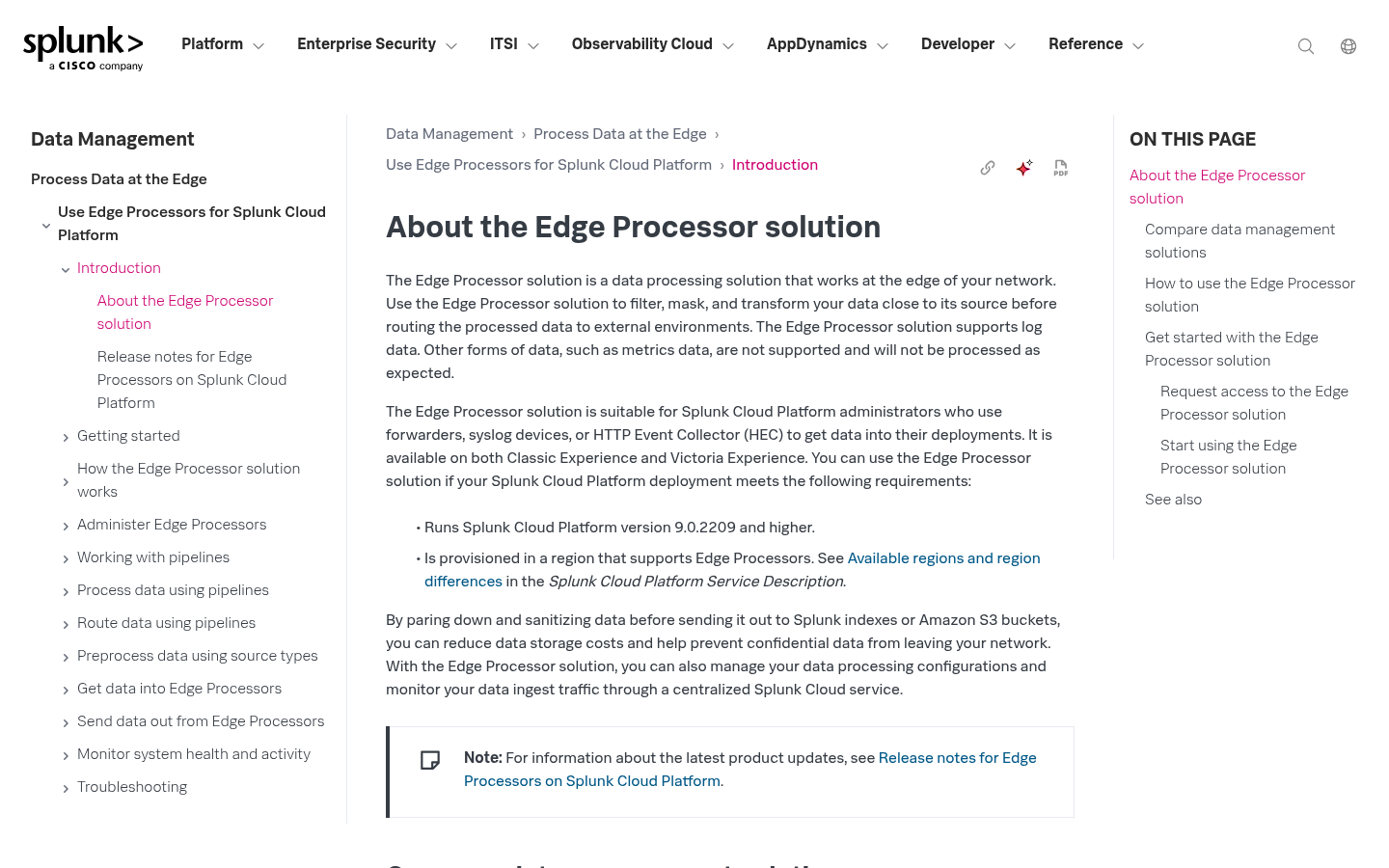
Splunk Edge Processor processes data with SPL2 at the edge of your network, before that data leaves for an external destination. Splunk’s data management docs state that Edge Processor is included with Splunk Cloud Platform and with Splunk Enterprise. On Cloud, a Splunk-managed service deploys and manages on-premises processors; on Enterprise, the control plane lives in your deployment.
Documented destinations include Splunk Cloud Platform, Splunk Enterprise, Amazon S3 (new-line JSON and Parquet), and Microsoft Azure Blob Storage and Azure Data Lake Storage, generally available with Splunk Cloud Platform 10.5.2605 or higher. Ingest Processor is the in-cloud counterpart, covered under License or pricing below.
Key features:
- SPL2 pipelines applied at the edge, before data leaves your network
- On-premises processors managed from Cloud or from a Splunk Enterprise control plane
- Destinations that include Splunk Cloud, Splunk Enterprise, Amazon S3, and Azure storage
- Ingest Processor as the in-cloud counterpart
Why we like it:
When the pipe is already Splunk, SPL2 at the edge is the documented way to filter and route before data leaves the network, without buying a second pipeline product first.
Limits:
Access on Cloud requires activation. Destinations are the Splunk path plus documented object storage, not a vendor-neutral catalog.
License or pricing: Splunk’s data management documentation, checked 12 Nov 2026, states that Edge Processor is included with Splunk Cloud Platform and with Splunk Enterprise. Ingest Processor Essentials is included with a Splunk Cloud Platform subscription up to 500 GB/day of incoming data. The Premier tier is priced for volumes over 500 GB/day; no public dollar rate is listed. See Data management solutions.
Datadog Observability Pipelines
Best for a platform-native processor that can dual-ship to a SIEM and to storage
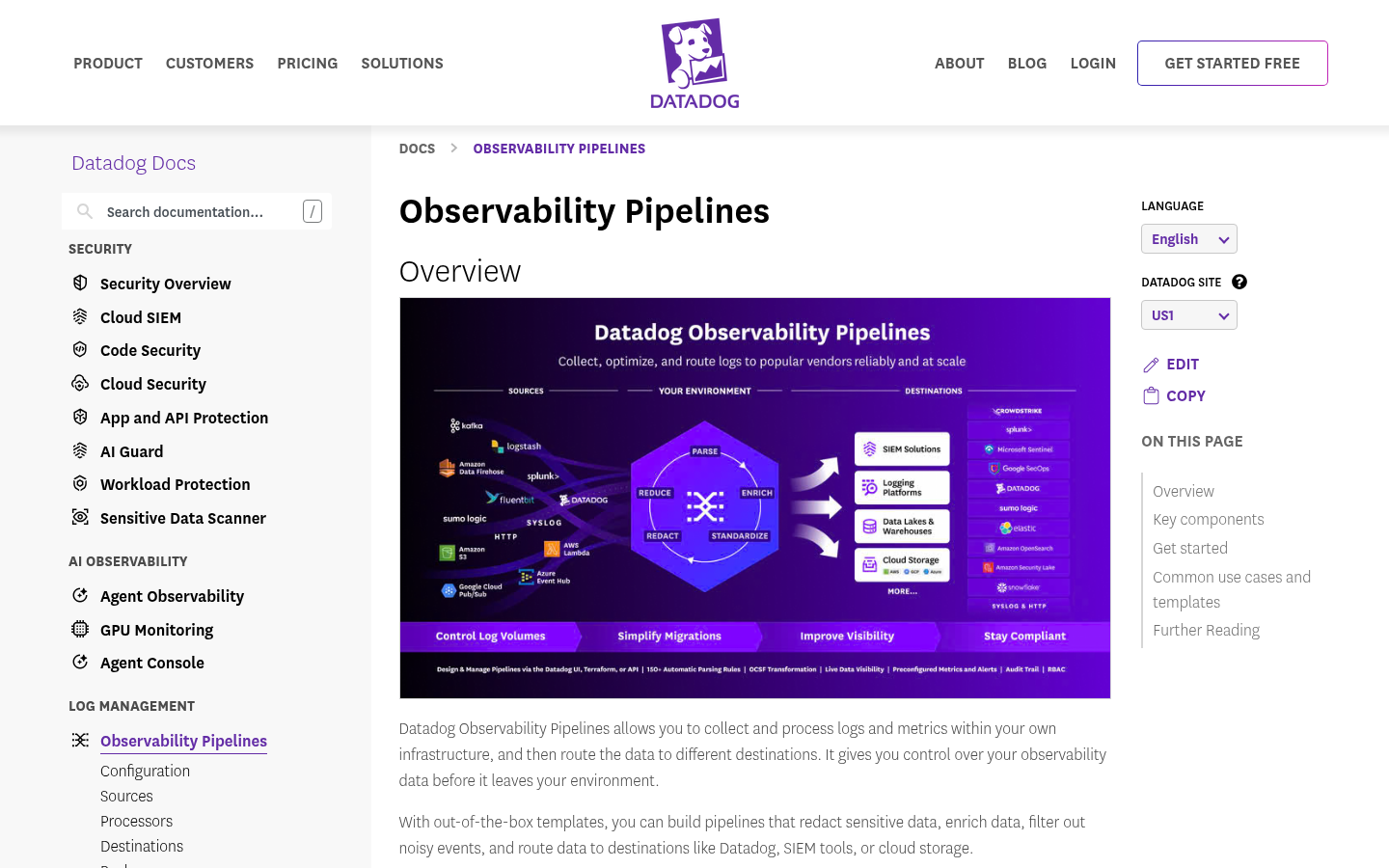
Datadog Observability Pipelines runs a Worker in your infrastructure to collect, process, and route logs and metrics before they leave your environment. Datadog’s docs describe out-of-the-box templates for redacting sensitive data, enriching events, filtering noisy logs, archiving to cloud storage, and dual-shipping the same stream to multiple destinations, including Datadog and a SIEM.
Documented destinations include Datadog, SIEM tools such as Splunk HTTP Event Collector, and cloud storage such as Amazon S3, Google Cloud Storage, and Azure Storage. Docs also describe streaming logs in OCSF to security vendors or data lakes.
Key features:
- Worker that runs in your infrastructure, with a central UI to build and deploy pipelines
- Templates for volume control, sensitive-data redaction, enrichment, archives, and dual shipping
- Routing to Datadog, SIEM tools, and cloud storage, including Splunk HEC and Amazon S3
- OCSF streaming to security vendors or data lakes, as documented
Why we like it:
A worker you run, plus templates for dual shipping and volume control, is the documented way to process telemetry in a Datadog path and still feed a SIEM or an archive.
Limits:
You still pay Datadog for the pipelines you run, including streams you send elsewhere. This SKU is an add-on, not a feature included at no extra charge with every Datadog contract.
License or pricing: On Datadog’s pricing list, checked 12 Nov 2026, Observability Pipelines is USD 0.095 per ingested GB per month on annual billing, USD 0.10 month-to-month, and USD 0.12 on-demand. The same list also shows Observability Pipelines Plus at USD 1,950 per vCPU per month on annual billing. Datadog’s Observability Pipelines pricing page, checked 12 Nov 2026, recommends that per-vCPU rate for volumes above 30 TB/month, billed annually per vCPU allocated to an Observability Pipelines Worker.
DataBahn
Best for a security data layer that tiers high-value events to a SIEM and other data to cheaper storage
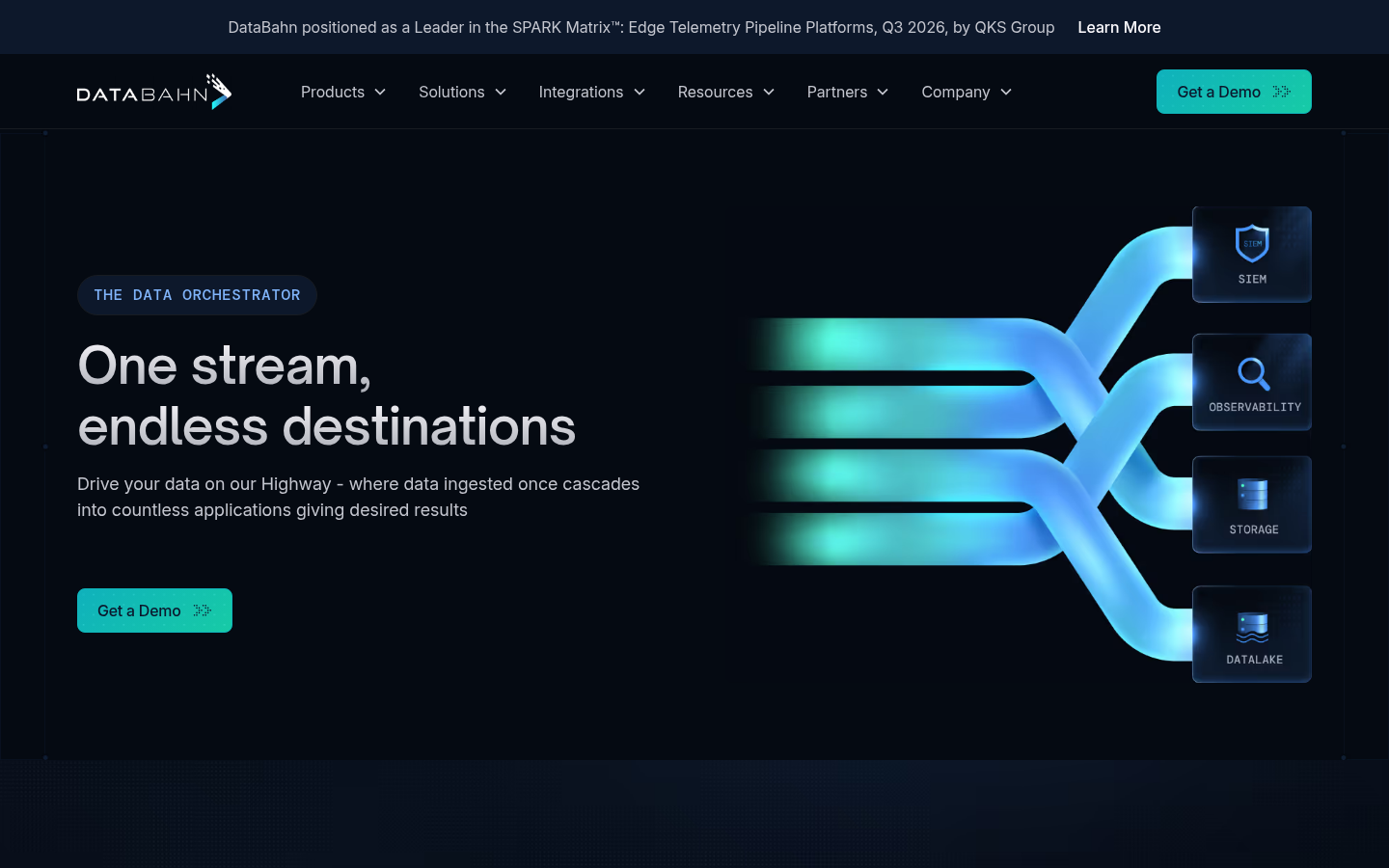
DataBahn Highway is a security data pipeline that collects telemetry once, then filters, normalizes, enriches, and routes it to the destinations you already run. The Highway page documents mapping to CIM, OCSF, CEF, UDM, or a custom format, and smart data tiering that sends high-value data to a SIEM or SOAR and other logs to cost-efficient storage.
The same vendor describes Highway as vendor-agnostic, with delivery to SIEMs, UEBAs, data lakes, and data warehouses. Sensitive-field detection and masking in motion is documented on DataBahn’s platform pages. Autonomous In-Stream Data Intelligence, announced on 24 Mar 2026, was in private preview on that date, so it is not the pipeline job this shortlist starts from.
Key features:
- Filter, normalize, enrich, and route telemetry on Highway
- Schema mapping to CIM, OCSF, CEF, UDM, or a custom format
- Smart data tiering to a SIEM or SOAR and to cost-efficient storage
- Vendor-agnostic delivery to SIEMs, lakes, and warehouses
Why we like it:
Smart data tiering plus mapping to CIM, OCSF, CEF, or UDM is the documented way to send a reduced, schema-aligned stream to a SIEM and keep the rest in cheaper storage.
Limits:
Autonomous In-Stream Data Intelligence was in private preview as of 24 Mar 2026. Federated search and other control-plane features sit beside this pipeline cut. List pricing is not published.
License or pricing: No public list price with a defined unit on DataBahn’s own site, checked 12 Nov 2026. Sold by quote.
Beacon
Best for a security data layer that normalizes telemetry and can detect in stream

Beacon documents a security data layer, Agent Lake, that collects, normalizes, enriches, and routes telemetry so analysts and agents reason on a consistent picture. The product pages state native collection and schema normalization across 150+ sources, cost optimization that identifies what to optimize, aggregate, or keep, and in-stream detection that can run during the event, before data lands in a SIEM.
The same pages describe routing to SIEMs, data lakes, and AI agents, coverage-gap detection for uncollected sources or broken pipelines, and an agent runtime with MCP, CLI, and API.
Key features:
- Collection and schema normalization across 150+ sources
- Cost optimization that identifies what to aggregate, keep, or drop
- In-stream detection before data lands in a SIEM
- Routing to SIEMs, data lakes, and agents, plus coverage-gap detection
Why we like it:
Normalization across a large source catalog, plus detection that can run in stream, is the documented way to make telemetry usable for analysts or agents before it hits a SIEM meter.
Limits:
Several capabilities, including reduction figures, are stated on Beacon’s own site. The product also includes an agent runtime and shadow-AI discovery, which sit beside the pipeline cut on this page.
License or pricing: No public list price with a defined unit. Sold by demo and quote.
Abstract Security
Best for a security data layer with no-code collection and routing to a SIEM or lake
Abstract documents pipelines that collect from cloud, SaaS, network, endpoint, and identity sources, then normalize, enrich, filter, mask, and route events to a SIEM, a data lake, or both. The pipelines page states automatic mapping to OCSF, ECS, Splunk CIM, or a custom schema, in-stream enrichment such as Geo-IP, asset ownership, identity, and threat intelligence, and PII masking before data lands anywhere.
The same page states that pipeline and edge filtering drop low-value events, deduplicate alerts, and aggregate noisy sources, reducing volume by 70-80% on average, as claimed by Abstract.
Key features:
- Collection from cloud, SaaS, network, endpoint, and identity sources
- Normalization to OCSF, ECS, Splunk CIM, or a custom schema
- In-stream enrichment, PII masking, and filtering at the pipeline or the edge
- Routing to a SIEM, a data lake, or both, without code, as stated
Why we like it:
No-code collection with automatic mapping to OCSF, ECS, or CIM is the documented way to shape events once and fan them to a SIEM or a lake.
Limits:
Volume-reduction figures are vendor-stated. Independent validation is not documented. In-stream detections and Abstract Lake sit outside this pipeline cut.
License or pricing: No public list price with a defined unit on Abstract’s own site. Sold by quote.
How to choose a security data pipeline
- If you need a vendor-neutral router in front of destinations you already picked. Cribl Stream documents any-source to any-destination routing, with portable Packs and published credit rates per GB. Tenzir documents programmable TQL pipelines on nodes you run, including a free Community edition and a Sovereign edition for a self-hosted platform.
- If you already run Splunk or Datadog and want to process data in that path. Splunk documents Edge Processor as included with Splunk Cloud Platform and Splunk Enterprise, with SPL2 at the edge and destinations that include Splunk, S3, and Azure storage. Datadog Observability Pipelines documents a worker in your environment, volume-control and dual-ship templates, and a published per-GB rate.
- If you need a security data layer that normalizes and enriches for analysts or agents. DataBahn Highway documents mapping to CIM, OCSF, CEF, or UDM, and smart data tiering that sends high-value data to a SIEM or SOAR and other logs to cost-efficient storage. Beacon documents collection and schema normalization across 150+ sources, cost optimization, and detection that can run in stream. Abstract’s pipelines document no-code collection, mapping to OCSF, ECS, or CIM, and routing to a SIEM or a lake.
- Keep the SIEM and the lake on their own lists. A pipeline changes what arrives. It does not replace the console you hunt in, or the store you keep. Use our SIEM alternatives and log management tools pages for those jobs.
What we left out
- Vector: already covered on our log management tools page as the shipper you run, under MPL-2.0.
- Fluent Bit: a forwarder already discussed on that log management page, not a managed security pipeline product in this shortlist.
- Logstash and Elastic ingest pipelines: Elastic Security already sits on our SIEM alternatives list. This is SIEM-side ingest, not a standalone pipeline entry.
- Cribl Edge: the collector that runs at the source. Cribl Stream is the pipeline product compared above.
- Splunk Ingest Processor: the in-cloud companion, covered in the Splunk Edge Processor entry.
- Mezmo: a log management product. The log management tools page is the right list.
- Microsoft Sentinel data collection rules and Azure Monitor Agent: native Sentinel ingest, not a standalone pipeline product. Sentinel itself is on the SIEM alternatives list.
- Observo AI and Onum: AI-assisted security pipelines that SentinelOne and CrowdStrike have since acquired. They are now sold inside those platforms, as Singularity AI Data Pipelines and Falcon Onum, so evaluate them with those vendors.
- Edge Delta sells telemetry pipelines together with its own observability backend for logs, metrics, traces, and events, rather than as a processor on a SIEM or observability platform you already run. This shortlist is the security-telemetry cut in front of a SIEM or lake you already picked.
What public docs say about processing data first
The argument is not whether a SIEM can index everything. It is what should be filtered, reshaped, or copied before that meter, or before data leaves the environment.
Microsoft Learn, Best practices for data collection in Microsoft Sentinel
“You might want to filter the logs collected, or even log content, before the data is ingested into Microsoft Sentinel.”
The same page says filtering can drop logs that are irrelevant to security operations, and that filtering message content can help drive down costs on high-volume sources such as Syslog, CEF, or Windows logs.
Splunk Docs, About the Edge Processor solution, last updated 3 Oct 2026
“By using the Edge Processor solution, you can process data in your own local network while also managing and monitoring your data ingest ecosystem from a Splunk-managed cloud service.”
Splunk’s companion data-management page states that Edge Processor is included with Splunk Cloud Platform and with Splunk Enterprise, which is why it sits in the platform-native group on this list.
Datadog Docs, Observability Pipelines
“It gives you control over your observability data before it leaves your environment.”
The same overview documents templates for volume control, sensitive-data redaction, archives in cloud storage, and dual shipping to destinations such as Datadog and a SIEM.
Choose a vendor-neutral router when the job is to reduce and send telemetry to destinations you already picked, and a platform-native processor when you already run Splunk or Datadog and want to process data in that path. Choose a security data layer, DataBahn, Beacon, or Abstract, when the job is normalized, enriched telemetry for analysts or agents, still in front of the SIEM or lake. Beacon and Abstract are launch-stage: pilot them against a week of your own sources before you treat the reduction figures as a budget input.
FAQs
What is a security data pipeline, and how is it different from a SIEM?
A security data pipeline sits between sources and the SIEM or the lake. It collects, reduces, reshapes, and routes telemetry so the destination receives less volume, a cleaner schema, or both. The SIEM is where you detect and investigate. A pipeline does not replace that console.
Why does Cribl appear here and on the log management list?
The log management page treats Cribl Stream as the commercial router you put in front of a store you already query. This shortlist compares Stream on the pipeline job only: routing, reduction, and schema work before a SIEM or a lake, alongside vendor-native processors and security data layers.
If we already pay for Splunk or Datadog, do we still need an independent pipeline?
Not automatically. Splunk documents Edge Processor as included with Splunk Cloud Platform and Splunk Enterprise, and Datadog sells Observability Pipelines as a metered product that can also dual-ship to a SIEM and to object storage. An independent router such as Cribl or Tenzir, or a security data layer such as DataBahn, Beacon, or Abstract, is the fit when you need that control in front of destinations those processors are not built to feed first.
Do these pipelines replace a SIEM or a data lake?
No. They change what arrives at a SIEM or a lake you already run, or that you choose next. Some vendors also sell detections or a lake as adjacent products; those pieces still leave the pipeline in front of the console you hunt in, not in place of it.
What does public pricing look like in this category?
Cribl Stream publishes credit rates per GB ingested, with one credit equal to USD 1, plus a region-based infrastructure charge for Cloud Workers, checked 12 Nov 2026. Datadog Observability Pipelines publishes USD 0.095 per ingested GB per month on annual billing. Tenzir Community is free up to 1 TB/day of ingress; Enterprise and Sovereign are quoted. Splunk Edge Processor is included with Splunk Cloud Platform and Splunk Enterprise. DataBahn, Beacon, and Abstract are sold by quote.
Where do Vector and Fluent Bit fit?
They are shippers, not the managed pipelines on this shortlist. Vector is already covered on our log management tools page as the agent you run. Fluent Bit is discussed there as a forwarder. Use them as collection points into a pipeline, not as a substitute for the products above.