Best Product Security Platforms in 2026: 7 Tools for What You Ship
Seven tools that analyze the firmware a manufacturer ships, or manage the SBOM and compliance evidence around it, before a connected product leaves the factory.
A firmware image frozen 24 hours before shipment can still hide a statically linked library that never appeared in the supplier SBOM. Product security for device manufacturers is the work of finding what is actually in that image, deciding which vulnerabilities matter, and keeping SBOM, VEX, and regulatory evidence current before and after the product ships.
Application security and ASPM look at the code you write. SCA inventories packages in a build. An SBOM tool stores a bill of materials. IT/OT platforms watch devices already on a network. None of those, on its own, answers whether a library is in the firmware you will flash, or whether you have ISO 21434, FDA, or EU CRA evidence for that product.
The seven platforms below approach that work from different angles. We start with LG Cybellum, an established product security platform for device manufacturers, because its product pages document a single workflow from SBOM creation through vulnerability triage, regulatory evidence, and PSIRT. Finite State, which raised a USD 27 million Series C on 10 Nov 2026, focuses on binary firmware analysis. Capabilities below are vendor-stated.
How we evaluated
We read each vendor’s product pages, documentation, and pricing pages on 12 Nov 2026, and checked each one against the same questions: what artifact it analyzes or ingests, what SBOM or VEX it produces, what regulatory evidence it claims to generate, and how it helps after a product ships. Capabilities are vendor-stated unless noted.
| Tool | Best for | What to check |
|---|---|---|
| LG Cybellum | SBOM, vuln, compliance, and PSIRT in one manufacturer workflow | Quote-based |
| Finite State | Firmware and supplier inputs to living SBOMs, VEX, and evidence packs | Quote-based |
| NetRise Turbine | Binary-derived SBOM from compiled firmware, no source required | Quote-based |
| ONEKEY | Firmware analysis plus a Compliance Wizard for CRA and related standards | Quote-based |
| Binarly | Binary-derived SBOM and reachability on compiled firmware | Quote-based |
| Cybeats SBOM Studio | Product Release SBOMs as a system of record, with VEX and sharing | Quote-based |
| Medcrypt | Medical-device SBOM, vuln, and FDA postmarket evidence | From USD 35,000 per product line per year |
Cybellum
Finite State
NetRise
ONEKEY
Binarly
Cybeats
Medcrypt
Capability matrix: firmware, SBOMs, and evidence
Each cell restates what the vendor documents on the product or documentation pages cited in its entry. Uncited claims are omitted; if a product does not document a capability, the cell says so in a full sentence.
| Cybellum | Finite State | NetRise | ONEKEY | Binarly | Cybeats | Medcrypt | |
|---|---|---|---|---|---|---|---|
| What it analyzes or ingests | Binaries, source code, and uploaded SBOM files, merged into one inventory | Firmware, binaries, source, and supplier SBOMs | Compiled firmware or software images, without requiring source | Firmware images, without source, device access, or a network connection | Compiled firmware and software, without source | Product Release SBOMs and related SBOM files; firmware unpacking from a raw image is not documented as SBOM Studio’s job | SBOMs and vulnerability data for medical devices; firmware unpacking from a raw image is not documented as Helm’s core job |
| SBOM and VEX | High-fidelity SBOMs from merged binaries, source, and uploaded files, with validation and approval | SBOMs and VEX documents produced from the ingested artifacts, including living SBOMs after shipment | A binary-derived SBOM from the compiled image | SBOM export in CycloneDX and SPDX, with VEX | A binary-derived SBOM, which can be compared with a supplier declaration | Product Release SBOMs in SPDX and CycloneDX, held as a system of record, with VEX | SBOM management in Helm, as part of medical-device vulnerability work |
| A newly published CVE | Automatic detection and triage of product vulnerabilities and coding weaknesses, as Cybellum describes it | Reachability results plus updates to living SBOMs and evidence, as the platform page describes | Vulnerability inventory and reachability from the compiled artifact, plus secrets and keys found in the image | Vulnerability findings on the analyzed firmware image | Presence in the derived SBOM, plus reachability analysis in the compiled code | Vulnerability enrichment against the Product Release SBOM, with VEX you can share | Vulnerability management in Helm, aimed at medical-device and FDA workflows |
| Regulatory evidence | Regulator-ready evidence for FDA PMA, ISO 21434, and CRA, plus custom policies, and a stated set that includes ISO, FDA, UNECE, and 50+ other standards | Evidence packs aimed at CRA and FDA filings | A full CRA or FDA evidence-pack workflow is not documented on the public Turbine pages we reviewed | Compliance Wizard reports for CRA, IEC 62443, EN 18031, and ETSI 303 645 | A full multi-regulation evidence suite is not the focus of the public pages we reviewed; the documented output is analysis, a derived SBOM, and related findings | Manufacturer-oriented CRA workflow as Cybeats describes it, through SBOM, VEX, and sharing rather than a firmware compliance wizard | FDA-ready reports; FDA is what the platform covers today, with other regulators described as in development |
| After the product ships | PSIRT monitoring of threat sources and support for investigations after launch | Living SBOMs described as staying current in the field | Post-market evidence packs are not documented on the public Turbine pages we reviewed; the documented job is analysis of the compiled image | The documented Compliance Wizard runs against the analyzed firmware; a separate PSIRT module is not documented on the public pages we reviewed | A dedicated PSIRT module is not documented on the public pages we reviewed; the documented job is analysis and transparency of compiled artifacts | Product Release SBOMs held as a system of record that can be enriched and shared after release | Postmarket monitoring for medical devices, as Medcrypt describes it |
Worked example: a release-candidate firmware image and a new CVE
You have a release-candidate firmware image and a supplier SBOM that may be incomplete. A new CVE is published against a library that may be statically linked in the image. Here is what each product documents that it would do, and what evidence you could take forward.
None of the vendors publishes this exact scenario; the cells restate capabilities from the entries below.
| What it does with the firmware or SBOM | Evidence you can take forward | |
|---|---|---|
| LG Cybellum | Merges the firmware binary, any available source, and the supplier SBOM into one product inventory, then triages the new CVE against that inventory | Updated SBOM plus regulator-ready evidence for the frameworks in your edition, such as CRA, FDA PMA, or ISO 21434, and a PSIRT path if the product is already in the field |
| Finite State | Ingests the firmware image, related binaries or source, and the supplier SBOM, then applies reachability to the new CVE | Updated SBOMs and VEX, plus an evidence pack aimed at CRA or FDA filings, including a living SBOM if the product has already shipped |
| NetRise Turbine | Analyzes the compiled firmware image without source and inventories components, vulnerabilities, secrets, and keys, with reachability on the new CVE | A binary-derived SBOM and analysis findings; a regulator-ready CRA or FDA evidence pack is not documented on the public Turbine pages we reviewed |
| ONEKEY | Analyzes the firmware image without source, device access, or a network connection, and maps findings to the new CVE | CycloneDX or SPDX SBOM and VEX, plus a Compliance Wizard report for CRA or a related standard in your edition |
| Binarly | Analyzes the compiled firmware, derives an SBOM, compares it with the supplier declaration, and checks whether the new CVE is reachable in the binary | A binary-derived SBOM, a supplier-declaration comparison, and a reachability result for the CVE |
| Cybeats SBOM Studio | Works from a Product Release SBOM; if you only have a raw firmware image, ingesting that image is not documented as SBOM Studio’s job, so a derived SBOM would need to come from an analysis tool first | An enriched Product Release SBOM and VEX you can share with a customer, once that SBOM exists in the system of record |
| Medcrypt | Works from the SBOM and vulnerability data in Helm; firmware unpacking from a raw image is not documented as Helm’s core job, so a raw image would need an analysis step first | FDA-ready reports and postmarket documentation for a medical device; FDA is what the platform covers today |
This is our illustration of a common pre-shipment and post-shipment day, not a vendor-published walkthrough of this incident.
LG Cybellum
Best for a manufacturer workflow that runs SBOM, vulnerability, compliance, and PSIRT from one inventory
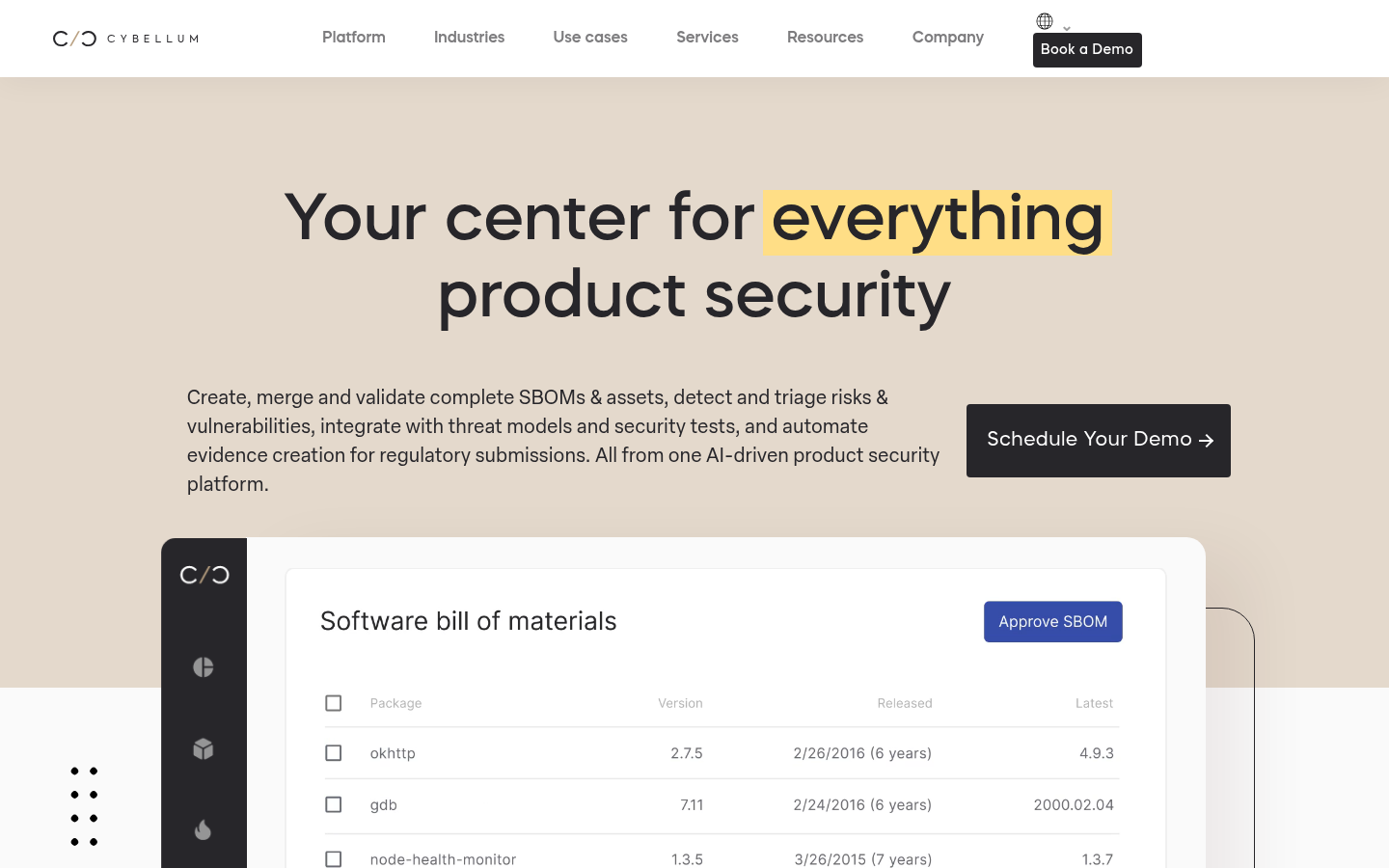
Cybellum, part of LG Electronics and still sold under the Cybellum name, describes a product security platform that brings SBOM and asset management, assurance and vulnerability management, product risk, cyber compliance, and product security incident response into one workflow for device manufacturers.
SBOMs are created by merging binaries, source code, and uploaded SBOM files, then validated and approved across teams. Compliance pages describe regulator-ready evidence for FDA PMA, ISO 21434, and CRA, plus custom policies, and the company also states support for ISO, FDA, UNECE, and 50+ other standards. PSIRT is described as monitoring threat sources and supporting investigations after launch.
Key features:
- SBOMs created by merging binaries, source code, and uploaded SBOM files
- Vulnerability and coding-weakness triage, with intake from threat models and tests
- Regulator-ready evidence for FDA PMA, ISO 21434, CRA, and custom policies
- PSIRT monitoring and investigation after a product launches
Why we like it:
It merges binaries, source, and uploaded SBOMs into one inventory, so compliance and PSIRT teams work from the same product file.
Limits:
Pricing is quote-based, and public pages describe industry-specific packaging without a single public list price. Confirm which standards and reports are in the edition you would buy.
License or pricing: Quote-based. Cybellum’s public product pages do not list a USD price, checked 12 Nov 2026.
Finite State
Best for turning firmware and supplier inputs into living SBOMs, VEX, and CRA or FDA evidence
Finite State’s Product Security OS, as the platform page describes it, ingests firmware, binaries, source, and supplier SBOMs and produces SBOMs, VEX documents, reachability results, and evidence packs aimed at CRA and FDA filings.
The same pages describe living SBOMs that stay current after a product is in the field, so post-market monitoring is part of the documented workflow rather than a one-time pre-shipment scan. Packaging and edition details are not on the public platform page.
Key features:
- Ingests firmware, binaries, source, and supplier SBOMs
- Produces SBOMs, VEX, and reachability results
- Evidence packs aimed at CRA and FDA filings
- Living SBOMs described as staying current after shipment
Why we like it:
It turns the firmware and supplier inputs you already have into SBOMs, VEX, and audit-ready evidence that can stay current after shipment.
Limits:
Pricing is quote-based, and edition details are not on the public platform page. Ask to see an evidence pack produced from a firmware image and an incomplete supplier SBOM.
License or pricing: Quote-based. Finite State’s public platform pages do not list a USD price, checked 12 Nov 2026.
NetRise Turbine
Best for a binary-derived SBOM and reachability when you do not have source
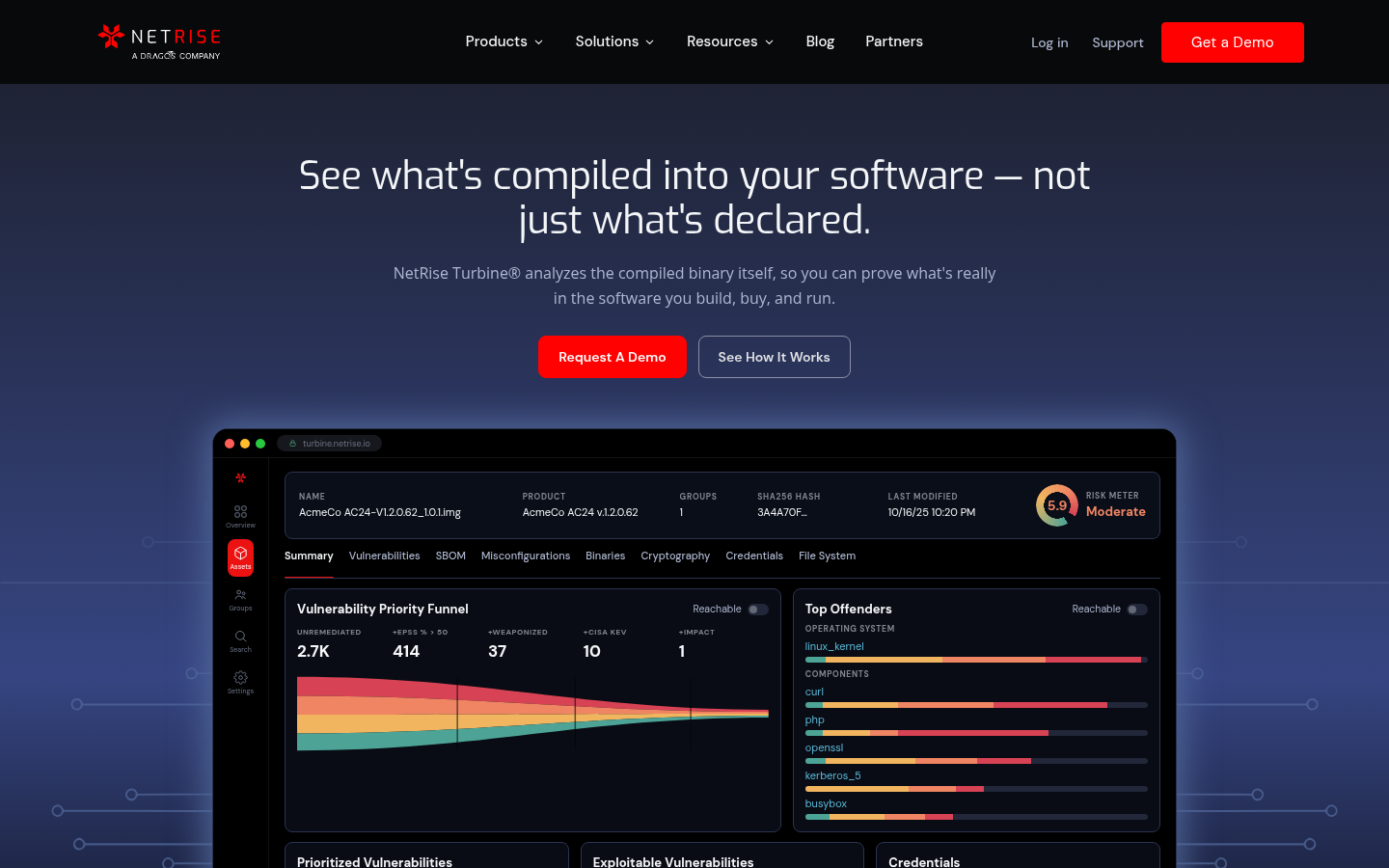
NetRise Turbine is documented as a product that builds a software bill of materials from a compiled firmware or software image, without requiring source. Dragos acquired NetRise on 21 September 2026; the product is still offered under the NetRise Turbine name.
The Turbine pages describe component and vulnerability inventory from that compiled artifact, plus reachability and discovery of secrets and keys in the image. Public pages we reviewed do not present a full CRA or FDA evidence-pack workflow of the kind Finite State and Cybellum describe, so confirm what report you would actually file.
Key features:
- Binary-derived SBOM from a compiled firmware or software image, no source required
- Component and vulnerability inventory from the compiled artifact
- Reachability to help tell what is exploitable
- Discovery of secrets and keys in the image
Why we like it:
It builds a bill of materials from the compiled image, which matters when a supplier will not give you source.
Limits:
A full CRA or FDA evidence-pack workflow is not documented on the public Turbine pages we reviewed. Pricing is quote-based.
License or pricing: Quote-based. NetRise’s public Turbine pages do not list a USD price, checked 12 Nov 2026.
ONEKEY
Best for firmware analysis with a Compliance Wizard for CRA and related standards
ONEKEY, formerly IoT Inspector, describes a firmware analysis platform that works without source code, device access, or a network connection to the product. The analysis produces vulnerability findings and SBOMs in CycloneDX and SPDX, with VEX support documented on the product pages.
The Compliance Wizard is documented against the EU Cyber Resilience Act, IEC 62443, EN 18031, and ETSI 303 645. That is a standards-walkthrough on the analyzed image, not a medical-FDA specialist workflow. Confirm which wizard reports are in the edition you would buy.
Key features:
- Firmware analysis without source, device access, or a network connection
- SBOM export in CycloneDX and SPDX, with VEX
- Compliance Wizard for CRA, IEC 62443, EN 18031, and ETSI 303 645
- Vulnerability findings on the analyzed firmware image
Why we like it:
It analyzes firmware without source or device access and walks the same image against CRA and related standards in one wizard.
Limits:
The documented compliance set is CRA and related technical standards, not a medical-device FDA evidence workflow. Pricing is quote-based.
License or pricing: Quote-based. ONEKEY’s public platform pages do not list a USD price, checked 12 Nov 2026.
Binarly
Best for a binary-derived SBOM and reachability checks on compiled firmware
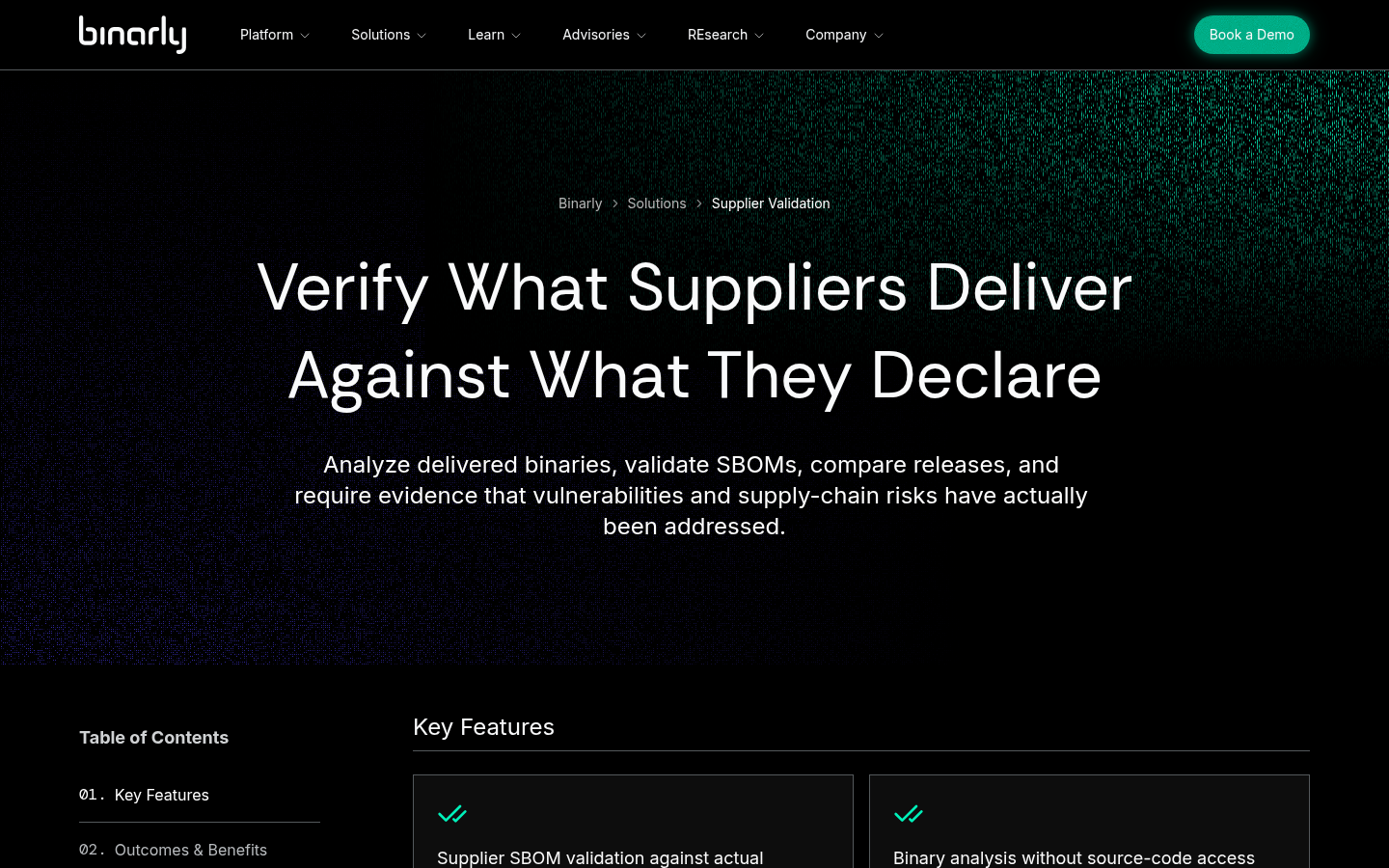
Binarly’s Transparency Platform is documented as analyzing compiled software and firmware without source, then producing a binary-derived SBOM and inspecting components, vulnerabilities, cryptographic assets, and secrets in that image.
Documentation also describes reachability analysis, so a CVE that is present in a component can be checked for whether it is reachable in the compiled code, and a derived SBOM can be compared with a supplier declaration. Public pages we reviewed emphasize analysis and transparency rather than a full PSIRT or multi-regulation evidence suite.
Key features:
- Analysis of compiled firmware and software without source
- Binary-derived SBOM from the compiled image
- Reachability analysis for vulnerabilities in that binary
- Comparison of a derived SBOM against a supplier declaration
Why we like it:
It derives a ground-truth SBOM from compiled firmware and checks whether a CVE is reachable in that binary, not only listed in a component.
Limits:
A full PSIRT and multi-regulation evidence suite of the kind Cybellum documents is not the focus of the public pages we reviewed. Pricing is quote-based.
License or pricing: Quote-based. Binarly’s public product and documentation pages do not list a USD price, checked 12 Nov 2026.
Cybeats SBOM Studio
Best for a manufacturer SBOM system of record, with VEX and customer sharing
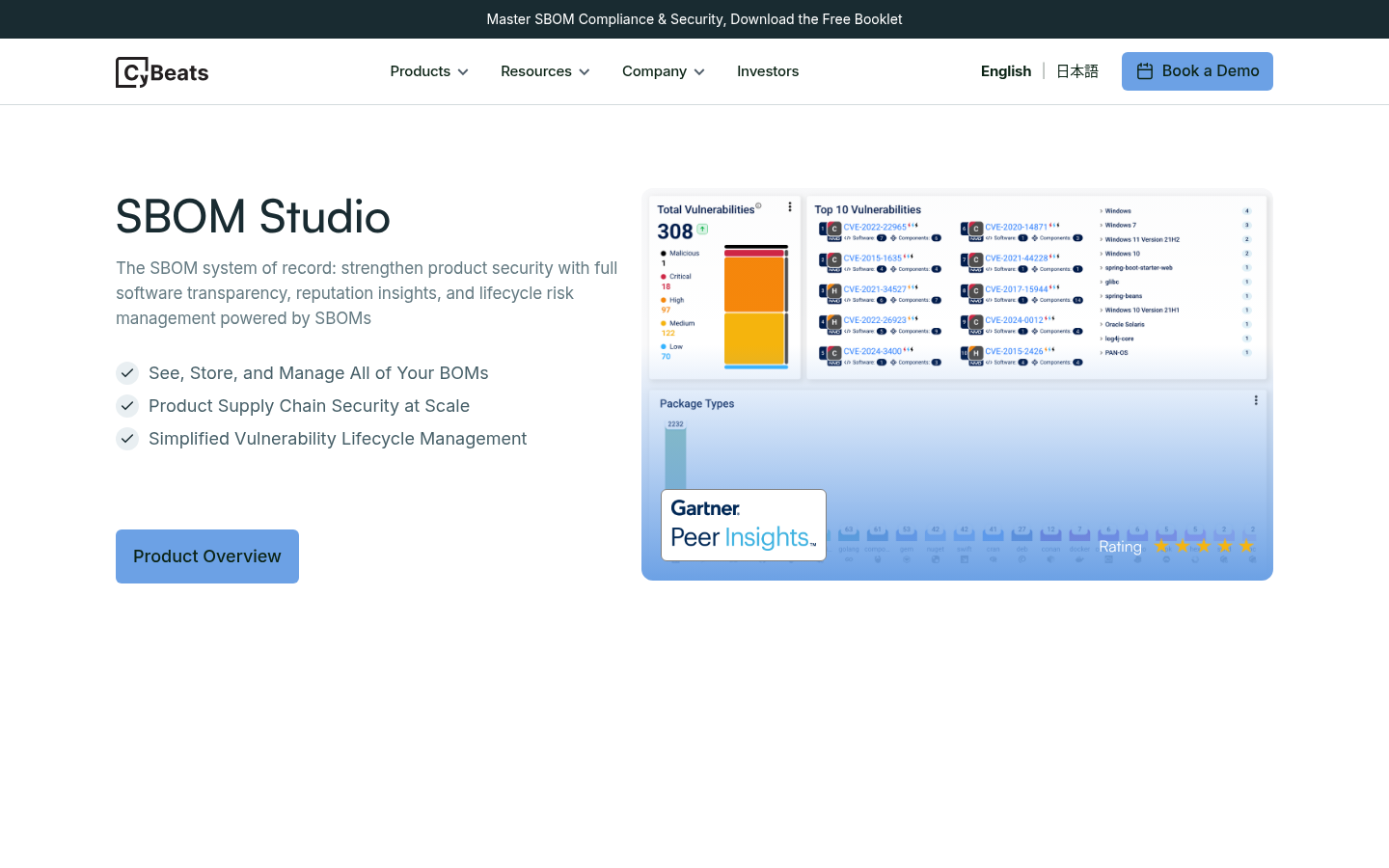
Cybeats SBOM Studio is documented as a system of record for Product Release SBOMs, including SPDX and CycloneDX formats, vulnerability enrichment, VEX, and sharing with customers. Product Release SBOMs are described as immutable commits, which is a lifecycle-management model rather than a firmware-unpacking model.
The company discusses manufacturer obligations under the EU Cyber Resilience Act on its product pages. Firmware unpacking from a raw image is not documented as SBOM Studio’s job, so you would still need an analysis product if the supplier SBOM is incomplete or missing.
Key features:
- Product Release SBOMs held as a system of record, including SPDX and CycloneDX
- Vulnerability enrichment and VEX
- Sharing SBOMs with customers
- Manufacturer-oriented CRA workflow as Cybeats describes it
Why we like it:
It keeps Product Release SBOMs as a system of record you can enrich, issue VEX against, and share with customers.
Limits:
Firmware unpacking from a raw image is not documented as SBOM Studio’s job. If you only have a firmware binary and no SBOM, this is not the first product to run.
License or pricing: Quote-based. Cybeats’ public SBOM Studio pages do not list a USD price, checked 12 Nov 2026.
Medcrypt
Best for medical-device SBOM, vulnerability, and FDA postmarket evidence
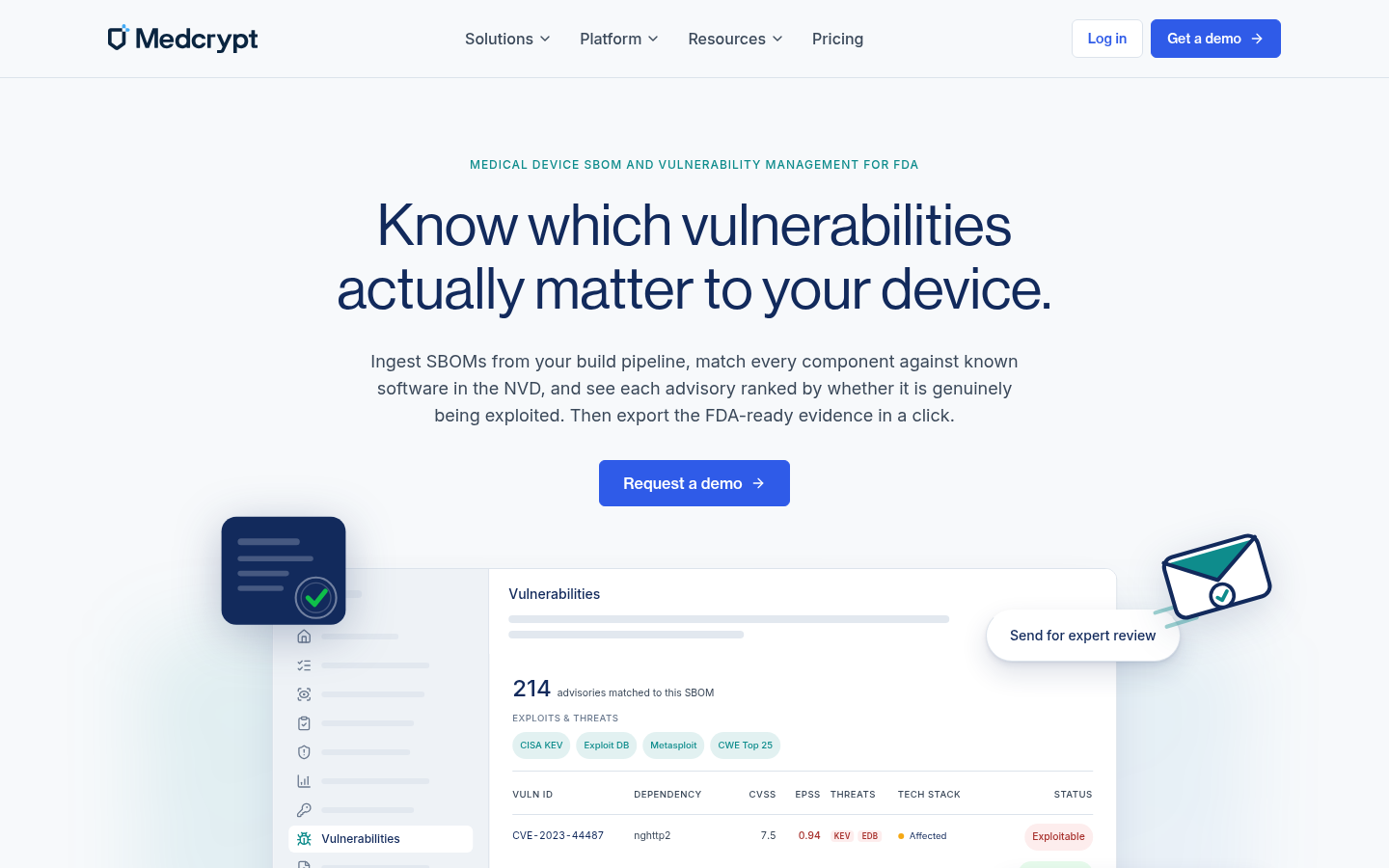
Medcrypt’s Helm, included with the Medical Security Intelligence plan, is documented as SBOM and vulnerability management for medical devices, with FDA-ready reports and postmarket monitoring. The company states that FDA is what the platform covers today, with other regulators in development.
The public pricing page lists Medical Security Intelligence from USD 35,000 per product line per year, including Helm and 15 advisory hours, and offers a free security review, checked 12 Nov 2026. Firmware unpacking from a raw image is not documented as Helm’s core job; some customers, as Medcrypt describes it, keep an existing scanner and use Medcrypt for the work around it.
Key features:
- Helm SBOM and vulnerability management for medical devices
- FDA-ready reports and documentation support
- Postmarket monitoring
- 15 advisory hours on the Medical Security Intelligence plan
Why we like it:
Helm keeps medical-device SBOMs and vulnerabilities in a form you can take into FDA postmarket work.
Limits:
FDA is what the platform covers today; other regulators are described as in development. Firmware unpacking from a raw image is not documented as Helm’s core job.
License or pricing: Medical Security Intelligence starts at USD 35,000 per product line per year, includes Helm SBOM and vulnerability management and 15 advisory hours, and offers a free security review, per Medcrypt’s pricing page, checked 12 Nov 2026.
How to choose a product security platform
- Start from the artifact you actually have. If you have a firmware image and an incomplete supplier SBOM, you need a product that can analyze the compiled image. If you already have complete Product Release SBOMs, a system of record with VEX and sharing may be the tighter fit.
- Decide whether analysis and evidence should live in one product. Some platforms document firmware analysis and CRA or FDA evidence packs together. Others do the analysis, or hold the SBOM and reports, but not both. Ask to see the exact file you would give a regulator or a customer.
- Match the industry the vendor actually documents. A medical-device platform may be strong on FDA postmarket work and silent on other regimes. A multi-industry platform may list CRA, ISO 21434, and FDA without being a medical specialist.
- Ask what happens after the product ships. A one-time pre-shipment scan is not the same as a living SBOM, PSIRT monitoring, or postmarket process. Have the vendor show how a new CVE against a shipped product shows up in the inventory you already built.
What we left out
- Scribe Security: signs CI attestations and generates SBOMs for container images, directories, and git repositories. We left it out because first-party docs describe CI and artifact attestation, not firmware analysis of a shipped device. The split is covered in our Finite State vs Scribe Security compare.
- JFrog Xray: software composition analysis for packages, binaries, and containers. We left it out because that is an artifact SCA job, not a firmware product-security platform for device manufacturers. See SCA tools.
- Armis: monitors connected assets in IT and OT environments. We left it out because that is fleet visibility after devices are deployed, not analysis of the firmware a manufacturer is about to ship. See IT/OT security platforms.
- Black Duck Binary Analysis: binary and firmware composition analysis that produces SBOMs from compiled images without source. We left it out because it is sold as part of Black Duck’s application security portfolio rather than as a manufacturer platform with CRA or FDA evidence packs and PSIRT; shortlist it if you already buy Black Duck.
What the internet thinks about product security platforms
Published customer comments, quoted for the argument, not the score. These appeared on vendor or vendor-issued pages, so read them as vendor-selected.
Finite State customer comment · Bruce Lin, JET OPTOELECTRONICS
“The depth of Finite State’s binary and firmware analysis, the insight it yields into what’s in a shipped device and not just the build manifest, the direct and transitive dependency visibility, and audit-ready compliance mapped to the regulations we actually face, are all invaluable.”
From Finite State’s 10 Nov 2026 Series C release on GlobeNewswire. It is a named customer comment published by the vendor, and it speaks to firmware analysis and compliance evidence, not to a CI attestation workflow.
Cybellum customer comment · Sungho Hwang, cybersecurity analyst team leader
“Cybellum’s services and platform have helped us produce a comprehensive CSMS”
A named comment published on Cybellum’s homepage. Treat it as a vendor-selected reference; it speaks to a cybersecurity management system, not to a side-by-side firmware analysis result.
Choose LG Cybellum when you want one manufacturer platform that merges binaries, source, and SBOMs and then runs vulnerability triage, regulatory evidence, and PSIRT from that inventory. Choose Finite State when the job is to turn firmware, binaries, source, and supplier SBOMs into living SBOMs, VEX, and CRA or FDA evidence packs that stay current after shipment. Choose NetRise Turbine when you need a binary-derived SBOM and reachability from a compiled image and you do not have source. Choose ONEKEY when firmware analysis should sit next to a Compliance Wizard for CRA, IEC 62443, EN 18031, or ETSI 303 645. Choose Binarly when you want a ground-truth SBOM from compiled firmware and a reachability check against a new CVE, including a comparison to a supplier declaration. Choose Cybeats SBOM Studio when the need is a Product Release SBOM system of record, VEX, and customer sharing rather than unpacking a raw firmware image. Choose Medcrypt when the product is a medical device and the work is SBOM, vulnerability, and FDA postmarket evidence; Helm is not documented as a raw-firmware unpacker, and FDA is what the platform covers today.
FAQs
What is product security for a device manufacturer?
Product security is the work of knowing what software and firmware is in a connected product you manufacture, deciding which vulnerabilities in that inventory matter, and keeping SBOM, VEX, and regulatory evidence current before and after the product ships. It is not the same as scanning application source in an ASPM program, inventorying packages in a build repository, or monitoring devices already on a network.
How is a product security platform different from SCA or an SBOM tool?
SCA looks at packages, containers, and artifacts in a software build. An SBOM tool creates or stores a bill of materials. A product security platform for manufacturers starts from the firmware or compiled image that will be flashed, or from the SBOM and evidence file a regulator or customer will ask for, and keeps that inventory useful after shipment. Some products do the binary analysis, some hold the SBOM and evidence, and a few document both.
Can these platforms work if we do not have source code?
Several of them are built to analyze a compiled firmware image or binary without source, and to produce a bill of materials from that image. Others start from an SBOM you already have, including a supplier SBOM, and manage vulnerabilities and evidence from there. If your suppliers will not give you source, confirm that the product you are evaluating can ingest the firmware image itself, not only a manifest.
Does the EU Cyber Resilience Act require a specific product security platform?
No. The Act places duties on manufacturers of products with digital elements, including security documentation and, in later stages, software bills of materials, but it does not name a commercial platform. The platforms here document CRA-oriented evidence, VEX, or SBOM workflows to different degrees. A medical specialist may document FDA work more clearly than CRA. Ask to see the exact report or evidence pack you would file, rather than a slide that lists the regulation.