Best AI Agent Authorization Tools in 2026: Per-Action Decisions at Tool Execution
Six ways to decide what an AI agent may do on each call, not just what it may sign in to.
An OAuth 2.0 grant is decided once. An agent then makes hundreds of tool calls with it, chosen by a model that can be steered by whatever text it last read. That gap, between a login decided by a person and actions decided by a model, is what agent authorization tools try to close.
The approaches differ in where the decision sits. Outerlimit decides at the moment of tool execution and issues a usable credential only for on-policy calls. Aembit and Okta’s Auth0 for AI Agents broker short-lived, scoped tokens. Microsoft Entra Agent ID gives agents their own directory identities under Conditional Access. NewCore and AIR fold agent authorization into a wider identity or agent security platform.
Outerlimit, NewCore, and AIR came out of stealth in 2026 and are listed after Aembit, Okta, and Microsoft. Their capabilities are launch claims, stated rather than independently demonstrated.
How we evaluated
We read each vendor’s product pages, pricing pages, launch material, and public documentation on 14 Oct 2026, and checked each one against the same questions: where the authorization decision is made, whether agents hold standing credentials, how a human approves a sensitive action, how multi-agent chains are handled, and how it is priced. Where public material does not cover a question, we write “not documented”.
| Tool | Best for | What to check |
|---|---|---|
| Aembit | Short-lived scoped credentials and an MCP identity gateway | Free for 3 agents · USD 20/agent/mo |
| Auth0 for AI Agents (Okta) | Token Vault, human approval, and fine-grained authorization for agents you build | Auth0 · free tier to start |
| Microsoft Entra Agent ID | Directory identities and Conditional Access for agents | Agent 365 USD 15/user/mo |
| Outerlimit | Deterministic allow or deny at tool execution, no standing credentials | Launched Sep 2026 · quote |
| NewCore | Agents as first-class identities in a new IdP | Launched Jun 2026 · quote |
| AIR | Runtime control over coding agent actions and add-ons | Launched Sep 2026 · quote |
Aembit
Auth0
Entra Agent ID
Outerlimit
NewCore
AIR
Worked example: an agent tries to delete a Salesforce record
A sales-ops agent is allowed to read and update Opportunity records. A prompt injection in an email it summarizes tells it to delete an Account. The agent calls the Salesforce API with a delete request. Here is what each tool documents that it would actually enforce at that moment, and where the decision is made.
| Where the decision sits | What happens to the delete call | |
|---|---|---|
| Aembit | Per request, before a credential is issued | Policy is checked for the request; if delete is not authorized for this agent and user, no short-lived credential is issued and the call fails |
| Auth0 for AI Agents | Token Vault plus asynchronous authorization | The agent never holds the Salesforce token. If delete is marked sensitive, a human is asked to approve before it proceeds. Per-record checks need Fine-Grained Authorization set up by you |
| Microsoft Entra Agent ID | Token and access time, through Conditional Access | Decides whether the agent can get access to Salesforce at all. Whether a single delete inside an allowed session is blocked is not decided per tool call |
| Outerlimit | At tool execution, per call (launch claim) | An off-policy delete produces an inert credential, so the call cannot succeed (launch claim) |
| NewCore | Agent identity and policy in the IdP | Agent can be revoked or its trust score lowered; per-tool-call blocking of the delete is not documented |
| AIR | Endpoint, per agent action | Blocking a delete by a non-coding agent is not documented |
The cells restate capabilities documented in each entry below. None of the vendors publishes this exact Salesforce scenario; it is our illustration.
Aembit
Best for short-lived, scoped credentials across agents and workloads
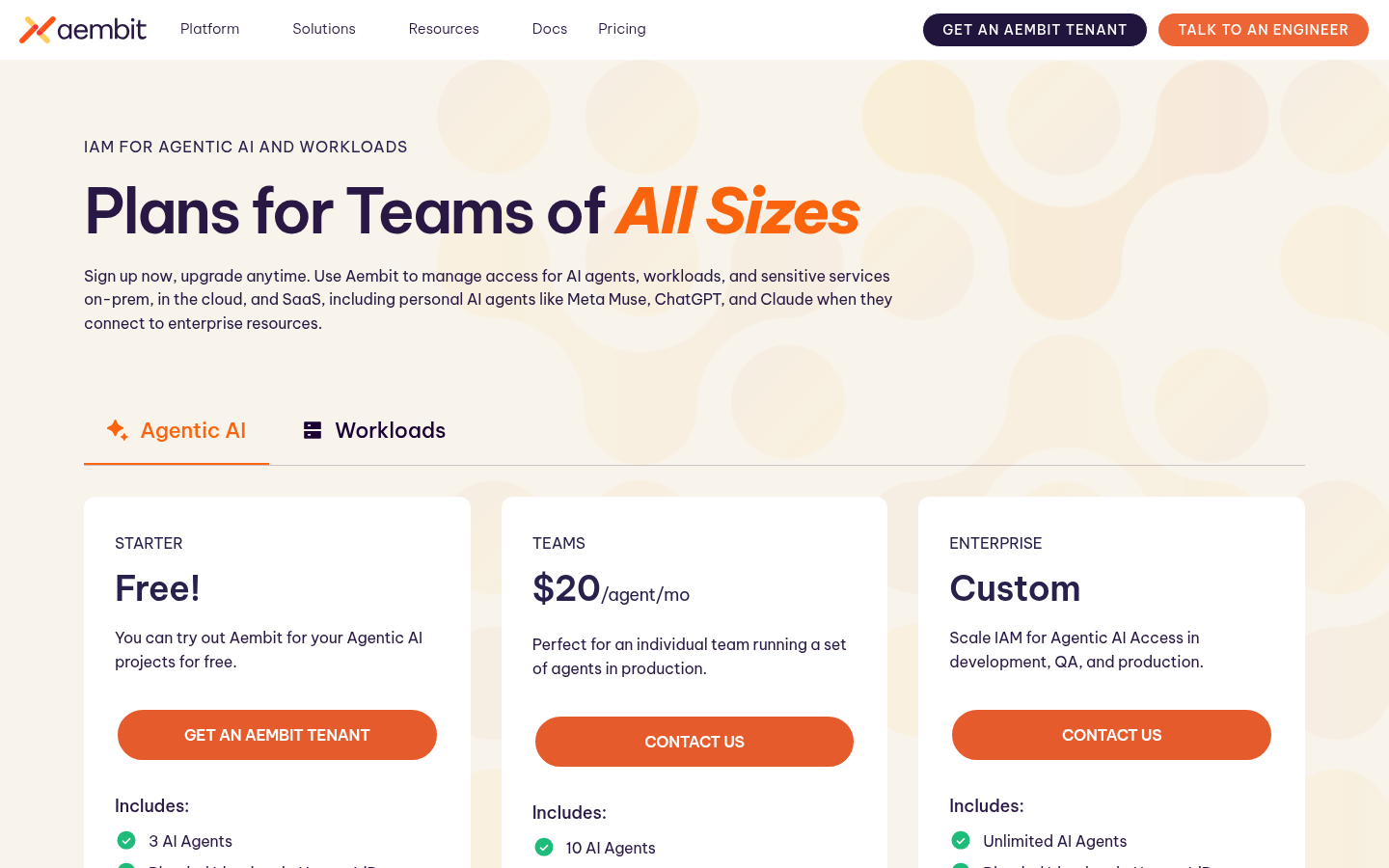
Aembit sits between an agent and the resource it calls. The agent gets its own identity, each request is checked against policy, and Aembit issues a short-lived, scoped credential only if the request is authorized, so the agent holds no long-lived secret.
Its blended identity combines the user’s context from your IdP with the agent’s context, and an MCP identity gateway applies it to MCP servers. It also covers personal agents such as ChatGPT and Claude when they reach enterprise resources.
A named customer quote published by Aembit, so read it as a vendor-selected reference rather than an independent review.
Key features:
- Per-request policy and short-lived credentials
- Blended human and agent identity
- MCP identity gateway and authorization service
- Logs attributed to the human and agent
Why we like it:
It is the cheapest serious option to start, and it handles workloads and agents with one model.
Limits:
Paid self-serve plans cap at 500 agents. Above that pricing is custom.
License or pricing: Free for 3 AI agents. USD 20 per agent per month, from 10 up to 500 agents. Custom above that.
Auth0 for AI Agents (Okta)
Best for developers building agents that act on behalf of users
Auth0 for AI Agents gives developers Token Vault, which stores and exchanges third-party tokens so the agent does not hold them, asynchronous authorization that asks a human to approve a sensitive action, and Fine-Grained Authorization for per-document and per-resource checks.
It is aimed at the agents you build and ship, not at governing agents employees bring.
Key features:
- Token Vault for third-party API tokens
- Human approval through asynchronous authorization
- Fine-Grained Authorization
- Works with any agent that calls APIs
Why we like it:
It is the most mature developer path to per-user, per-resource agent permissions, with a standard approval flow built in.
Limits:
It covers agents you build. Pricing for the AI agent features specifically is not documented.
License or pricing: Auth0 has a free tier. AI agent feature pricing is not documented.
Microsoft Entra Agent ID
Best for Microsoft tenants that want agents under existing Entra policy
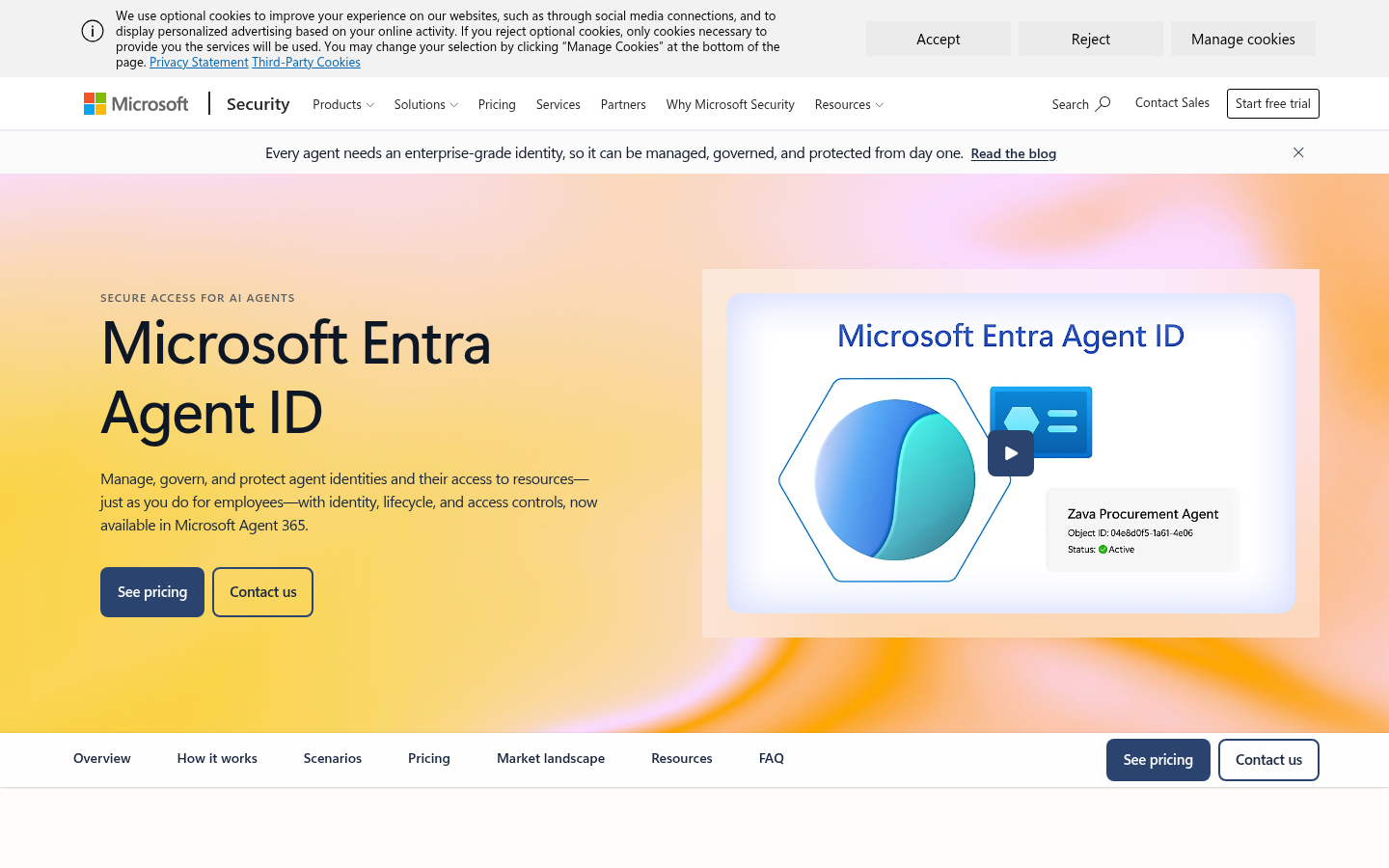
Entra Agent ID gives each agent a directory identity, then applies Conditional Access, identity governance with human sponsors, identity protection, and network controls that can categorize APIs and MCP servers.
It ships in Microsoft Agent 365 and Microsoft 365 E7. For on-behalf-of agents, Conditional Access and Identity Protection evaluate the user’s token, so the user needs E3 or E5 licensing for those features to apply.
Key features:
- Directory identities for agents
- Conditional Access for agents
- Sponsors and lifecycle governance
- Network controls for APIs and MCP servers
Why we like it:
It reuses the policy engine Microsoft shops already run, so agent access appears in the same reviews and logs.
Limits:
Decisions are made at token and access time, not on each tool call. Some features depend on the user’s own licenses.
License or pricing: Microsoft Agent 365 USD 15 per user per month, paid yearly. Also in Microsoft 365 E7.
Outerlimit
Best for deterministic, per-call enforcement with no standing credentials
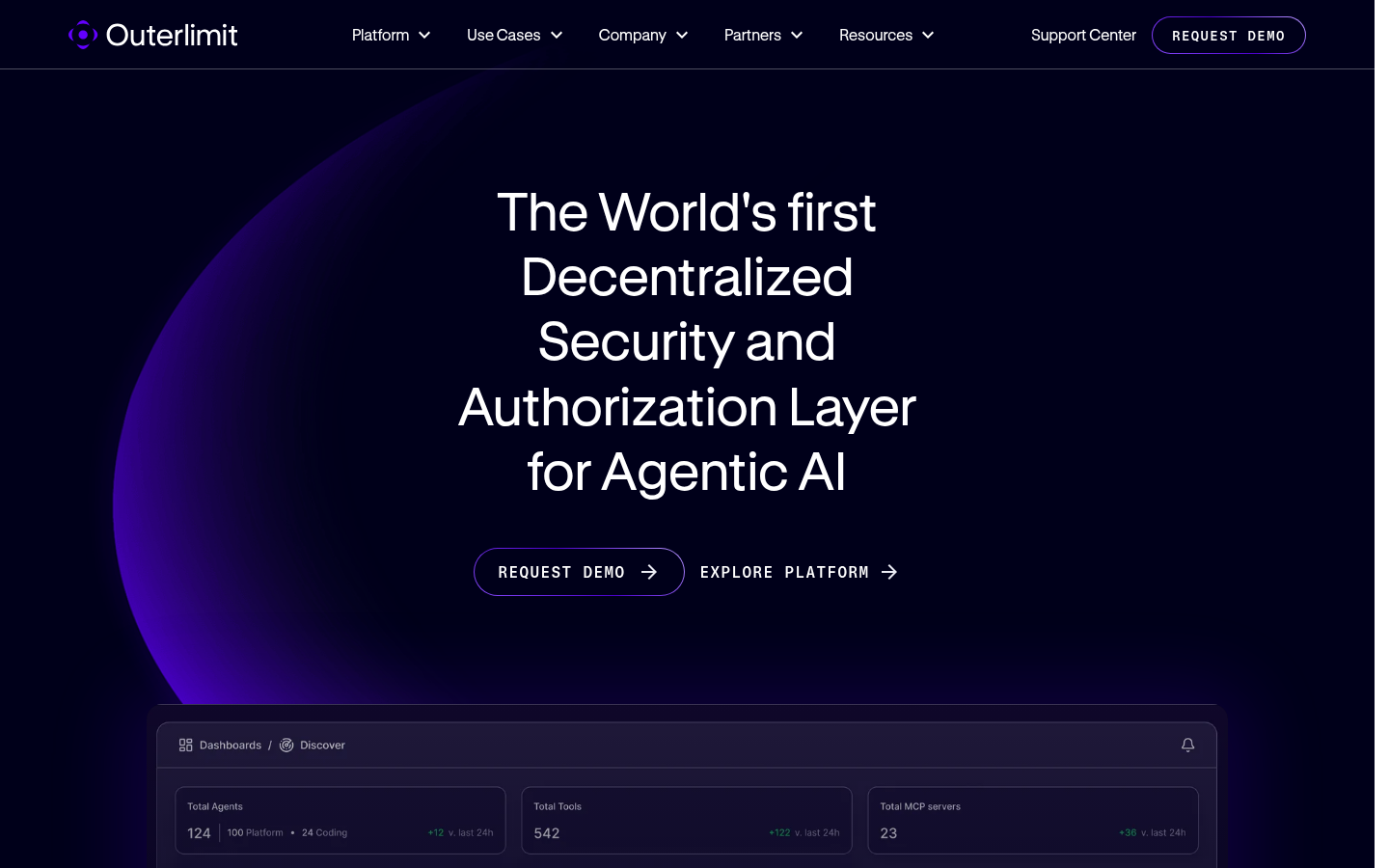
Outerlimit came out of stealth in September 2026 with a USD 16M pre-seed. It extends Zero Trust to the agent action layer: each tool call is on-policy or off-policy, decided at execution and independent of the agent’s reasoning.
The authorization decision and the credential reconstruction are one event, so an off-policy call produces an inert credential. In a multi-agent chain, every hop contributes a cryptographic factor, so a compromised intermediary cannot mint a valid credential for the final tool.
Key features:
- Discover inventory of agents, models, and tool exposure
- Tool-call-level observability before enforcement
- Deterministic enforcement at tool execution
- In-tenant virtual appliance or on-premises deployment
Why we like it:
Deciding at execution, not at the prompt, means prompt injection and goal drift meet the same test as any other call.
Limits:
Launch-stage. Supported agent frameworks and pricing are not documented.
License or pricing: Commercial. No public pricing.
NewCore
Best for one identity provider that governs agents and people together
NewCore launched in June 2026 with USD 66M.
For authorization, it starts from the agent’s identity: each agent gets its own lifecycle, a trust score, and revocation, and Agentic Governance applies one policy grammar and audit trail to agents and the humans who own them.
Key features:
- Agent identities with trust scores
- Revocation per agent
- One policy grammar for agents and people
- Split-key token signing
Why we like it:
Agent authorization rides on the same identity source as the humans who own the agents.
Limits:
Launch-stage. Per-tool-call enforcement is not documented.
License or pricing: Commercial. No public pricing.
AIR
Best for controlling what coding agents may do on developer machines
AIR launched in September 2026 with USD 50M across two seed rounds.
Authorization in AIR means what a coding agent may run and reach on an endpoint: AIR Control holds agents to policy on configuration, identity, and permissions, and AIR Defend acts on their actions at runtime.
Key features:
- Fleet policy on agent identity and permissions
- Runtime protection on agent actions
- Add-on vetting before install
- Free agent tool scanner
Why we like it:
Coding agents run with a developer’s full access, and AIR scopes that down where the agent runs.
Limits:
Launch-stage. Authorization for agents outside coding tools is not documented.
License or pricing: Commercial. No public pricing.
How to choose an AI agent authorization tool
- Separate agents you build from agents you run. Auth0 and Aembit fit agents you ship. Outerlimit, AIR, and Entra Agent ID fit agents employees use.
- Decide how fine the decision must be. Per tool call stops more, and costs more latency and policy work.
- Check credential exposure. Ask whether the agent ever holds a long-lived token.
- Plan human approval. Find out how a sensitive action reaches a person and what happens if they do not answer.
What we left out
- Astrix: Cisco announced its intent to acquire Astrix in May 2026.
- MCP gateways without identity: see MCP security.
- Oso: an authorization engine developers call per action. See authorization libraries.
What the internet thinks about agent authorization
Live threads, quoted for the argument, not the score.
Hacker News · February 2026
“Most MCP server implementations don’t differentiate between ‘list’ and ‘delete’ at the authorization layer; they’re a single connection with all tools available.”
From a thread arguing agents need authorization more than identity. It describes the gap Outerlimit, Aembit, and Auth0 each sell into: one connection with every tool allowed.
Hacker News · May 2026
“One more very important factor is authorization, which no one seems to mention in these discussions.”
From a thread asking whether MCP is dead. The commenter argues the MCP authorization spec beats CLI tools with hardcoded API keys. Critics reply that a standard flow is only as good as the scopes behind it.
Choose Aembit for a cheap, fast start on scoped credentials. Choose Auth0 for AI Agents when you build agents for your users. Choose Entra Agent ID if you run Entra and Microsoft agents. Choose Outerlimit for deterministic per-call enforcement with no standing credentials. Choose NewCore when the IdP is being replaced. Choose AIR when coding agents are the main concern. Outerlimit, NewCore, and AIR are launch-stage, so pilot any of them before you commit.
FAQs
What is AI agent authorization?
Deciding what an AI agent may do on each action or request, with scoped, short-lived access, rather than giving it a user’s full session.
Is OAuth enough for AI agents?
OAuth decides access once per grant. Per-action tools add checks on every call and keep long-lived tokens away from the agent.
Do I need a separate tool if my IdP already supports agents?
Often yes, for per-call decisions. Entra Agent ID and NewCore govern an agent’s identity and access when a token is issued. Checking each tool call needs a broker or gateway such as Aembit or Outerlimit.