Best MDR Platforms in 2026: 10 Compared by Who Runs Response
Ten platforms for 24/7 detection, investigation, and response when you do not want to scale a full in-house SOC.
The 2026 SANS SOC Report, drawn from 444 practitioners and 69 cyber leaders, still names skilled staff shortages as the top SOC challenge, while only 32% of practitioners say management prioritizes hiring and retention. That gap is why teams buy managed detection and response: 24/7 detection, investigation, and response without scaling a full in-house SOC.
The classic jobs are a compromised endpoint that needs isolation, a compromised identity, and a malicious mailbox. The platforms below differ less on whether they name those jobs than on who staffs the 24/7 queue and where the response actions run: on a vendor-managed agent, or in the EDR, identity, and email tools you already operate.
This shortlist is not a general MSSP catalog, and it is not the same kind of purchase as an AI SOC tool that automates a queue your team still owns. Some vendors here also sell agentic SOC features, including Arctic Wolf’s Aurora Agentic SOC, ReliaQuest GreyMatter, and Daylight’s agentic investigations, but the question this page answers is the MDR contract: who is on the hook at 2 a.m., and which system actually isolates the host.
How we evaluated
We read each vendor’s product pages, pricing pages, and public documentation on 12 Nov 2026, and asked the same questions: who staffs the 24/7 queue, where response actions run, what a compromised-host isolation looks like, and how the service is priced. Where public material does not cover a question, we write “not documented”.
| Tool | Best for | What to check |
|---|---|---|
| CrowdStrike Falcon Complete | 24/7 CrowdStrike analysts remediating on the Falcon sensor | Quote only |
| Arctic Wolf | A named Concierge Security Team, with Managed Containment | USD 44,000 per 12-month contract for up to 100 users on AWS Marketplace |
| eSentire | A 24/7 SOC that contains on the Atlas agent, or on your EDR in higher packages | USD 17 per user per month for Atlas Professional, up to 100 users, billed annually |
| Sophos MDR | 24/7 response in Sophos tools or a supported third-party stack | USD 239.64 per user per 12-month contract on AWS Marketplace |
| Huntress | A 24/7 SOC on the Huntress agent, with a public per-endpoint price | USD 8.99 per endpoint per month MSRP |
| Expel | A vendor SOC that contains through the tools you already run | Quote |
| Zscaler MDR | A 24/7 CIRT and playbooks in your EDR, identity, and Zscaler stack | Quote |
| Microsoft Defender Experts MDR | Microsoft analysts managing the queue inside Defender | Quote, sold separately from Defender |
| ReliaQuest | GreyMatter in your stack, with ReliaQuest enablement | Quote |
| Daylight | Fully managed, co-managed, or a forward-deployed engineer | USD 200 per active user per 12-month contract on AWS Marketplace |
Falcon Complete
Arctic Wolf
eSentire
Sophos MDR
Huntress
Expel
Zscaler MDR
Defender Experts
ReliaQuest
Daylight
Use-case matrix: a compromised host, identity, or mailbox
Each cell reflects what the vendor publishes for that job. A gap means it is not documented, not that the product cannot help.
| Scenario | Falcon Complete | Arctic Wolf | eSentire | Sophos MDR | Huntress | Expel | Zscaler MDR | Defender Experts | ReliaQuest | Daylight |
|---|---|---|---|---|---|---|---|---|---|---|
| Compromised endpoint needs isolation | Analysts contain and remediate on the Falcon sensor, including playbook containment and full-cycle cleanup | Concierge Security Team works with you to start Managed Containment, isolating at network and host level | Host isolation and TCP disruption are named response actions; the SOC performs manual containments | Host isolation is a named Response Action; Authorize mode can act and notify, Collaborate mode seeks approval | Host Isolation and Active Remediation through the Huntress agent, enabled by default | After the SOC validates the threat, Workbench can isolate the host through your EDR API | Playbooks can isolate endpoints through your EDR, with optional human approval | Isolate machine is in-scope for Managed response on devices you have not excluded; otherwise the experts guide you | Approved GreyMatter Respond playbooks can contain in your stack; destructive wipe or reimage is out of scope for enablement | Public pages name session revocation, credential reset, and IP blocking; host isolation is not documented |
| Compromised identity or account | Identities are in the investigation scope Falcon Complete describes; a named account-disable action is not documented on the service page | Active Directory monitoring is in the MDR documentation; a named account-disable action is not documented | User suspension is a named response action | Disabling users and revoking sessions are named Response Actions in the service description | Managed ITDR is a separate Huntress product that covers account takeover and mail-flow changes | SOC-validated actions can disable a user, reset credentials, or disable a cloud access key | Playbooks can suspend users through your identity provider | Disable user is in-scope for Managed response, except on excluded accounts | Containment and remediation can run through identity tools connected to GreyMatter, on approved playbooks | Named response examples include revoking sessions and resetting credentials |
| Malicious or user-reported email | SaaS and identity investigation is in the service scope; mailbox purge is not documented on the Complete page | not documented | Investigation of suspicious emails reported by your staff is included in every Atlas package | Email is among the surfaces Sophos names for integrations; a named mailbox-purge action is not documented in the service description | Managed ITDR names mail-flow manipulation; mailbox purge is not documented for Managed EDR | Remove malicious email is a documented auto remediation action when that tool is connected | Managed Phishing Response is offered for user-reported phishing email | Soft-delete emails is in-scope for Managed response | Phishing Analyzer classifies user-reported mail and can use playbooks for remediation when that item is in the order | User-reported phishing is investigated as part of the MDR service |
Sources: Falcon Complete, Arctic Wolf MDR and Arctic Wolf’s public MDR FAQ on Managed Containment, eSentire MDR and eSentire packaging, Sophos MDR service description, Huntress platform documentation, Expel auto remediation, Zscaler MDR, Defender Experts Managed response FAQ, ReliaQuest Ongoing Enablement, and Daylight MDR.
CrowdStrike Falcon Complete
Best for teams that want CrowdStrike analysts to remediate on the Falcon sensor
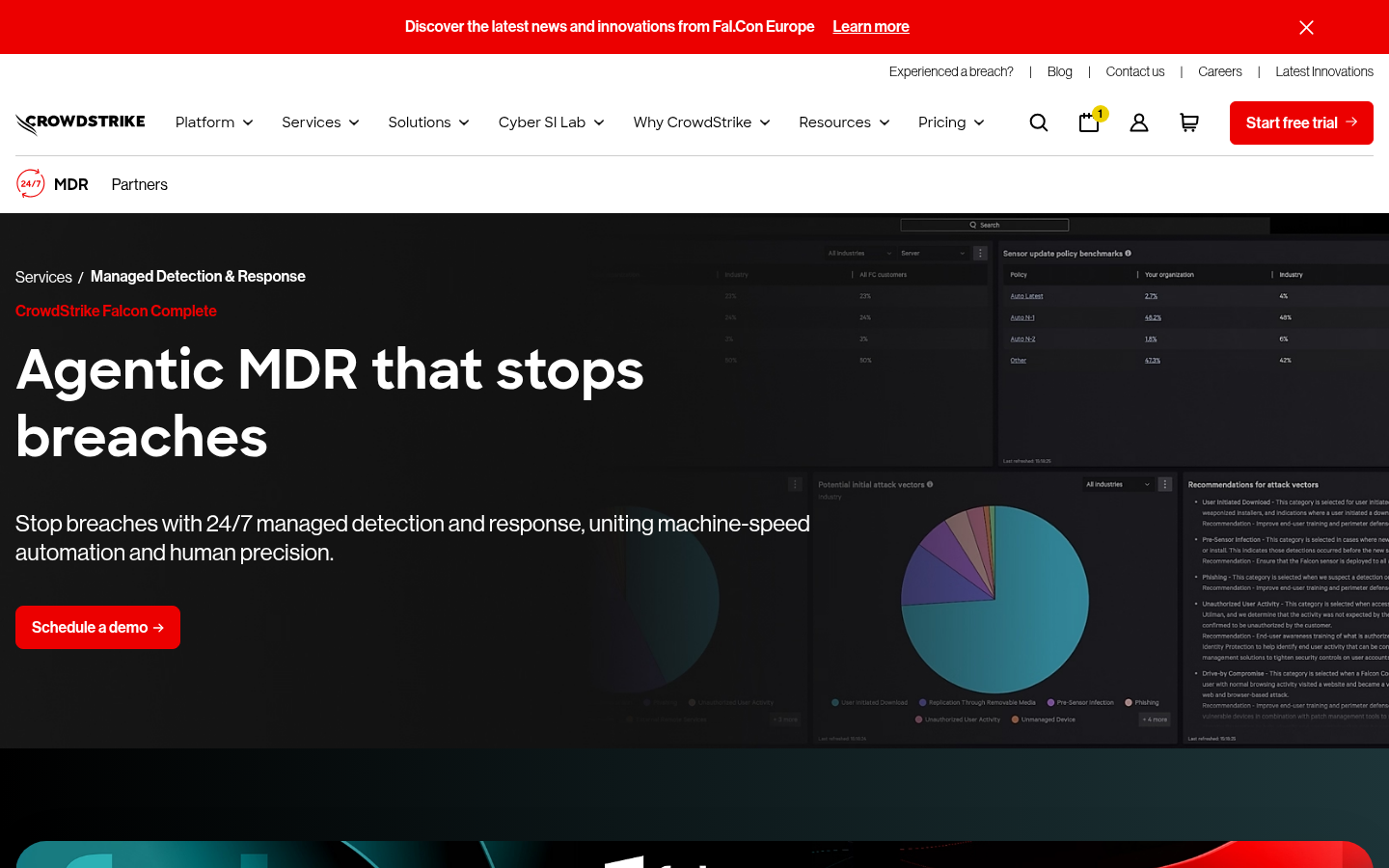
Falcon Complete is CrowdStrike’s 24/7 managed detection and response service on the Falcon platform. CrowdStrike says experts stay in the loop while automation and AI agents do investigation and response work, and that analysts deliver full-cycle remediation on your behalf, including containment and restoring an environment to a known-good state.
The service page also describes response playbooks for containment, and investigation across endpoints, identities, cloud, SaaS, and third-party data that Falcon collects. A host without the Falcon sensor is outside the reach of that remediation model. CrowdStrike does not publish a list price for Complete; Go, Pro, and Enterprise software tiers are listed separately.
Key features:
- 24/7 expert-led detection, investigation, and full-cycle remediation
- Containment playbooks on the Falcon sensor
- Investigation across endpoint, identity, cloud, SaaS, and third-party Falcon data
- Warranty coverage of up to USD 2 million, as CrowdStrike states on the service page
Why we like it:
CrowdStrike analysts can isolate and remediate on the Falcon sensor, so your team is not the one containing the host after hours.
Limits:
Pricing is quote-only. Response beyond the endpoint depends on the Falcon modules in your bundle. CrowdStrike’s published median time-to-contain is a vendor-measured figure, not a contractual promise for every incident.
License or pricing: Quote only. CrowdStrike lists prices for Falcon Go, Pro, and Enterprise software, and marks Falcon Complete as contact sales.
Arctic Wolf
Best for a named Concierge Security Team that works containment with you
Arctic Wolf MDR gives you a named Concierge Security Team as the single point of contact for 24/7 monitoring, investigation, and reporting. The MDR license includes the Arctic Wolf Agent and Active Response. Telemetry can also come from Arctic Wolf sensors, cloud and syslog sources, and endpoint or Active Directory integrations.
When a critical incident is found, the Concierge Security Team works with you to start Managed Containment, which Arctic Wolf says isolates the threat at the network and the host. Arctic Wolf also markets Aurora Agentic SOC and an Aurora Security Assistant, so this is not a non-AI incumbent standing still next to newer vendors.
Key features:
- Named Concierge Security Team as the single point of contact
- Arctic Wolf Agent and Active Response included in the MDR license
- Managed Containment at network and host level, initiated with the customer
- Sensors plus cloud, syslog, and Active Directory monitoring
Why we like it:
A named Concierge Security Team is the person you call, which solves the problem of a rotating vendor queue that does not know your environment.
Limits:
Managed Containment is started with you, not as a silent unilateral action. Identity account-disable is not documented as a named MDR action on the public product and FAQ pages. Arctic Wolf also sells Aurora Agentic SOC alongside this MDR service.
License or pricing: USD 44,000 per 12-month contract for Arctic Wolf MDR Basic, covering up to 100 users, on AWS Marketplace. A Custom Pricing private-offer listing has no defined unit, so it is omitted here.
eSentire
Best for a 24/7 SOC that contains on the Atlas agent, or on your EDR in higher packages
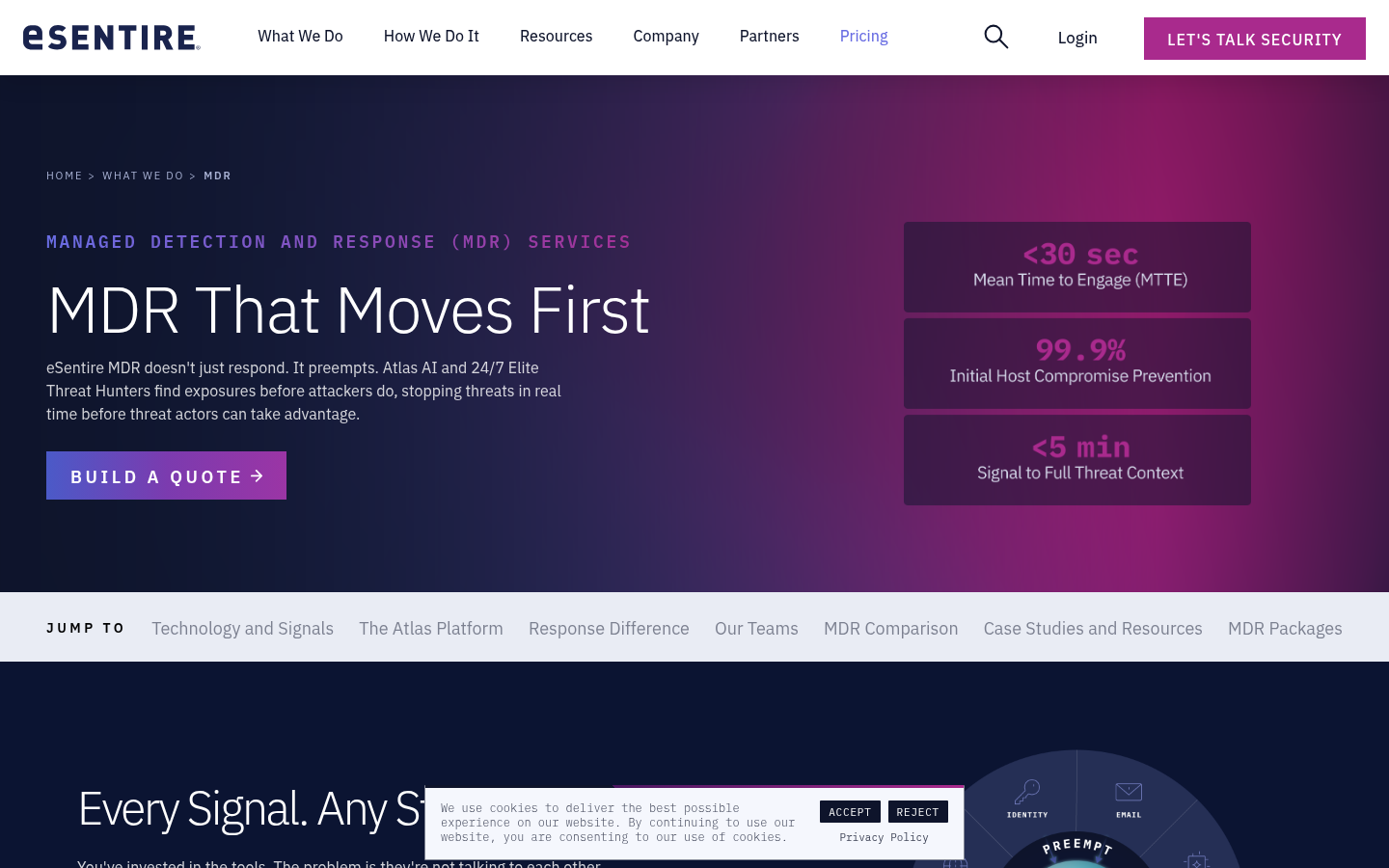
eSentire MDR is a 24/7 staffed service on the Atlas platform. Every package includes a SOC that investigates and acts, with manual containments, endpoint, identity, and cloud detection, a named Technical Account Manager, and investigation of suspicious emails reported by your staff. The product page names host isolation, user suspension, and TCP disruption as response actions.
Atlas Professional, which eSentire describes as a fit for teams with no SOC, uses the eSentire Atlas agent. Atlas Enhanced and Atlas Elite can use a bring-your-own EDR, including CrowdStrike, SentinelOne, Microsoft Defender for Endpoint, or Palo Alto, with or without the Atlas agent. Those higher packages add log detection, longer retention, hunting, and offensive testing.
Key features:
- 24/7 SOC investigation and containment on every Atlas package
- Host isolation, user suspension, and TCP disruption named as response actions
- Atlas agent on Professional; bring-your-own EDR available on Enhanced and Elite
- User-reported email investigations included in every package
Why we like it:
The SOC can isolate a host, suspend a user, and disrupt traffic, which solves hands-on containment for a team that does not have a SOC.
Limits:
Bring-your-own EDR is documented on Enhanced and Elite, not on Professional. Higher packages also bundle log retention, hunting, and offensive testing, which is a broader purchase than a detection-and-response queue alone. A Launch and Optimization fee is required on the shop.
License or pricing: On the eSentire shop, Atlas Professional is USD 17 per user per month for up to 100 users, billed annually, and USD 16.15 per user per month for 101 to 250 users. Atlas Enhanced is USD 24 and USD 22.80, and Atlas Elite is USD 28 and USD 26.60, on those same bands. A Launch and Optimization fee of USD 2,500 per year applies regardless of user count.
Sophos MDR
Best for 24/7 response in Sophos tools or a supported third-party stack, with an authorize or collaborate mode
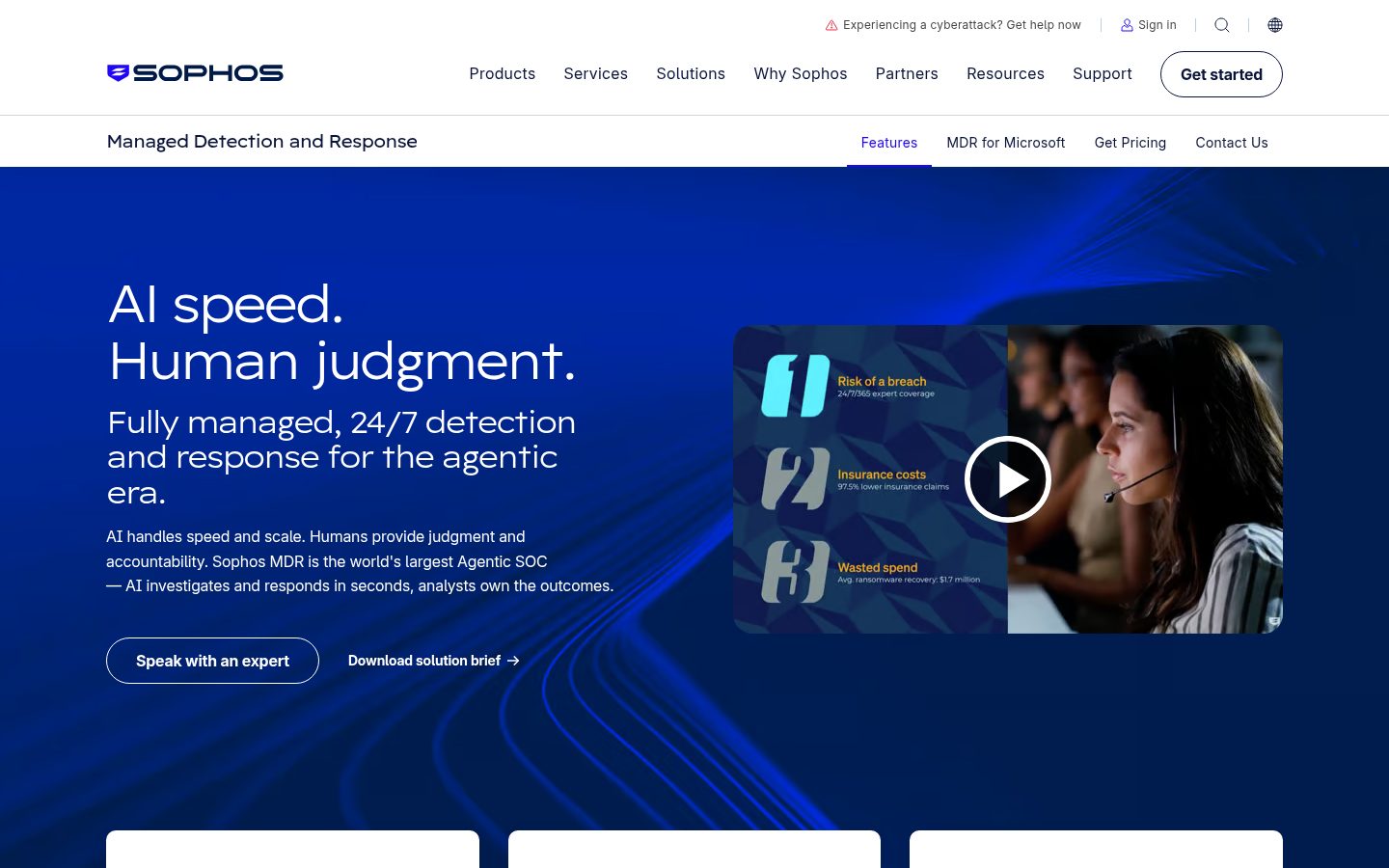
Sophos MDR is a 24/7 managed detection and response service that can run on Sophos products or on a supported third-party stack. Sophos says the service includes more than 500 integrations, and that you can bring your stack or use theirs. The official service description names response actions that include host isolation, process termination, disabling users, and revoking sessions.
You pick a threat-response mode. In Authorize mode, Sophos can take those actions and then notify you. In Collaborate mode, Sophos seeks your approval before acting. For an agentless third-party endpoint, the service description limits response to host isolation and un-isolation. Incident response that goes further is described as applying to monitored endpoints running Sophos XDR; on other systems, Sophos provides remediation guidance and you remain responsible for containment.
Key features:
- 24/7 managed detection and response, on Sophos tools or supported integrations
- Named actions include host isolation, process termination, disabling users, and revoking sessions
- Authorize or Collaborate threat-response modes
- More than 500 integrations, including Microsoft and other third-party EDR
Why we like it:
You can let Sophos isolate a host in Authorize mode, or require approval in Collaborate mode, in Sophos tools or in a supported third-party stack.
Limits:
On agentless third-party endpoints, documented response is isolation only. Deeper incident response is described for monitored endpoints running Sophos XDR; elsewhere you get guidance. Sophos.com does not show a rate and routes buyers to a quote.
License or pricing: USD 239.64 per user per 12-month contract, and USD 390.72 per server per 12-month contract, on AWS Marketplace for the Sophos MDR user and server dimensions. Sophos.com offers a quote and describes pricing as per user and per server, without showing a rate.
Huntress
Best for IT teams that want a 24/7 SOC on a Huntress agent, with a public price
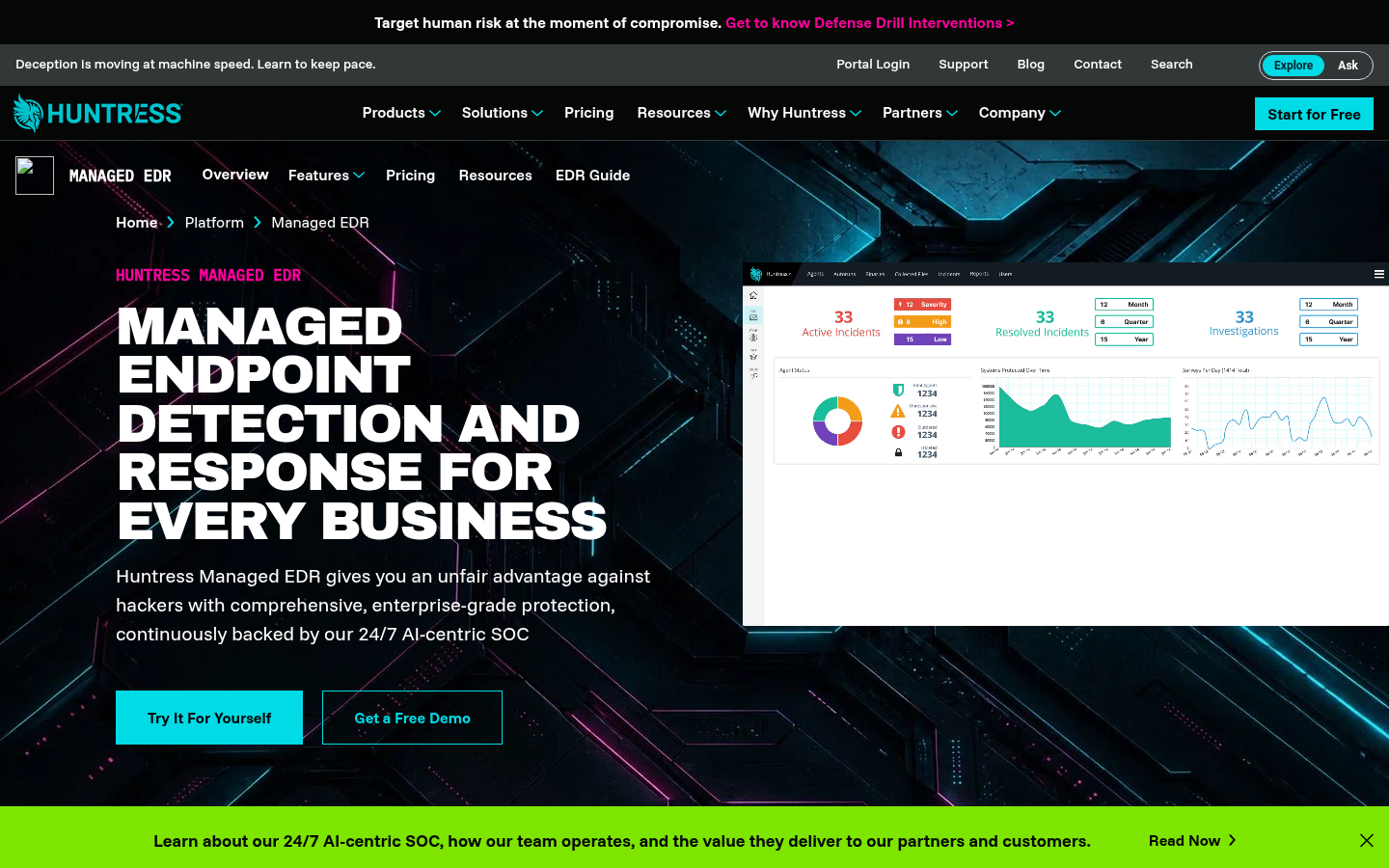
Huntress Managed EDR pairs a Huntress agent with a 24/7 SOC that investigates, contains, and remediates. Host Isolation and Active Remediation are enabled by default. During isolation the endpoint stays connected to Huntress so the SOC can keep working the host. Huntress says the service can replace the need for an internal SOC for many organizations, while your team still deploys the agent and acts on incident reports.
The platform is built for lean IT teams as well as larger ones. Managed ITDR, Managed SIEM, and security awareness training are separate Huntress products, not included in the Managed EDR price. Huntress can also monitor Microsoft Defender for Endpoint alerts, or manage Microsoft Defender Antivirus, alongside its own agent.
Key features:
- Huntress agent with 24/7 SOC investigation, containment, and remediation
- Host Isolation and Active Remediation enabled by default
- Public per-endpoint MSRP on a standard 12-month term
- Optional integration with Microsoft Defender for Endpoint
Why we like it:
A published per-endpoint price and a SOC that can isolate through the Huntress agent solves 24/7 coverage for an IT team that will not staff a SOC.
Limits:
Identity and log coverage sit in separate Huntress products. Direct and reseller purchases have a 50-endpoint minimum; buying through an MSP has no Huntress-required minimum. You still own deployment and follow-through on what the SOC sends.
License or pricing: USD 8.99 per endpoint per month MSRP for Managed EDR, on a standard 12-month term, with lower per-endpoint rates at higher volume. The 24/7 SOC is included. Direct and reseller purchases have a 50-endpoint minimum. Deployment and day-to-day portal management are not included in that MSRP.
Expel
Best for a vendor SOC that responds through the EDR and identity tools you already have
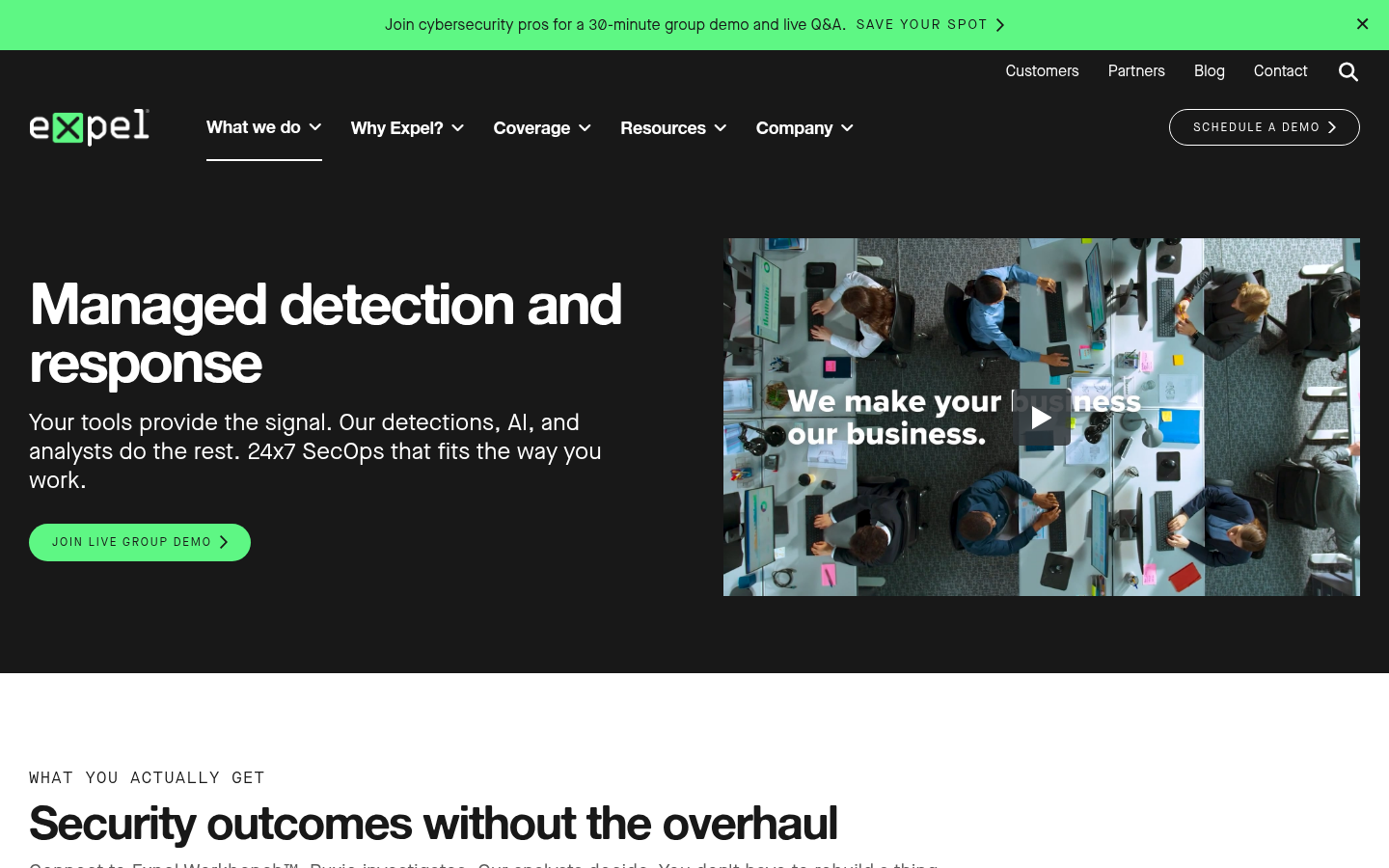
Expel MDR connects to the security stack you already run. There is no Expel endpoint agent to deploy. Expel says it integrates with more than 160 tools across endpoint, identity, cloud, network, and SaaS, and that its analysts investigate in Expel Workbench, with Ruxie used to enrich alerts and execute approved response actions.
After the SOC validates a threat, Workbench can isolate a host through your EDR API, including CrowdStrike and Microsoft Defender for Endpoint, and can also kill a process, reset credentials, disable a user or access key, or remove a malicious email, depending on the tools you have connected and the allow or deny lists you set. Actions outside those lists are assigned back to you.
Key features:
- No new endpoint agent; API connections to the stack you already run
- SOC-validated auto remediation in Expel Workbench
- Host isolation through connected EDR products, including CrowdStrike and Defender
- Identity, email, and cloud response actions where those tools are connected
Why we like it:
The SOC can contain a host through the EDR you already run, so you do not add a second agent just to get managed response.
Limits:
Response is only as strong as the tools you connect and the write permissions you grant. If a host is not on an always-contain list you created, Expel may assign the action back to you instead of isolating automatically.
License or pricing: Quote. Expel does not publish a list price for the MDR service.
Zscaler MDR
Best for a 24/7 response service that can act in your EDR, identity provider, and Zscaler controls
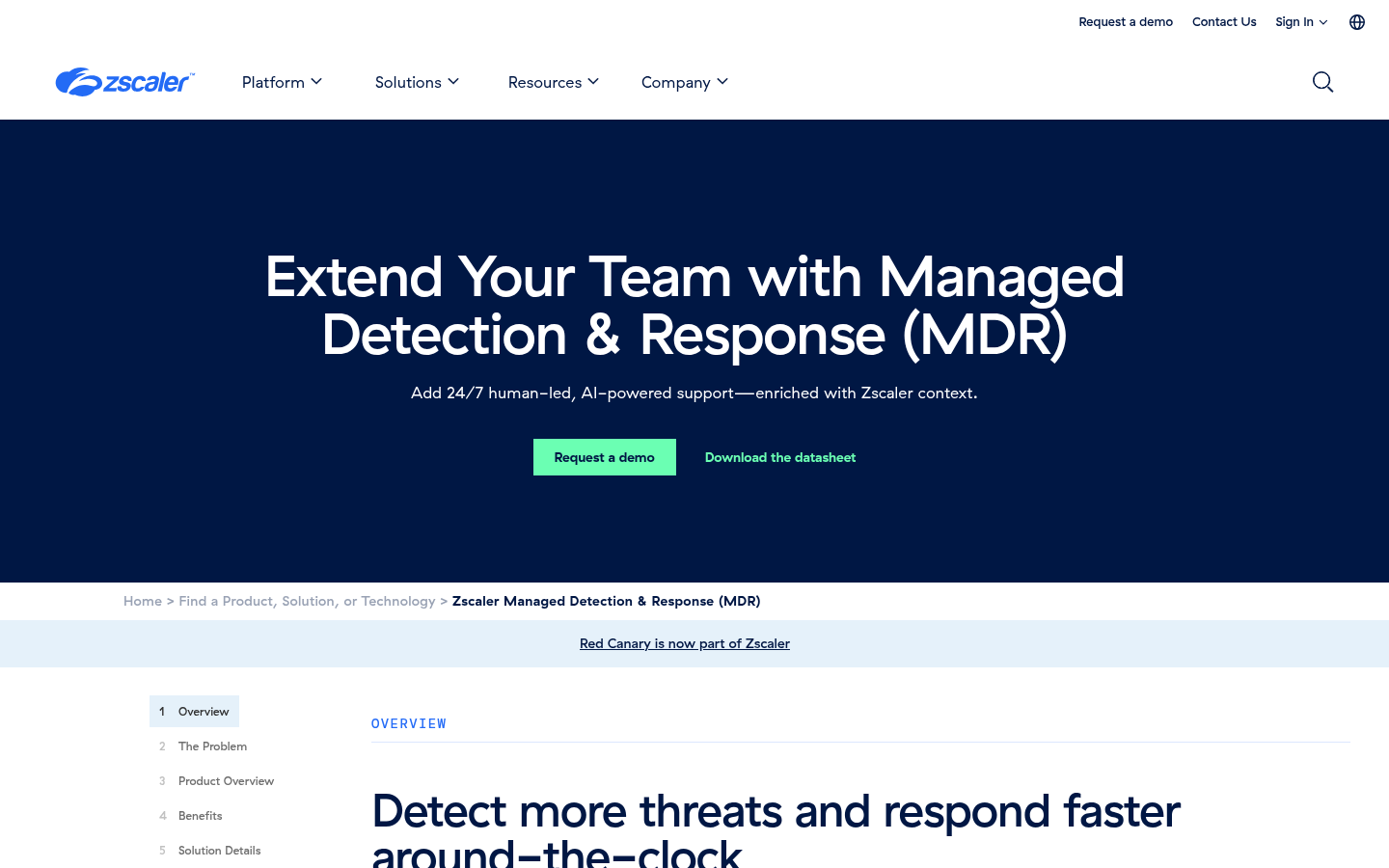
Zscaler MDR is the current purchasable name for the managed detection and response service previously sold as Red Canary. A 24/7 Cyber Incident Response Team investigates confirmed threats, and the platform can also use optional Zscaler MDR sensors plus alerts from the security products you already run. Zscaler says the service complements an existing SOC rather than replacing it.
No-code playbooks can isolate endpoints through your EDR, suspend users through your identity provider, and block URLs or indicators through Zscaler Internet Access. You can require a person to approve those actions, or allow them to run automatically. Investigations can also be enriched with ZIA user and network context when that product is in place.
Key features:
- 24/7 Cyber Incident Response Team, with optional Zscaler MDR sensors
- Integrations with the EDR, identity, cloud, and security tools you already run
- Playbooks that isolate hosts via EDR, suspend users, or block indicators via ZIA
- Optional human approval before a response action runs
Why we like it:
Playbooks can isolate a host through your EDR or block traffic through Zscaler, which solves after-hours response in a stack you already operate.
Limits:
Zscaler describes this as a complement to your SOC, not a replacement for one. The deepest automated network containment is available if you already use Zscaler Internet Access. Pricing is not published.
License or pricing: Quote. Zscaler does not publish a list price for Zscaler MDR.
Microsoft Defender Experts MDR
Best for Microsoft Defender customers who want Microsoft analysts on the incident queue
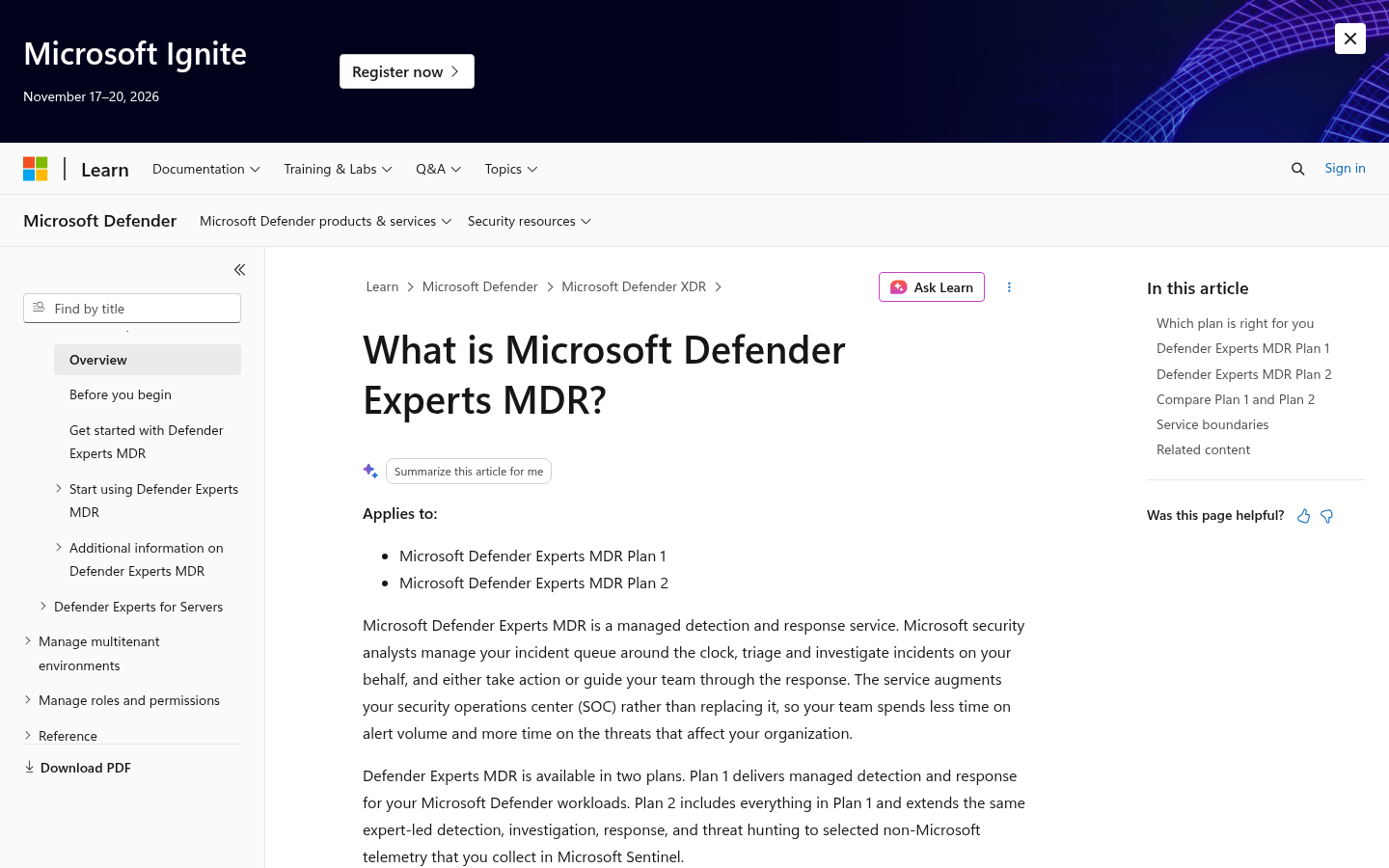
Microsoft Defender Experts MDR, the service previously called Defender Experts for XDR, puts Microsoft analysts on your Defender incident queue around the clock. Microsoft says the service augments a SOC rather than replacing it. On Microsoft Defender workloads, the experts can take Managed response actions or guide your team. In-scope device actions include isolating a machine, releasing it, and stopping or quarantining a file. In-scope user actions include disabling a user and soft-deleting emails, except on assets you have excluded.
Plan 1 covers Microsoft Defender workloads. Plan 2 adds selected third-party telemetry that you collect in Microsoft Sentinel, but for those third-party products the experts provide response guidance rather than taking the action themselves. Neither plan is an incident response engagement for an active breach, and neither covers Microsoft Defender for Cloud workloads.
Key features:
- 24/7 Microsoft analysts on the Defender incident queue
- Managed response actions such as isolate device, disable user, and soft-delete email
- Exclusion lists so experts guide you instead of acting on sensitive assets
- Plan 2 extends investigation and guidance to selected Sentinel third-party sources
Why we like it:
Microsoft analysts can isolate a device or disable a user inside Defender, which takes the after-hours queue off a team that already works in that portal.
Limits:
The service is sold separately from Defender products, and pricing is not public. Plan 2 third-party coverage is guidance, not hands-on action, and needs a Sentinel workspace plus a 1,500 licensed-unit minimum. You still own the Sentinel deployment itself.
License or pricing: Quote. Microsoft sells Defender Experts MDR separately from other Defender products and does not publish a list price.
ReliaQuest
Best when you want GreyMatter in your existing stack and to remain the operator
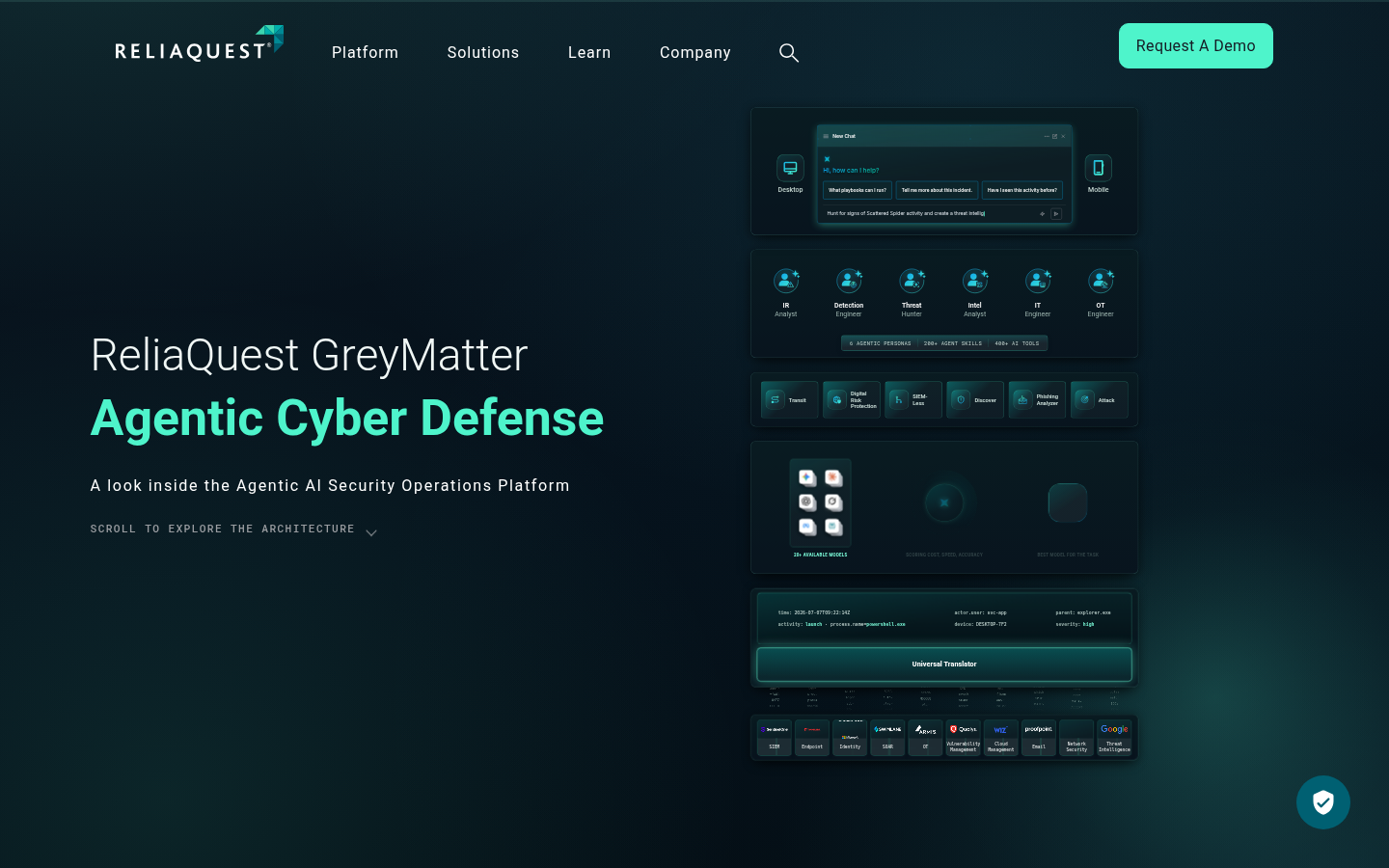
ReliaQuest sells GreyMatter, a security operations platform that connects to the SIEM, EDR, and other tools you already run, and staffs part of the work through Ongoing Enablement. ReliaQuest personnel can triage and qualify alerts, escalate true positives on the paths you configure, and use GreyMatter Respond playbooks for enrichment, containment, and remediation. ReliaQuest’s own FAQ says GreyMatter is not a fully autonomous SOC that replaces your internal or outsourced operations.
That is a different contract from Falcon Complete or Huntress. You stay in the operating model. Destructive actions such as wipe or reimage are out of scope for enablement, and hunt campaigns are a separate purchase. ReliaQuest also markets GreyMatter as an agentic AI SOC platform, which is why it sits next to, rather than on, our AI SOC tools shortlist: the MDR question here is still who staffs the work and where containment runs.
Key features:
- GreyMatter connections across the security tools you already run
- ReliaQuest Ongoing Enablement for triage, escalation, and approved playbooks
- GreyMatter Respond for containment and remediation in your stack
- Phishing Analyzer for user-reported mail, when that enablement item is in the order
Why we like it:
GreyMatter can contain in your existing tools while you remain the operator, which solves scale without handing over the operating model.
Limits:
Enablement escalates true positives to your team and does not include destructive response or, unless you buy it separately, ReliaQuest-run hunt campaigns. GreyMatter alone is not a drop-in replacement for a 24/7 SOC.
License or pricing: Quote. ReliaQuest does not publish a list price for GreyMatter or Ongoing Enablement.
Daylight
Best when you want to choose fully managed, co-managed, or an engineer on your team
Daylight staffs MDR with AI agents and security engineers, and lets you choose how close that team sits to yours. The company can run the work end to end, share it with your analysts in Aura, or place a forward-deployed engineer on your team. Daylight says it owns confirmed cases through resolution, with your team able to control each action, and it names examples such as revoking sessions, resetting credentials, and blocking IP addresses.
The same MDR workflow is also offered for AI-system detections, DLP signals, and user-reported phishing. Deeper technical documentation at docs.daylight.ai is login-gated, so those product claims are taken from Daylight’s public marketing pages. Daylight announced a USD 80 million Series B on 10 Nov 2026, led by Goldman Sachs Alternatives.
Key features:
- Choice of fully managed, co-managed in Aura, or a forward-deployed engineer
- AI agents plus engineers investigating toward a verdict
- Named response examples include session revocation, credential reset, and IP blocking
- MDR workflow also offered for AI-system, DLP, and phishing signals
Why we like it:
You can choose how closely Daylight staffs the work, which solves the need for 24/7 MDR without forcing a single delivery model.
Limits:
Public pages name session, credential, and IP actions; host isolation is not documented there. Technical docs are login-gated, so deeper capability detail is vendor-stated. Pricing outside the AWS Marketplace listing is not published.
License or pricing: USD 200 per active user per 12-month contract on AWS Marketplace. Other commercial terms are quote-only.
How to choose an MDR platform
- Decide who should own the 2 a.m. queue. If you want a vendor team to operate detection and response on an agent they run, start with Falcon Complete, Arctic Wolf, eSentire, or Huntress. If you want a vendor team to run that work in the tools you already have, start with Expel, Zscaler MDR, Sophos MDR, or Defender Experts. If you stay the operator, start with ReliaQuest. If you want to pick the staffing model, start with Daylight.
- Decide where containment has to run. If you want isolation on an agent the vendor operates, Falcon Complete, Arctic Wolf, Huntress, and eSentire Professional are the closer fits. If your EDR and identity tools are already chosen and you want a vendor team to work inside them, Expel, Zscaler MDR, Sophos MDR, and Defender Experts are the closer fits. eSentire Enhanced or Elite can also contain through a bring-your-own EDR.
- Be honest about whether you have a SOC. Huntress is explicit that Managed EDR can replace the need for an internal SOC for many organizations, and eSentire positions Atlas Professional the same way. Microsoft and Zscaler describe their services as complements to a SOC you already have. That difference should drive the shortlist before a feature matrix does.
- Separate a platform purchase from a staffed queue. ReliaQuest GreyMatter can look like an AI SOC tool until you read the enablement contract. Ask what ReliaQuest personnel will triage, which playbooks they may run, and what stays on your team.
- Use public prices only when the unit is stated, then read it. Huntress, eSentire, Daylight, Arctic Wolf, and Sophos publish a unit and a period. A quote for Falcon Complete, Expel, Zscaler MDR, ReliaQuest, or Defender Experts still needs the same clarity: what is counted, and what response is included.
What we left out
- We kept platform-attached MDR to the three most common endpoint stacks (CrowdStrike, Microsoft, Sophos). Rapid7 MDR and Unit 42 MDR follow the same model on InsightIDR and Cortex, so shortlist them if you already run those platforms.
What practitioners say about outsourcing the SOC
The recurring argument is not which logo is best. It is whether a team can actually staff 24/7 detection and response itself.
Hacker News, 9 Sept 2025
“I’m concerned that you’re not familiar with EDR and organizations who flat out can’t build a full 24/7 SOC. Which is the vast majority of businesses.”
The comment is a reply in a thread about outsourcing detection and response. It is about the staffing problem this shortlist starts from, not a review of one vendor on the list.
If you want a vendor team to own 24/7 detection and to contain on an agent they operate, start with Falcon Complete, Arctic Wolf, eSentire, or Huntress, and then decide whether you need CrowdStrike’s full-cycle remediation, a named Concierge Security Team, eSentire’s packaged Atlas SOC, or a public per-endpoint price built for IT teams. If your EDR is already chosen and you want a vendor team to work inside it, Expel, Zscaler MDR, Sophos MDR, and Defender Experts are the cleaner fits. ReliaQuest belongs here when you want GreyMatter and staffed enablement without handing over the operating model. Daylight is the one that lets you pick fully managed, co-managed, or a forward-deployed engineer.
FAQs
Is MDR the same as an AI SOC tool?
No. This list is for a contracted 24/7 detect, investigate, and respond service. AI SOC tools automate triage and investigation on a queue your team still owns. Some vendors here, including ReliaQuest, Arctic Wolf, and Daylight, also sell AI or agentic SOC capabilities, but the question here is still who staffs the MDR and where response runs.
How is MDR different from an MSSP or SOC-as-a-service?
An MSSP often manages a broad security stack, including device administration and monitoring, and may or may not own investigation and containment. SOC-as-a-service is a staffing model for a security operations center. MDR, as used here, is the narrower job: 24/7 detection, investigation, and response, with a defined place those response actions run.
If I already run CrowdStrike or Microsoft Defender, do I still buy MDR?
You might. Falcon Complete is CrowdStrike operating Falcon for you, including full-cycle remediation on the sensor. Expel can isolate a host through the CrowdStrike or Defender API you already have, without adding a second agent. Defender Experts can take Managed response actions, such as isolating a device or disabling a user, inside Microsoft Defender when you have not excluded those assets, or they guide you if you have.
Can Huntress replace a SOC for a lean IT team?
Huntress says Managed EDR can, for many organizations. The 24/7 SOC investigates, contains, and remediates through the Huntress agent when Host Isolation and Active Remediation are enabled, and your team still deploys the agent and acts on incident reports. That is a different shape from Microsoft or Zscaler MDR, which are described as complements to an existing SOC.
Why is ReliaQuest on an MDR list if it markets GreyMatter against classic MDR?
GreyMatter plus Ongoing Enablement is how ReliaQuest staffs detection and response in the tools you already run. ReliaQuest personnel triage alerts and can run approved GreyMatter Respond playbooks for containment, while destructive actions stay out of scope and you remain the operator. That is why it sits with flexible or customer-operated delivery on this page, not with Falcon Complete or Huntress.