AI Security
Best AI Agent Security Tools for Build Time to Runtime in 2026
A prompt firewall does not govern what an agent is allowed to do next.
NIST’s January 2026 request for information on securing AI agent systems treats agents as systems that take real-world actions, not chat boxes. The failure mode security teams already know is simpler: an agent with tool access, a broad token, and a “just let it run” flag can change production state while the LLM firewall still only grades the prompt.
AI agent security tools inventory agents, constrain identities and tools, test agentic workflows, and enforce runtime decisions on actions. That is a different center than model scanners, output filters, posture graphs for training pipelines, or MCP gateways alone. This shortlist stays on agent identity, tool governance, and runtime control from build to run.
For prompt and response filtering see LLM firewall tools. For broader LLM app testing see LLM security tools. For MCP transport control see MCP gateways. AI-SPM lives with cloud posture when the artifact is the model inventory.
How we evaluated
We read first-party agent security, agentic AI TRiSM, NHI-for-agents, and AI runtime product pages on 17 Sep 2026. We asked whether the product discovers agents and tools, whether it governs identity and permissions, whether it can enforce or observe runtime actions, and whether build-time posture connects to runtime decisions. Category labels move quickly; we preferred concrete agent and tool controls over slideware.
| Tool | Best for | What to check |
|---|---|---|
| Zenity | Agent decision and runtime boundaries | Commercial · agent TRiSM |
| Pillar Security | Discover, test, runtime guardrails | Commercial · agent platform |
| Lasso Security | Agent/tool discovery + runtime | Commercial · AI security |
| Astrix | Agent and NHI identity control | Commercial · identity graph |
| Prompt Security | Runtime + MCP controls (SentinelOne) | Commercial · S1 family |
| Oasis Security | NHI and agent access governance | Commercial · NHI |
Zenity
Best for intent-aware agent governance with runtime boundaries
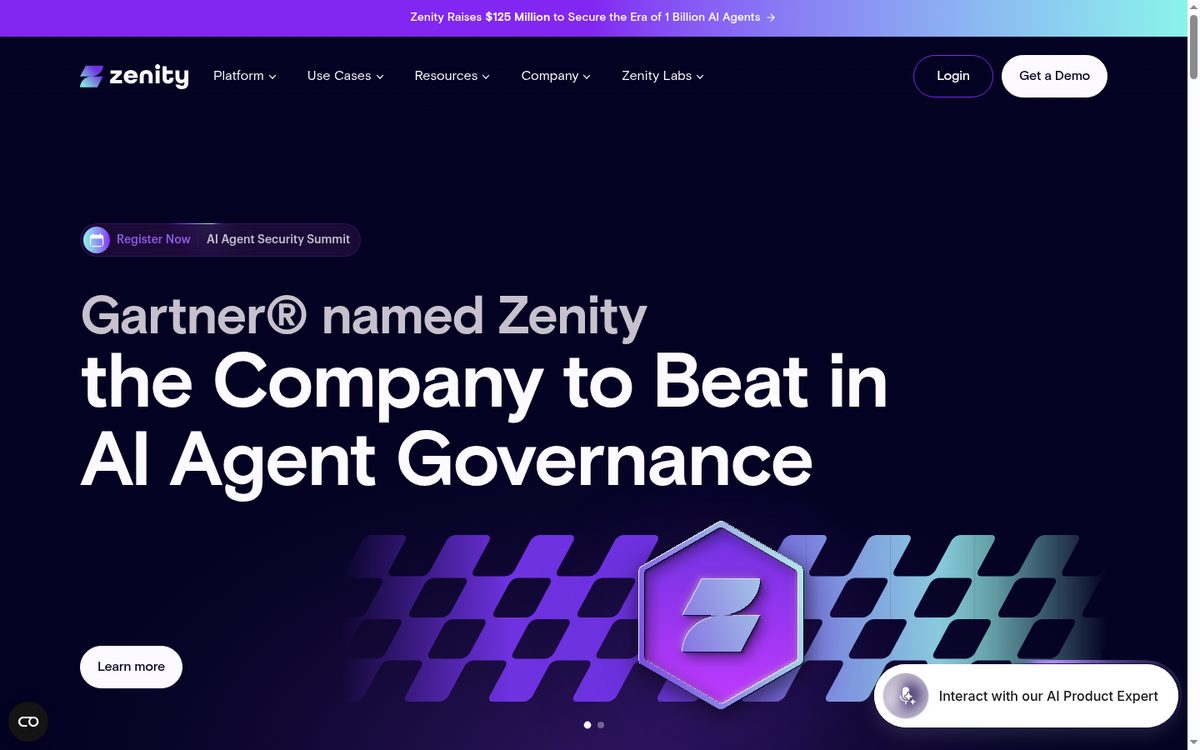
Zenity focuses on securing AI agents at the decision point: discovery, policy, identity context, and runtime boundaries that can allow, block, or stop agent actions across SaaS, cloud, and endpoint agent surfaces.
It is built around agent behavior rather than only prompt classification, which is why it sits at the center of this shortlist.
Key features:
- Agent discovery across SaaS, cloud, and endpoint contexts they list
- Runtime Boundaries for allow, block, and kill-switch decisions
- Policy that follows agent semantics across platforms
- Build-time guardrails plus runtime enforcement story
Why we like it:
Security teams that need one place to reason about what agents are allowed to do, not only what they say, get an agent-native control plane.
Limits:
Commercial. Confirm which agent platforms are covered in year one. Intent engines still need careful policy tuning to avoid blocking legitimate automation.
License or pricing: Commercial. Confirm packaging on 17 Sep 2026.
Pillar Security
Best for end-to-end discover, test, and runtime guardrails on agents
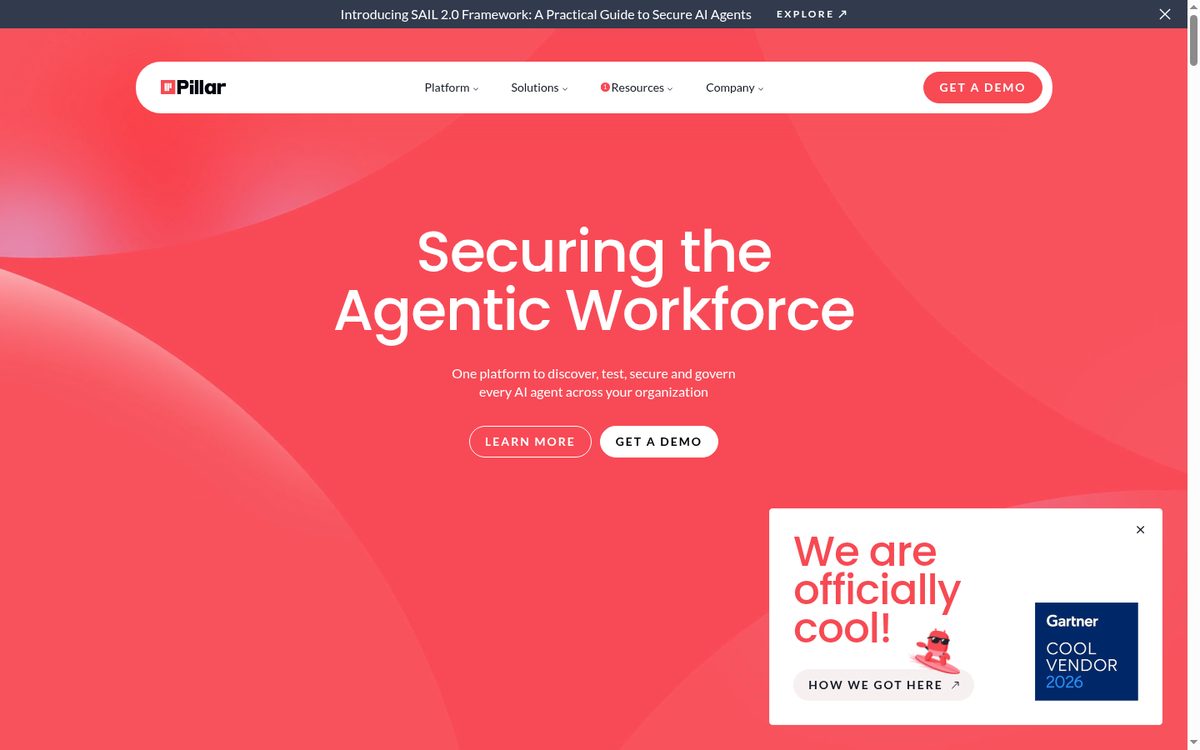
Pillar Security catalogs agents, models, tools, and MCP servers, tests agentic workflows with adversarial attacks, and applies adaptive runtime guardrails.
Pick it when you want discovery, red-team style testing, and runtime controls in one agent security narrative.
Key features:
- Agentless discovery of agents, tools, MCP servers, and skills
- Multi-turn adversarial testing of tool orchestration
- Runtime guardrails for malicious intent and data protection
- Governance and compliance evidence features they publish
Why we like it:
Programs that refuse to ship agents without both inventory and attack testing get a full-loop platform instead of a single filter.
Limits:
Commercial. Breadth can outrun staffing if every finding becomes a ticket. Confirm runtime enforcement points for your stack.
License or pricing: Commercial. Confirm on 17 Sep 2026.
Lasso Security
Best for agent and tool discovery with runtime enforcement on the path
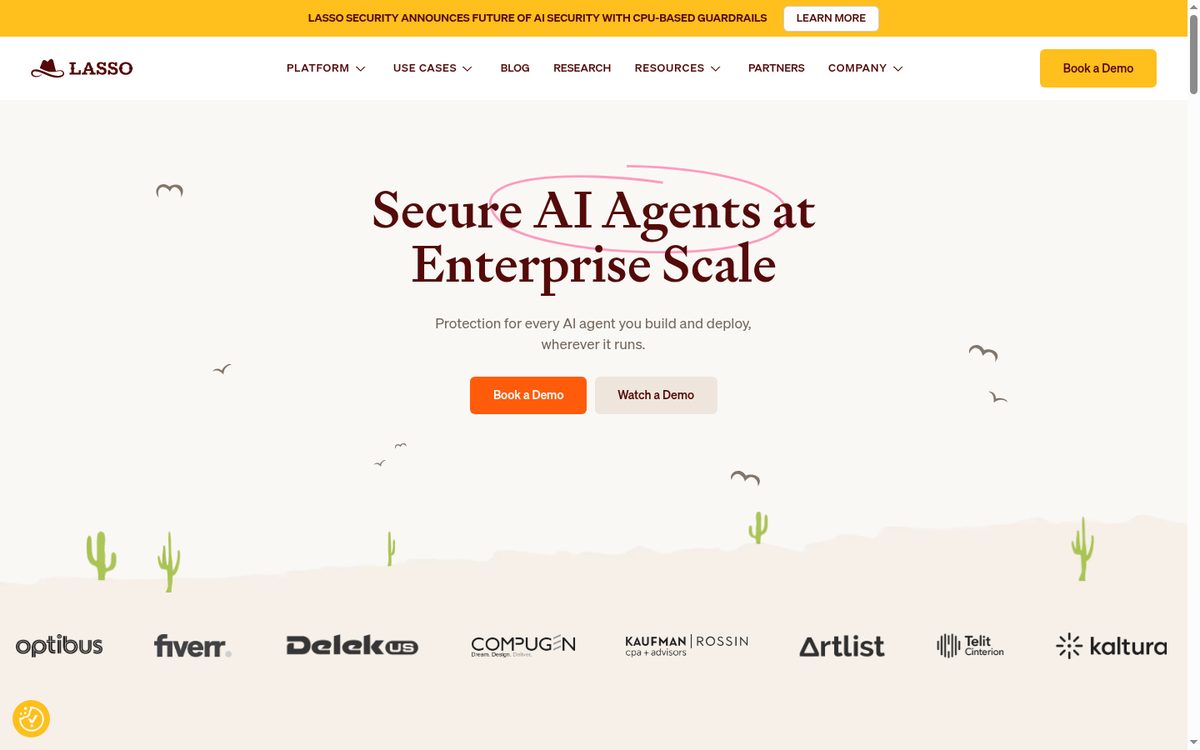
Lasso Security inventories agentic apps and the tools or MCP servers they call, assesses exposure, runs adversarial testing, and enforces policy at proxy, API, or gateway layers.
It fits teams that want a continuous loop from discovery to runtime for both third-party and homegrown agents.
Key features:
- Discovery of agents, tools, MCP servers, and resources
- Risk assessment for what agents can reach and do
- Adversarial testing with policy feedback
- Inline runtime enforcement options they document
Why we like it:
AppSec and AI security owners who need visibility into tool graphs before writing denylist policy get a practical discovery-to-enforce path.
Limits:
Commercial. Inline enforcement needs careful placement to avoid latency or blind spots. Confirm connectors for SaaS vs homegrown agents.
License or pricing: Commercial. Confirm on 17 Sep 2026.
Astrix
Best for agent and NHI identity graphs with least-privilege control
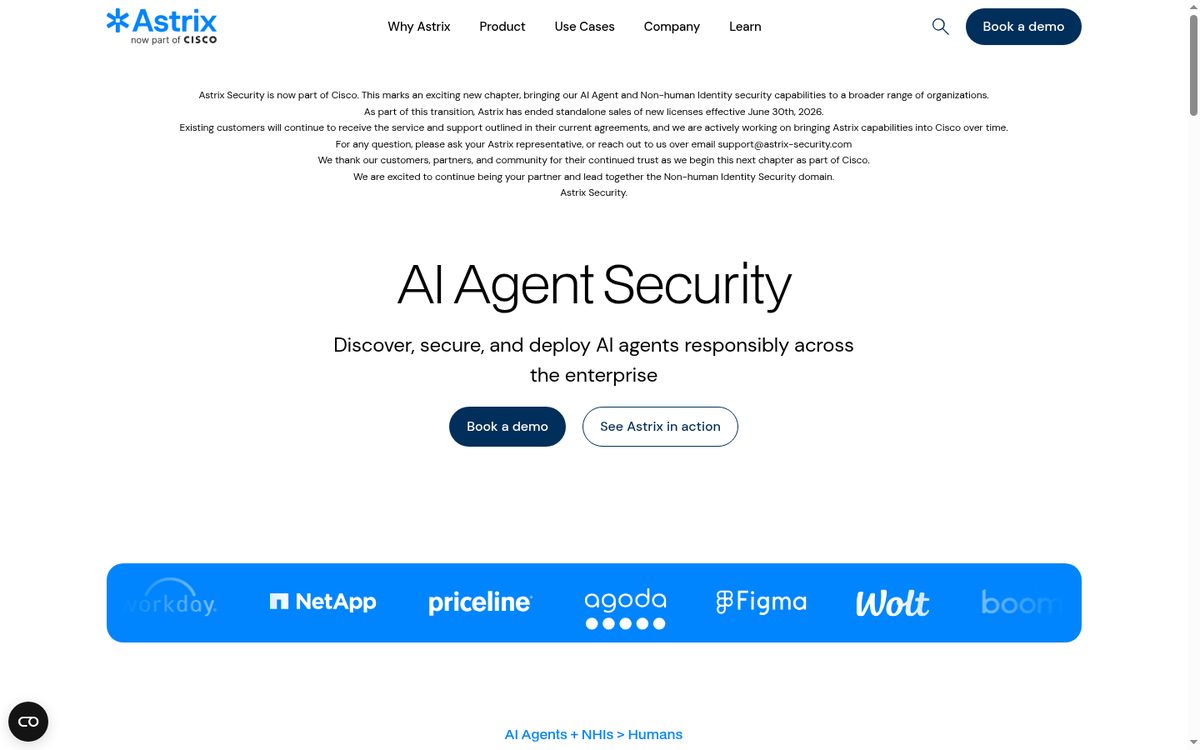
Astrix maps AI agents and non-human identities, their tokens and permissions, and who owns them, then pushes least-privilege and access policies before actions execute.
It is the identity-first seat on this list: critical when shadow agents and standing credentials are the breach path.
Key features:
- Identity graph for agents, MCP servers, keys, and OAuth apps
- Shadow agent discovery across cloud, SaaS, and CI contexts
- Risk scoring with ownership and usage context
- Agent control plane for short-lived, scoped credentials
Why we like it:
Identity and security engineering teams that already fight NHI sprawl get agent coverage in the same graph language.
Limits:
Commercial. Identity inventory without runtime tool semantics may miss prompt-driven misuse inside an allowed role. Pair with runtime action tools when needed.
License or pricing: Commercial. Confirm on 17 Sep 2026.
Prompt Security
Best for runtime AI controls spanning browser, endpoint, and MCP paths in the SentinelOne family
Prompt Security (now in the SentinelOne family) emphasizes securing AI usage at runtime across assistants, endpoints, and MCP connections rather than only scanning model files.
It is a pragmatic runtime seat for enterprises already consolidating on SentinelOne-style stacks.
Key features:
- Runtime protection for AI apps and assistants they list
- MCP and tool-path controls in their product story
- Browser and endpoint oriented AI usage visibility
- SentinelOne platform alignment after acquisition
Why we like it:
SOCs that want AI runtime signals next to endpoint telemetry get a path that is not a greenfield agent-only startup.
Limits:
Commercial. Confirm which Prompt capabilities ship under which SentinelOne SKU. Agent build-time posture may still need a specialist platform.
License or pricing: Commercial. Confirm current S1/Prompt packaging on 17 Sep 2026.
Oasis Security
Best for governing non-human and agent access at enterprise scale
Oasis Security focuses on discovering and governing non-human identities, including the service accounts and machine access patterns agents rely on.
Use it when the agent risk you can prove is standing privilege and ownership gaps, then add runtime action products if tool misuse remains.
Key features:
- NHI discovery and inventory at enterprise scale
- Ownership, usage, and risk context for machine identities
- Lifecycle and least-privilege workflows they publish
- Agent-adjacent access governance in their messaging
Why we like it:
IAM programs extending NHI discipline to agents get a mature identity governance angle without pretending to be an LLM firewall.
Limits:
Commercial. Not a full agent runtime brain. Confirm agent-specific connectors versus classic NHI sources.
License or pricing: Commercial. Confirm on 17 Sep 2026.
How to choose a AI agent security tool
Four questions before a PoC. Editorial, not a ranked bake-off.
| Critical question | Why it matters | What to evaluate | Red flag |
|---|---|---|---|
| Do agents already call tools in production? | Runtime without inventory is guesswork. | Zenity / Pillar / Lasso when action control is urgent. | Buying only a prompt filter after agents write to tickets and repos. |
| Is the urgent gap identity sprawl? | Shadow agents and tokens look like NHI problems. | Astrix / Oasis for identity graphs and least privilege. | An identity inventory with no plan for tool-level runtime denials. |
| Do you need adversarial testing of agent workflows? | Static policy misses multi-turn tool abuse. | Pillar / Lasso red-team style agent testing they document. | A one-time prompt injection demo as the whole program. |
| Where does MCP fit? | Protocol gateways help but are not the whole agent story. | Keep MCP gateways for transport; use this list for identity and action policy. | Replacing agent security with a single MCP proxy. |
What practitioners argue about agent security
Arguments cluster on permission bypass flags, MCP steering, and whether identity frameworks are ready for agents.
Permission bypass pattern
“Dangerously skip-permissions style flags bypass every guardrail and run commands without asking.”
Same Dec 2025 HN argument quoted in the Zenity entry (single HN link on this page).
NIST CAISI
“NIST asked for public input on securing AI agent systems that can take actions affecting real-world systems, including novel threats and adapted controls.”
January 2026 NIST news item linked in the opener. Agents are a standards conversation, not only a startup category.
If the next gap is prompt and response filtering, read LLM firewall tools. If MCP transport is the chokepoint, use MCP gateways.
FAQs
Is AI agent security the same as an LLM firewall?
No. Firewalls filter prompts and outputs. Agent security governs identities, tools, and whether actions may run.
How is this different from MCP gateways?
MCP gateways sit on the protocol path. Agent security covers inventory, identity, policy, testing, and runtime decisions across agent platforms, including but not limited to MCP.
Do NHI tools count as agent security?
They cover a major slice: credentials, ownership, and least privilege. You may still need runtime action control and agent-aware testing.
Is this a scored bake-off?
No. Order is editorial.