Platform security
Best Container Security Tools for Images, Admission, and Runtime
A clean image scan still ships if admission never checks the signature.
CI can return exit code 0 on an image scan while an unsigned tag still admits to production and a shell still starts at runtime. Those are three different controls: scan, admit, and runtime.
CVE-2024-21626 in runc is the concrete reminder that a container process can become a host problem. Image CVE gates help, but they do not replace signature policy or runtime detection after admit.
This shortlist mixes OSS scanners (Trivy, Grype), commercial lifecycle and runtime (Aqua, Sysdig), developer remediation (Snyk Container), and Sigstore Cosign for signing. It is not the Kubernetes admission/runtime shelf on Kubernetes security tools, and it is not general app SCA tools.
How we evaluated
We read first-party docs, GitHub licenses, and pricing pages on 17 Sep 2026. We asked whether the tool scans images in CI, whether it can gate admission with signatures or policies, whether runtime detection is in scope, and whether the license is OSS or quote-only. We did not run a lab bake-off.
| Tool | Best for | What to check |
|---|---|---|
| Trivy | OSS all-in-one image/IaC scan | Apache-2.0 · CI binary |
| Grype | OSS SBOM-first vuln scan | Apache-2.0 · Syft pairing |
| Aqua Platform | Commercial container lifecycle | Commercial · quote |
| Sysdig Secure | Commercial runtime defense | Commercial · quote |
| Snyk Container | Developer base-image fixes | Commercial · from $25/dev/mo |
| Cosign | Image signing and verify | Apache-2.0 · Sigstore |
Trivy
Best for open-source all-in-one image and IaC scanning
Trivy is Aqua’s open-source scanner for container images, filesystems, git repos, IaC, and secrets. Teams drop it into CI with a single binary and fail builds on severity thresholds.
On this page Trivy is the CLI image scanner, not Trivy Operator (that seat lives on the Kubernetes security list).
Key features:
- Image CVE scanning for OS and app packages
- IaC and Kubernetes manifest misconfig checks
- Secret detection in images and repos
- SBOM output formats they document
Why we like it:
The default OSS image scanner when you need one engine for CI without a sales call.
Limits:
Apache-2.0. You operate updates, ignore rules, and registry auth. Not a full runtime CNAPP.
License or pricing: Apache-2.0 open source. Commercial Aqua Platform is separate.
Grype
Best for SBOM-first vulnerability scanning with Syft
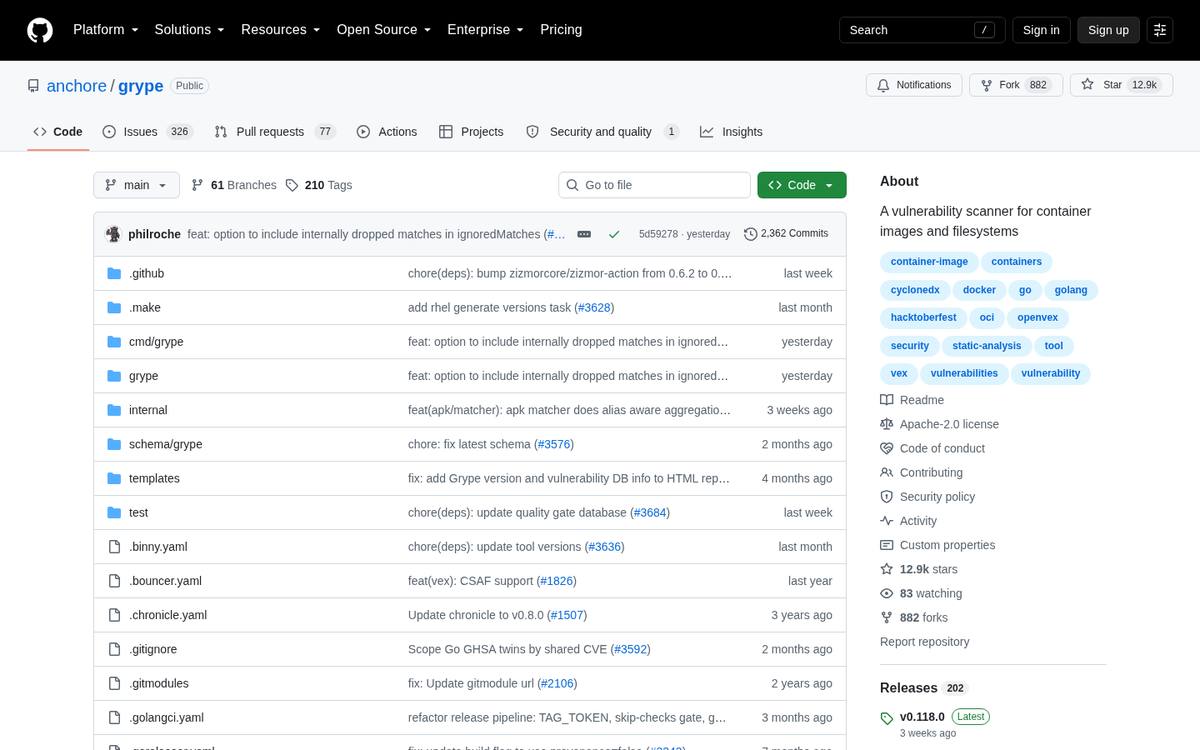
Grype scans container images and filesystems for known vulnerabilities and pairs naturally with Syft SBOMs. Teams that want SBOM-first workflows generate inventory once and re-scan as CVE feeds move.
It is the second OSS scanner seat: overlapping Trivy on purpose so buyers can pick SBOM-centric vs all-in-one CLI taste.
Key features:
- Vulnerability matches for images and directories
- Syft SBOM pairing for inventory-first pipelines
- CI-friendly exit codes
- Apache-2.0 distribution
Why we like it:
When SBOM pipelines are already a requirement, Grype fits the inventory-then-scan loop cleanly.
Limits:
Apache-2.0. Config and local-daemon quirks show up in practitioner threads; prove registry and daemon access in CI before you gate releases.
License or pricing: Apache-2.0 open source. Anchore Enterprise is commercial and separate.
Aqua Platform
Best for commercial container lifecycle control
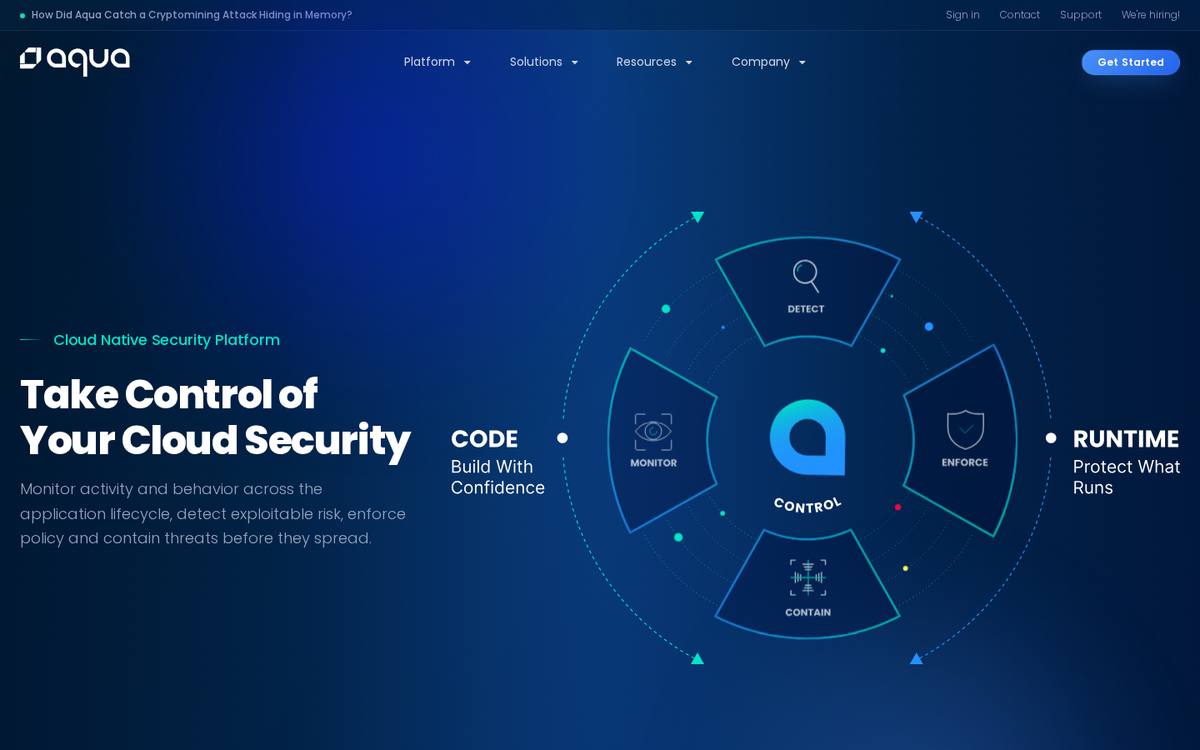
Aqua’s commercial platform covers image assurance, admission policies, and runtime controls for containers. It is the vendor path when Trivy in CI is not enough operations glue.
Distinct from the CNAPP page framing: here Aqua is judged as container lifecycle depth, not as a full multi-cloud graph suite.
Key features:
- Image scanning and assurance
- Admission control integrations they document
- Runtime protection for containers
- Supply-chain policy workflows
Why we like it:
Commercial container lifecycle when you need vendor support and policy across scan, admit, and runtime.
Limits:
Commercial quote. Overlap with Sysdig on runtime means you should pick one primary sensor strategy.
License or pricing: Commercial. Quote CTAs as of 17 Sep 2026.
Sysdig Secure
Best for commercial runtime defense on containers
Sysdig Secure brings commercial runtime detection, forensics, and scanning around the Falco lineage. On this list it is the runtime seat for teams that will run sensors, not only CI CVEs.
Falco itself remains on the Kubernetes tools page as the OSS engine. Here you evaluate the commercial container runtime program.
Key features:
- Runtime detection for containers and Kubernetes
- Image scanning in the Secure product
- Incident response and forensics workflows
- Policy and compliance reporting they document
Why we like it:
Runtime-first commercial choice when CI scanners never see the breakout.
Limits:
Commercial. Sensor rollout and tuning are the real cost. Image scanning alone may not justify the seat if Trivy already gates CI.
License or pricing: Commercial. Quote-only as of 17 Sep 2026.
Snyk Container
Best for developer-facing base-image remediation advice
Snyk Container focuses on developer experience: scan images, explain base-image upgrades, and open fixes in the workflows app teams already use. First-party pricing publishes Team plans from $25 per developer per month.
It is the DevEx commercial seat, not the deepest runtime sensor.
Key features:
- Container image vulnerability scanning
- Base-image remediation recommendations
- SCM and CI integrations they document
- Developer-first issue routing
Why we like it:
When engineering will only act on scanner output that suggests a concrete base-image move, Snyk’s framing fits.
Limits:
Commercial. Container is often bundled with other Snyk products; confirm the SKU. Runtime admission is not the center of this product.
License or pricing: Free tier exists; Team from $25 per developer/month on snyk.io/pricing (checked 17 Sep 2026). Enterprise is quote-based.
Cosign
Best for open-source image signing and verification
Cosign signs and verifies container images with Sigstore. Admission controllers can require signatures so an unsigned tag never becomes a running pod even when the CVE scan returned exit code 0.
This is the trust layer on the shortlist: scan proves known CVEs; Cosign proves provenance.
Key features:
- Container image signing and verification
- Keyless signing flows Sigstore documents
- Admission integration patterns in ecosystem docs
- Apache-2.0 tooling
Why we like it:
OSS admission trust when registries must prove what CI signed.
Limits:
Apache-2.0. Key management, policy wiring, and registry support are on you. Cosign does not replace CVE scanning.
License or pricing: Apache-2.0 open source.
How to choose a container security tool
Four questions before you gate the registry.
| Critical question | Why it matters | What to evaluate | Red flag |
|---|---|---|---|
| Where does the failure happen: build, admit, or run? | Different layers need different tools. | Trivy/Grype/Snyk for build; Cosign for admit trust; Sysdig/Aqua for runtime. | One CVE scanner sold as full container security. |
| Do we require SBOMs? | Inventory-first pipelines change scanner shape. | Grype+Syft when SBOM is mandatory; Trivy when one binary should also cover IaC. | SBOM slides without a generator in CI. |
| Who remediates base images? | Developers ignore abstract CVE piles. | Snyk when upgrade advice must land in PRs; Trivy when platform owns rebuilds. | Scanner email with no owner. |
| Will we run runtime sensors? | Breakouts happen after admit. | Sysdig/Aqua if yes; do not skip Cosign either way. | Runtime license with no admission policy. |
What practitioners argue about container security
Threads split between CI scanner friction, signature verify on pull, and whether CVE floods from fat images are actionable.
Stack Overflow
“You need to log in to ghcr.io before running Trivy and also pull the image manually.”
Scan private GitHub package with Trivy, Jul 2025. Private registry auth is still the first CI failure mode for image scanners.
Hacker News
“Sign the container image while pushing, verify the signature on fetch/pull.”
Jun 2025 comment on Cosign/nerdctl flows (permalink in the Cosign entry). Scan-clean images still need a trust gate at admit.
Cluster admission engines and KSPM sit on Kubernetes security tools. Library SCA for app deps sits on SCA tools. Full cloud correlation is on CNAPP tools.
FAQs
Is Trivy enough for container security?
Trivy is a strong OSS scanner for images and IaC. It does not replace admission signature policy or runtime detection by itself.
How is this different from the Kubernetes security list?
That page centers cluster tools (Falco, Kyverno, Gatekeeper, Trivy Operator). This page centers image scan, signing, and commercial container lifecycle/runtime products.
Is Snyk Container the same as Snyk SCA?
Related vendor, different job. SCA targets application dependencies. Snyk Container targets image layers and base-image remediation.
Is this a scored bake-off?
No. Order is editorial.