Whistic vs UpGuard: Which Vendor Risk Loop Fits Your Week?
Choose Whistic when questionnaire-led vendor trust exchange is the product. Choose UpGuard when continuous vendor security ratings and attack-surface monitoring are the product.
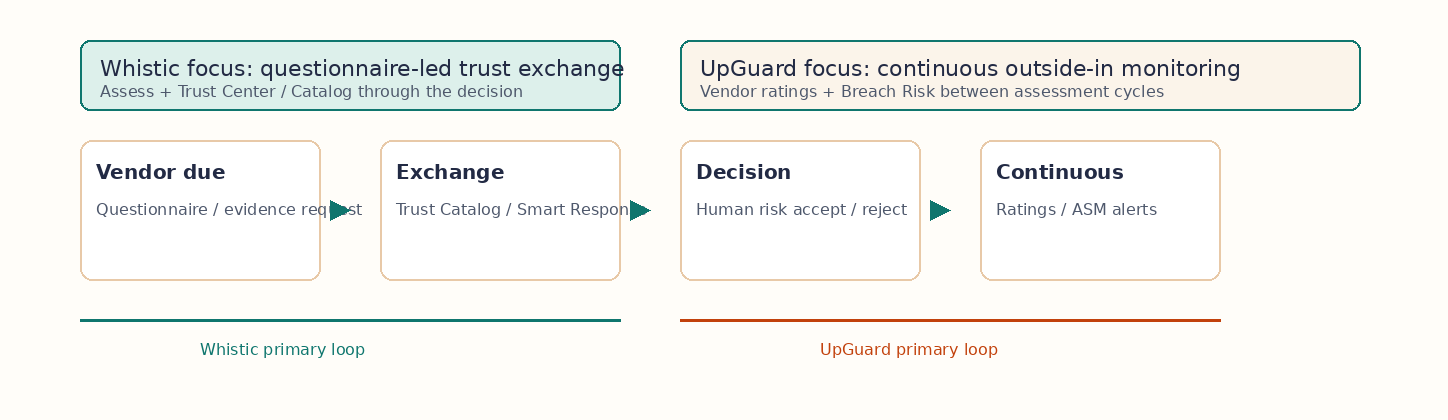
Both products land on the same RFP line: vendor risk, or third-party risk management. Both promise less manual chasing and fewer surprises from suppliers. That is where the contradiction starts. Shrinking third-party exposure is not one weekly loop. One loop is questionnaire-led trust exchange: send a framework, collect SOC 2s and control answers, publish a Trust Center so the next buyer does not restart from zero. The other loop is continuous outside-in monitoring: watch vendor security ratings and internet-facing exposure change between those assessment cycles.
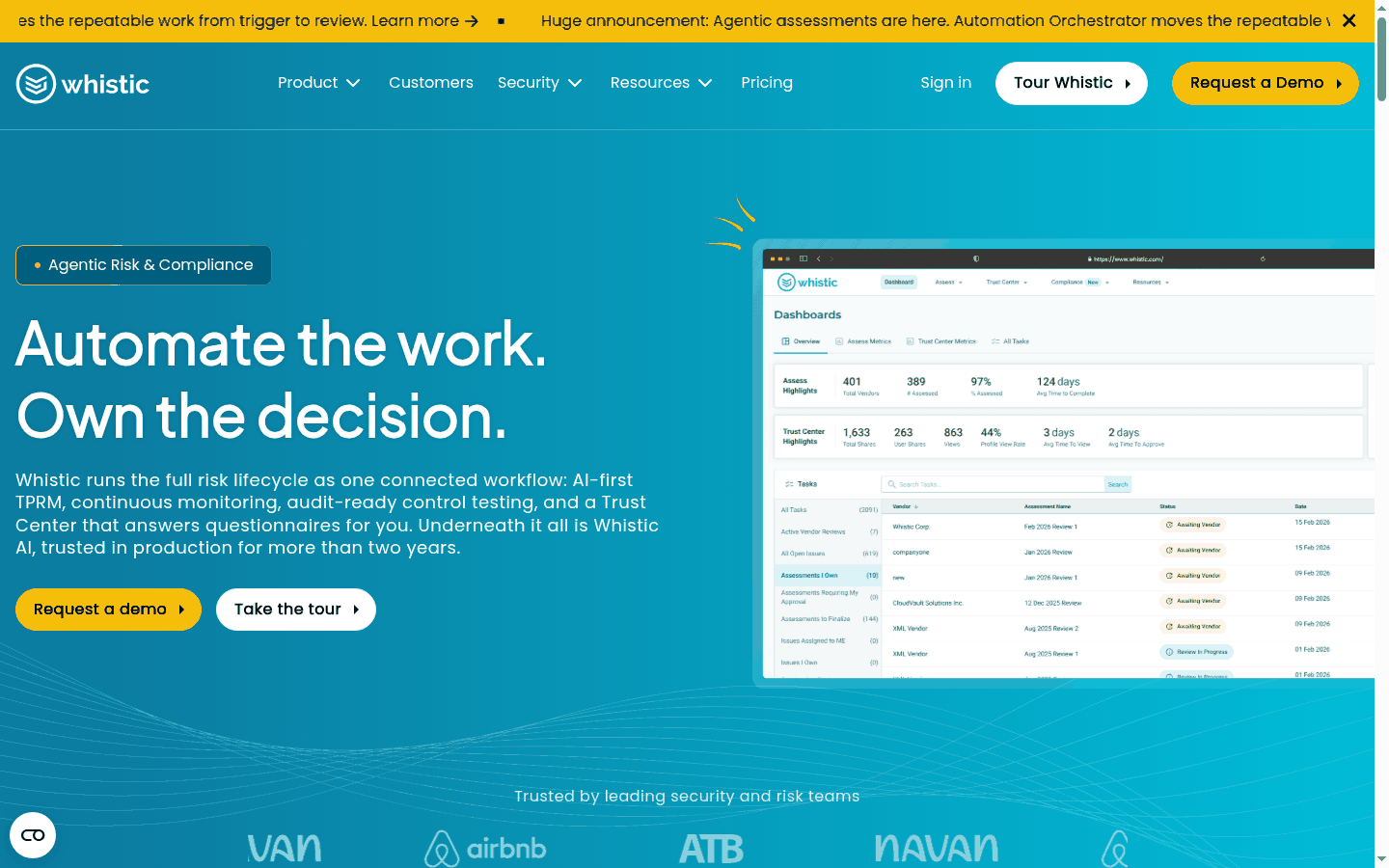
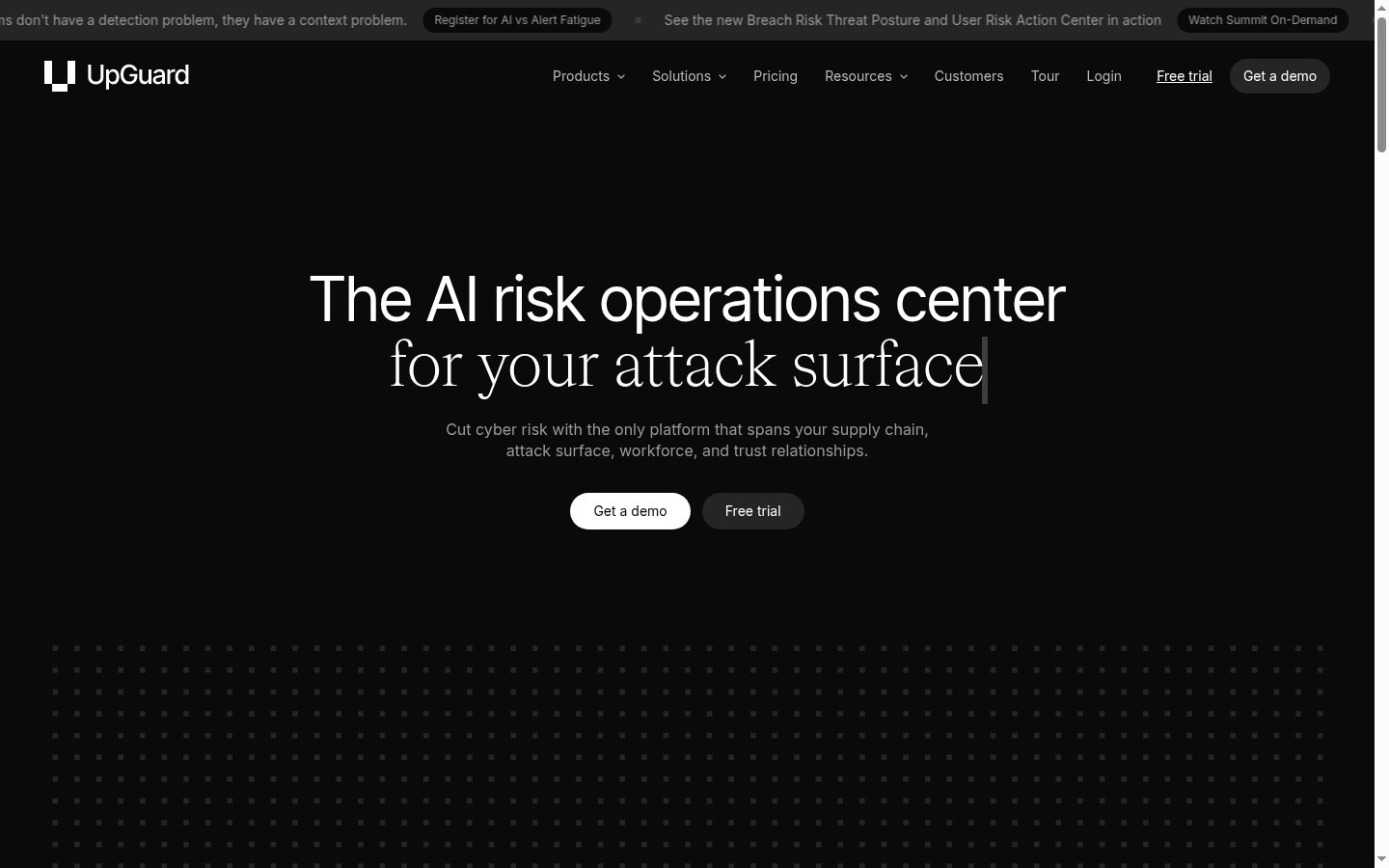
Between these two, Whistic Automation Orchestrator productizes the assessment loop with Assess, Trust Center / Trust Catalog sharing, Smart Response, and agentic handoffs from trigger to executive summary. UpGuard productizes continuous Vendor Risk ratings and Breach Risk attack-surface visibility, with questionnaires and remediation workflows attached to that monitoring spine. Related shortlists: vendor risk tools and attack surface management. Broader compares live under Compare.
| Job | Questionnaire-led vendor trust exchange: Assess, Trust Center / Trust Catalog, Smart Response | Continuous vendor security ratings and outside-in Vendor Risk / Breach Risk monitoring |
|---|---|---|
| How a bad day closes | Stuck questionnaire or overdue reassessment moves to collected evidence, AI summary, and a human risk decision | Rating drop or new exposure on a monitored vendor (or your own surface) opens alert, AI profile, and remediation |
| Deploy | SaaS TPRM / Agentic Risk Operations platform | SaaS Cyber Risk Posture Management (Vendor Risk + Breach Risk + Trust Exchange) |
| Operator morning unit | Open assessments, evidence packs, Trust Catalog reuse, vendor response queue | Rating changes, exposure findings, monitored vendor slots, remediation tickets |
| License/pricing | Quote-only Assess and Trust Center packages (checked 9 Sep 2026) | Standard $1,750/mo billed annually for 50 vendor slots; +$79/vendor/mo; higher tiers quote; free 5-vendor self-service path documented in help (checked 9 Sep 2026) |
| Who operates it | TPRM / InfoSec assessors; vendor InfoSec publishing Trust Centers | TPRM plus security ops watching ratings and attack surface; vendors may use Trust Exchange |
Recent first-party moves keep the split visible. Whistic generally available Automation Orchestrator in August 2026 so four agents can run Assess from trigger to executive summary while people keep the risk decision. UpGuard keeps publishing a public Vendor Risk ladder on its pricing page and continues shipping Breach Risk and Trust Exchange updates around continuous posture, not questionnaire-only exchange.
We reviewed first-party docs, public pricing pages, and live community threads. We did not sit in paid production tenants, so this is not a hands-on benchmark.
Whistic
UpGuard
Editions and pricing
Whistic keeps list dollars behind a sales conversation. The public packaging page separates Whistic Assess (frameworks, Trust Catalog access, review workflow, AI Copilot summaries) from Whistic Trust Center (catalog publish, NDA sharing, Smart Response). Automation Orchestrator is included for Assess customers with Whistic AI enabled, with no separate add-on called out in the launch post.
UpGuard publishes a Vendor Risk ladder. Prefer the public pricing card numbers when the help center still shows older Starter/Professional dollar lines: two official pages disagree on the paid entry price, so treat $1,750/mo billed annually on the main pricing page as the list figure for Standard (50 monitoring slots, additional vendors $79/mo). Help documentation still describes a free self-service path with 5 vendors and a Breach Risk add-on starting at $250/mo for that path.
| Public list lines | Quote-only Assess and Trust Center packages; AI Copilot and Smart Response capacity negotiated in the package | Standard $1,750/mo annual (50 vendors); Professional / Corporate / Enterprise+ contact sales; +$79 per extra vendor/mo on Standard |
|---|---|---|
| What the quote usually meters | Assessment volume, Trust Centers, users, Smart Response increments, AI Copilot licenses per assessment | Vendor monitoring slots, snapshots, platform users, fourth-party and multi-org options on higher tiers |
| Self-serve start | Demo / sales-led; no public self-serve dollar ladder | Free trial and a documented free 5-vendor Vendor Risk path; paid Standard listed publicly |
If procurement needs a published monthly rate before a call, UpGuard fills the spreadsheet first. Full Whistic Assess + Trust Center packaging still needs a Whistic conversation.
Questionnaire exchange and Trust Catalog
| Primary exchange job | Assess frameworks against vendor evidence; publish and reuse Trust Centers via Trust Catalog; Smart Response from a Knowledge Base | Questionnaire library/builder and AI document profiles sit on top of continuous Vendor Risk monitoring |
|---|---|---|
| Network / catalog | Trust Catalog exchange so buyers can find published vendor proof and start lower-touch assessments | Trust Exchange helps vendors publish posture and answer questionnaires; center of gravity remains ratings + monitoring |
| Agentic assessment | Automation Orchestrator agents (Initiator, Collector, Analyst, Reporter) move Assess from trigger to executive summary | AI security profiles and automated assessment reports accelerate evidence review; not the same four-agent Assess hub |
| Operator morning unit | Assessment queue, evidence age, catalog reuse, Smart Response backlog | Questionnaire tasks attached to monitored vendors, not a catalog-first exchange product between these two |
That is the questionnaire-exchange pain Whistic productizes on the buyer and seller sides: structured assessments, reusable Trust Centers, and agentic collection/summary so the case reaches a human decision faster. UpGuard can run questionnaires too; between these two, the catalog-first trust exchange job still belongs to Whistic.
Continuous ratings and attack-surface monitoring
| Continuous outside-in | Vendor monitoring and breach/disclosure change workflows exist inside the broader risk platform; not the dedicated ratings product here | Vendor security ratings updated multiple times per day; daily scanning between assessments; Breach Risk for your own external surface |
|---|---|---|
| What triggers work | Assessment cadence, evidence age, catalog publish/share events | Rating drops, new vulnerabilities/misconfigs, news/incidents, typosquatting and related Breach Risk findings |
| Remediation shape | Findings and follow-ups inside the assessment / vendor record toward a risk decision | Risk and remediation workflows tied to monitored vendors and your own posture |
| Buy the queue | Exchange and decide on control evidence | Watch posture change continuously, then open the assessment when evidence is still required |
Between these two, do not buy “TPRM platform” as a unique checkbox. Buy the queue your operators close every week: clear questionnaire and Trust Catalog exchange work, or watch continuous ratings and attack-surface change and remediate.
Where they overlap
Both sell into third-party risk programs. Both ingest vendor evidence, support security questionnaires, and market AI to shrink analyst hours. Both can help a vendor publish posture to customers. An RFP that only says “automate vendor risk” will shortlist both. Continuous ratings do not replace a signed control answer, and a completed CAIQ does not tell you a vendor’s TLS broke last night, so overlap is real and still incomplete.
When to use both
Use both only if you deliberately want a questionnaire / Trust Catalog exchange product and a separate continuous ratings / ASM product. That is two tools and two operating models.
Skip UpGuard here if primary pain is unanswered questionnaires, evidence reuse, and Trust Catalog publishing. Skip Whistic here if primary pain is vendor rating drops, continuous monitoring slots, and Breach Risk visibility between assessment cycles.
Decide which operational pain owns the budget. Questionnaire-led trust exchange with Assess and Trust Catalog: Whistic. Continuous vendor security ratings and attack-surface monitoring: UpGuard. Only then open the quotes.
FAQs
Are Whistic and UpGuard the same vendor risk product?
No. Both sit under TPRM. Whistic leads on questionnaire-led trust exchange and Trust Catalog publishing. UpGuard leads on continuous vendor security ratings and Breach Risk attack-surface monitoring.
Do I need both?
Only if you deliberately want an exchange/catalog product and a separate continuous ratings/ASM product. Most teams pick the weekly queue that hurts more.
Is there a public list price?
Whistic is quote-only for Assess and Trust Center packages (checked 9 Sep 2026). UpGuard lists Standard at $1,750/mo billed annually for 50 vendor monitoring slots, with additional vendors at $79/mo, and documents a free 5-vendor self-service path in help (checked 9 Sep 2026).
Is this a scored bake-off?
No. Order is editorial.