Best Insider Risk Management Tools in 2026: When Agents Act for Employees
Five platforms for spotting risky behavior by people and the AI agents working in their name.
Insider risk programs are built around 4 classic scenarios: a departing employee taking files, intellectual property theft, negligent sharing, and a compromised account acting like an insider. A DTEX-sponsored Ponemon study puts the average annual cost of insider risk incidents at USD 19.5M.
Microsoft Purview, DTEX, Proofpoint, and Mimecast Incydr cover those scenarios with different evidence: Microsoft 365 signals, endpoint behavior telemetry, user activity capture, and file exfiltration detection. The use-case matrix below shows which scenario each one documents.
AI agents add one newer problem: an agent acting with an employee’s session shows up as the employee. Ent, out of stealth in June 2026, is built around that. It is listed last because its capabilities are launch claims, stated rather than independently demonstrated.
How we evaluated
We read each vendor’s product pages, pricing pages, launch material, and documentation on 14 Oct 2026, and checked each one against the same questions: which channels it watches, whether it separates human from AI agent activity, whether it can block or only alert, how it protects employee privacy, and how it is licensed. Where public material does not cover a question, we write “not documented”.
| Tool | Best for | What to check |
|---|---|---|
| Microsoft Purview Insider Risk Management | Risk scoring and cases from Microsoft 365 signals | Purview Suite USD 12/user/mo with E3 |
| Mimecast Incydr | Exfiltration detection and adaptive controls for humans and agents | Formerly Code42 · quote |
| DTEX | Behavioral telemetry with pseudonymization and AI risk | Quote |
| Proofpoint Insider Threat Management | User activity monitoring with sentiment and forensics | Quote |
| Ent | Intent-aware intervention on human and agent actions | Launched Jun 2026 · quote |
Purview IRM
Incydr
DTEX
Proofpoint ITM
Ent
Use-case matrix: classic insider scenarios
Each cell reflects what the vendor documents publicly for that scenario. A gap means the vendor does not name it, not that the product cannot help.
| Scenario | Microsoft Purview IRM | Mimecast Incydr | DTEX | Proofpoint ITM | Ent |
|---|---|---|---|---|---|
| Departing employee taking data | Policy template: Data theft by departing users | Departing employee detection named | Departing employees named in use cases | Departing users named | not documented |
| IP and source code theft | Data leaks template | Source code exfiltration named | Not named separately | Malicious insiders stealing intellectual property named in its insider threat reference | not documented |
| Negligent or careless sharing | Data leaks and security policy violations templates | not documented | Negligent insiders named | Careless users named | Mistakes named alongside risky actions and AI misuse (vendor site) |
| Compromised account | Security policy violations template | not documented | Compromised insiders named | Compromised users named | not documented |
| AI agent acting with a user session | Risky AI usage template | Agents named in risk model | AI risk named | not documented | Core launch claim |
Sources: Purview policy templates, Incydr, DTEX use cases, Proofpoint ITM Proofpoint ITM data sheet, and Proofpoint insider threat reference, and Ent.
Microsoft Purview Insider Risk Management
Best for Microsoft 365 organizations that own E5 or the Purview Suite
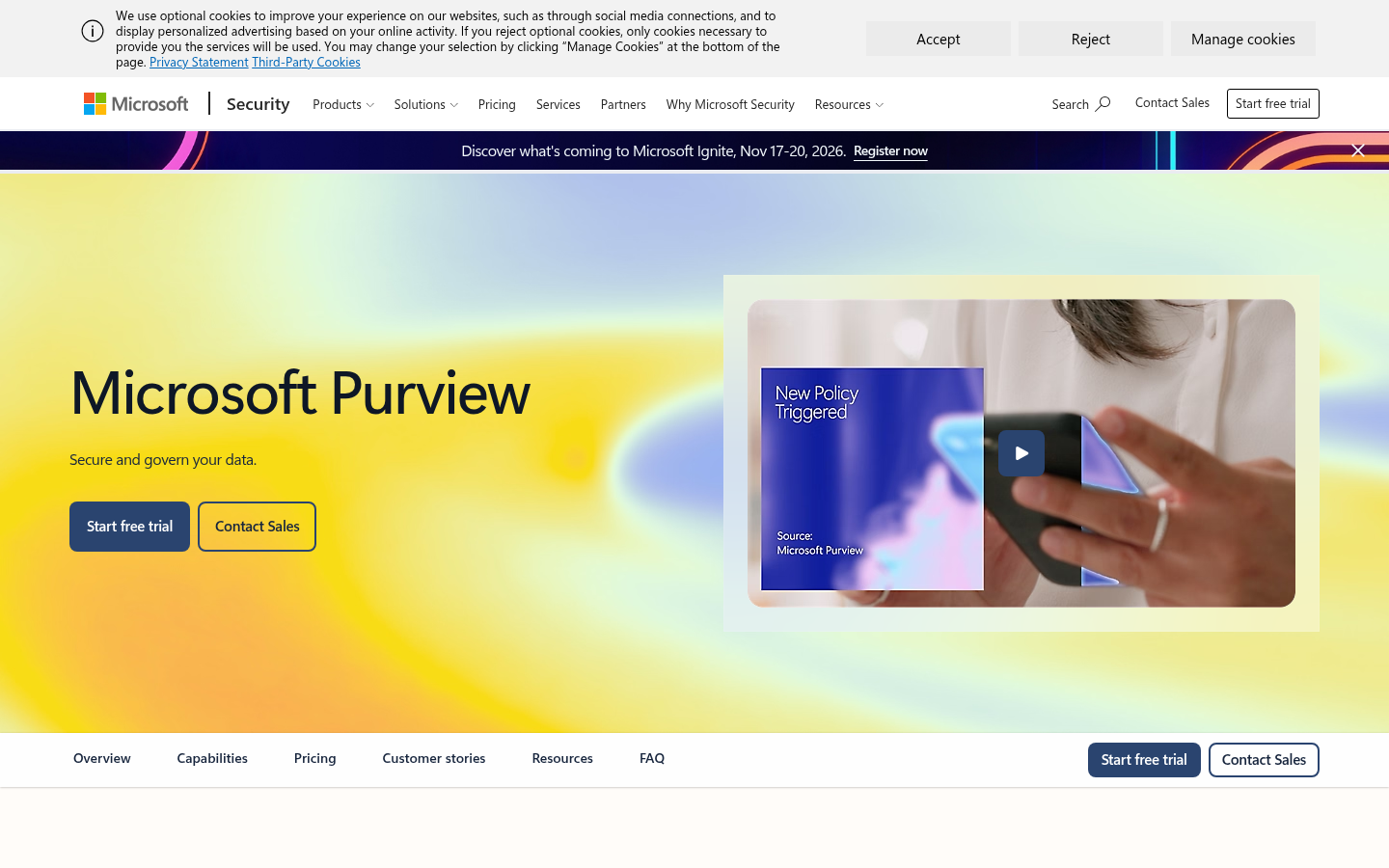
Purview Insider Risk Management scores risky activity from Microsoft 365 and Microsoft Graph signals using policy templates such as data theft by departing users, triages alerts into cases, and escalates to eDiscovery (Premium).
Endpoint DLP on onboarded Windows and macOS devices does the blocking. Adaptive Protection links the two so higher-risk users get stricter DLP.
Key features:
- Policy templates for departing users and data leaks
- Case management with eDiscovery escalation
- Adaptive Protection with Endpoint DLP
- Pseudonymized users by default
Why we like it:
For an E5 tenant, the signals, licensing, and investigation tools are already in place.
Limits:
Signal depth outside Microsoft 365 depends on connectors. Agent-specific attribution is not documented.
License or pricing: Microsoft Purview Suite USD 12 per user per month, paid yearly, with Microsoft 365 E3. Included in Microsoft 365 E5 at USD 60 per user per month, paid yearly.
Mimecast Incydr
Best for fast-to-deploy exfiltration detection that covers AI agents
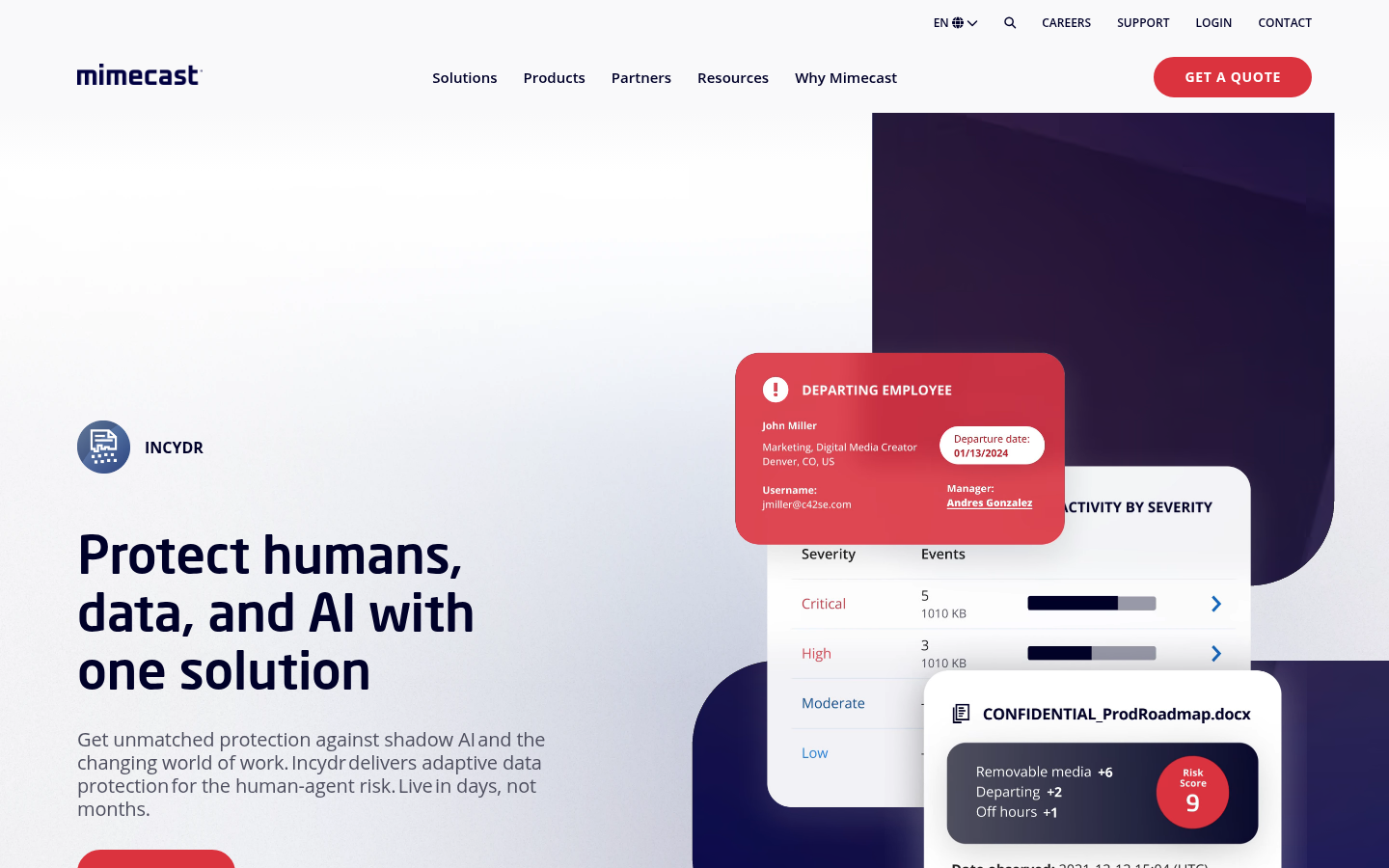
Incydr, which Mimecast acquired with Code42, detects data movement across email, endpoint, cloud, browser, and agentic channels from day one without tagging or policy setup, and ties each event to a person.
Its Agent Risk Center discovers agents, classifies their AI activity, and applies controls. Responses range from education to allow-with-justification to blocking.
Key features:
- Exfiltration detection without upfront policy
- Agent Risk Center and MCP connection dashboards
- Adaptive controls from coaching to blocking
- Integrations with CrowdStrike, Cortex XSOAR, and Splunk
Why we like it:
It is the quickest to show value, and it names AI agents and MCP connections as risk surfaces.
Limits:
Deep behavioral analytics and sentiment are lighter than DTEX or Proofpoint.
License or pricing: Commercial. No public pricing.
DTEX
Best for privacy-conscious behavioral analytics at enterprise scale
DTEX captures 12 groups of human-driven activity as more than 500 metadata elements and correlates them into one risk score. Its patented pseudonymization removes personal identifiers until an investigation justifies revealing them.
It sells Insider Risk Management, Risk-Adaptive DLP, and AI Risk Management for AI usage and agentic workflows, plus the i3 investigations team.
Erik Devine, Director of Cybersecurity & IT Infrastructure at Blick Art Materials, in a DTEX-published post. Blick set out to improve DLP and now uses DTEX daily for prevention and forensics. It is a vendor-published testimonial, not an independent review.
Key features:
- Metadata-based behavioral telemetry
- Pseudonymization by design
- AI Risk Management for agentic workflows
- Triage Guardian and Threat Hunter agents
Why we like it:
It sees intent through behavior patterns without screen recording, which eases works council and privacy reviews.
Limits:
Pricing is not published. Blocking depends on the Risk-Adaptive DLP module.
License or pricing: Commercial. No public pricing.
Proofpoint Insider Threat Management
Best for investigations that need forensic evidence for HR and legal
Proofpoint ITM combines user activity monitoring across endpoints, browsers, cloud, and email with sentiment analysis of workplace communications. Investigations use timelines and forensic screenshots that can be shared with HR, legal, and compliance.
Real-time controls block risky transfers to USB, cloud sync, web uploads, and GenAI tools, with in-the-moment coaching.
Key features:
- User activity monitoring
- Sentiment analysis
- Timeline investigations with screenshots
- Blocking for USB, cloud sync, uploads, and GenAI
Why we like it:
It produces the evidence that holds up when a case goes to HR or legal.
Limits:
Screenshot capture and sentiment analysis need careful privacy governance.
License or pricing: Commercial. No public pricing.
Ent
Best for stepping in on risky actions by people and AI agents before they finish
Ent launched in June 2026 with a USD 100M seed round.
In an insider case the hard question is who acted. Ent treats a person and the AI agent working in that person’s session as separate actors, judges the intent behind each action, and can intervene just in time, so a file copy is stopped instead of reported afterward.
Key features:
- One agent across Windows, macOS, Linux, and browsers
- Intent evaluation for human and agent actions
- Just-in-time interventions
- Self-hosting in the customer’s cloud
Why we like it:
It is built for the timing problem: alerts that arrive after the data has left.
Limits:
Launch-stage. Case management and HR and legal workflows are not documented.
License or pricing: Commercial. No public pricing.
How to choose an insider risk tool
- Decide what you must stop, not just see. If blocking matters, check that the product, not only a separate DLP add-on, can act.
- Test agent attribution. Run an agent in a pilot and see whose name lands on the alert.
- Involve privacy and HR early. Pseudonymization, screenshots, and sentiment analysis each need sign-off.
- Price the Microsoft baseline. If you own E5, measure what Purview misses before buying.
What we left out
- Code42 as a separate product: it is now Mimecast Incydr.
- Pure UEBA tools in SIEMs: useful, but not built for insider case management.
- Forcepoint: its insider threat page now leads to Risk-Adaptive Protection, a DLP policy layer rather than insider case management.
- Teramind: it is sold as a workforce analytics and employee monitoring platform, with productivity tracking at its center, so it fits a different buyer.
What the internet thinks about insider risk
Live threads, quoted for the argument, not the score.
Hacker News · April 2026
“If you aren’t designing your systems to be robust against insider threats, they will fail.”
From a ransomware thread. The same commenter added that systems built for insider threats will probably also fail, so limiting the blast radius matters more than catching everyone.
Hacker News · January 2026
“Though, it’s important to recognize the amplification of insider threat that exists on any employees desktop who uses this.”
On Anthropic’s Cowork agent. Others argued sandboxing solves it. The commenter’s view was that monitoring is the only real answer, which is the bet these vendors make.
Choose Purview IRM if you own Microsoft 365 E5. Choose Incydr for fast exfiltration coverage that includes agents. Choose DTEX for privacy-first behavioral analytics. Choose Proofpoint ITM when investigations need forensic evidence. Choose Ent when AI agents acting in employees’ sessions are the main concern and you can pilot a launch-stage vendor first.
FAQs
What is insider risk management?
Detecting and responding to risky actions by employees, contractors, and now AI agents acting for them, such as data theft, leaks, and policy violations.
Is insider risk management the same as DLP?
No. DLP enforces data rules. Insider risk tools score behavior over time and support investigations. Most vendors here sell both.