Best Exploit Intelligence Tools in 2026
Seven tools that add exploit evidence or an exploit-likelihood score to a CVE, so a team can decide what to fix first.
A Cyentia Institute study for Kenna Security found that only 2% of published vulnerabilities were observed exploited in the wild. That gap is why a CVSS-ranked queue is a poor map of what a team should fix first: most of the work never lines up with observed exploitation.
Exploit intelligence, on this page, is the evidence or the score that sits between a published CVE and a remediation decision: whether a proof of concept exists, whether the flaw is being used, and, for some products, what that means on your assets. It is not another scanner, and it is not a full CTEM program. Those jobs are covered on our vulnerability management platforms and CTEM tools pages.
Seven tools are compared here, in this order: VulnCheck, Tenable, Recorded Future, Google Threat Intelligence, Microsoft Security Exposure Management, Qualys Enterprise TruRisk, and Empirical Security. Empirical announced a USD 25M Series A on 20 Jul 2026 and is listed last because its capabilities are launch claims, stated on its own site rather than independently demonstrated.
How we evaluated
We read each vendor’s product pages, pricing or licensing pages, and public documentation on 12 Nov 2026, and checked each one against the same questions: what exploit evidence or score it publishes, whether that score is global or built on your assets, whether it has to be the scanner of record, and how it is sold. Where public material does not cover a question, we write “not documented”.
| Tool | Best for | What to check |
|---|---|---|
| VulnCheck | Exploitation timeline, maturity, and in-the-wild evidence on a CVE | KEV catalog free · commercial product by quote |
| Tenable | Predictive Prioritization (VPR) and Node Exposure Score | Tenable One quote, per asset |
| Recorded Future | Risk Score and weaponization lifecycle, matched to your stack | Quote by package and org size |
| Google Threat Intelligence | Mandiant-backed vulnerability intelligence and exploitation state | Quote |
| Microsoft Security Exposure Management | MDVM exploit flags and attack paths inside Security Exposure Management | Included with qualifying licenses |
| Qualys Enterprise TruRisk | TruRisk score from Qualys threat research, exploit inputs, and asset criticality | Quote |
| Empirical Security | Global 30-day probability plus a local model on your findings | Quote |
VulnCheck
Tenable
Recorded Future
Google TI
Microsoft SEM
Qualys
Empirical
What each tool tells you about a CVE
Each cell reflects what the vendor documents publicly. A gap means the public material does not name it, not that the product cannot help.
| Question | VulnCheck | Tenable | Recorded Future | Google TI | Microsoft SEM | Qualys | Empirical |
|---|---|---|---|---|---|---|---|
| Exploit evidence on the CVE itself | Timeline, maturity flags, in-the-wild and actor mappings | VPR threat component, including PoC, exploit kits, and in-the-wild hashes | Weaponization lifecycle and exploitation signals | Exploitation-state filters and actor or malware associations | Defender Vulnerability Management, inside SEM, flags per CVE when an exploit is available, verified, or in an exploit kit, with threat insights | QVS uses Qualys threat research: working exploit, CISA KEV, malware or ransomware, threat actors, and EPSS | Foundation 30-day probability, as stated on Empirical’s pages |
| Includes your assets or criticality | not documented as a local model | Yes: ACR, AES, CES, and NES blast-radius context | Yes: tech-stack matching and scanner watch lists | ASM for internet-facing assets; a local model is not documented | Yes: exposure graph, critical assets, and attack paths | Yes: Asset Criticality Score, internet-facing exposure, and a TruRisk score on the asset | Yes: Radiant local model and Threat Score on assets or groups |
| Works on findings from scanners you already run | Yes: you apply CVE intelligence to a list you already have | Yes, inside Tenable; third-party connectors are part of Tenable One | Yes: watch lists from vulnerability scanners, no new agent | Yes, as intelligence you apply to a queue; not a scanner replacement | Microsoft sources, including Defender Vulnerability Management, plus third-party connectors in preview | Yes: findings from Qualys sensors and from third-party tools you connect | Yes: built to score output from existing discovery tools |
Worked example: a CVE gets a public exploit, then in-the-wild use
A new CVE appears. A public proof of concept is released, then reports of use in the wild. You already have the flaw on internet-facing servers and on internal workstations. This is what each product documents for that sequence.
| Stage | VulnCheck | Tenable | Recorded Future | Google TI | Microsoft SEM | Qualys | Empirical |
|---|---|---|---|---|---|---|---|
| After a public proof of concept | Timeline records first exploit published; maturity can show a PoC | VPR threat component includes PoC research | Lifecycle can move to Proof of Concept, with a Risk Score update | Reports can include exploit details; exploitation state may still be unconfirmed | MDVM can flag that an exploit is available or verified when those conditions apply; SEM still prioritizes by exposure and paths | QVS can rise when Qualys threat research shows a working exploit | Foundation probability, as stated, can move as global evidence changes |
| After in-the-wild reports | Reported-exploited flags, actor or ransomware mappings, CISA and VulnCheck KEV | VPR can incorporate in-the-wild malware hashes and exploitation reports | Lifecycle can move to Exploited, with alerts on the stage change | Filter by exploitation state Confirmed, plus actor and malware context | Exploit-available and threat-insight flags on the CVE, plus attack-path context to critical assets | KEV, malware or ransomware, and threat-actor inputs can raise the finding and the asset TruRisk score | Global probability and, with Radiant, expected exploitations on an asset or group |
| Internet-facing servers versus internal workstations | Asset placement is not an input; you apply the CVE evidence to hosts you already know | NES and internet-exposure relationships, plus ACR, can separate the two groups | Stack matching can highlight the CVE if those products are on a watch list | ASM is documented for internet-facing assets; a local internal score is not documented | Critical-asset classification, attack paths, and MDVM exposed-device counts can separate the two groups | Asset criticality and internet-facing exposure factors change the TruRisk score for the same CVE | Radiant and Threat Score, as stated, are built to differ by asset and group |
VulnCheck
Best for a detailed exploitation timeline and maturity flags on a CVE
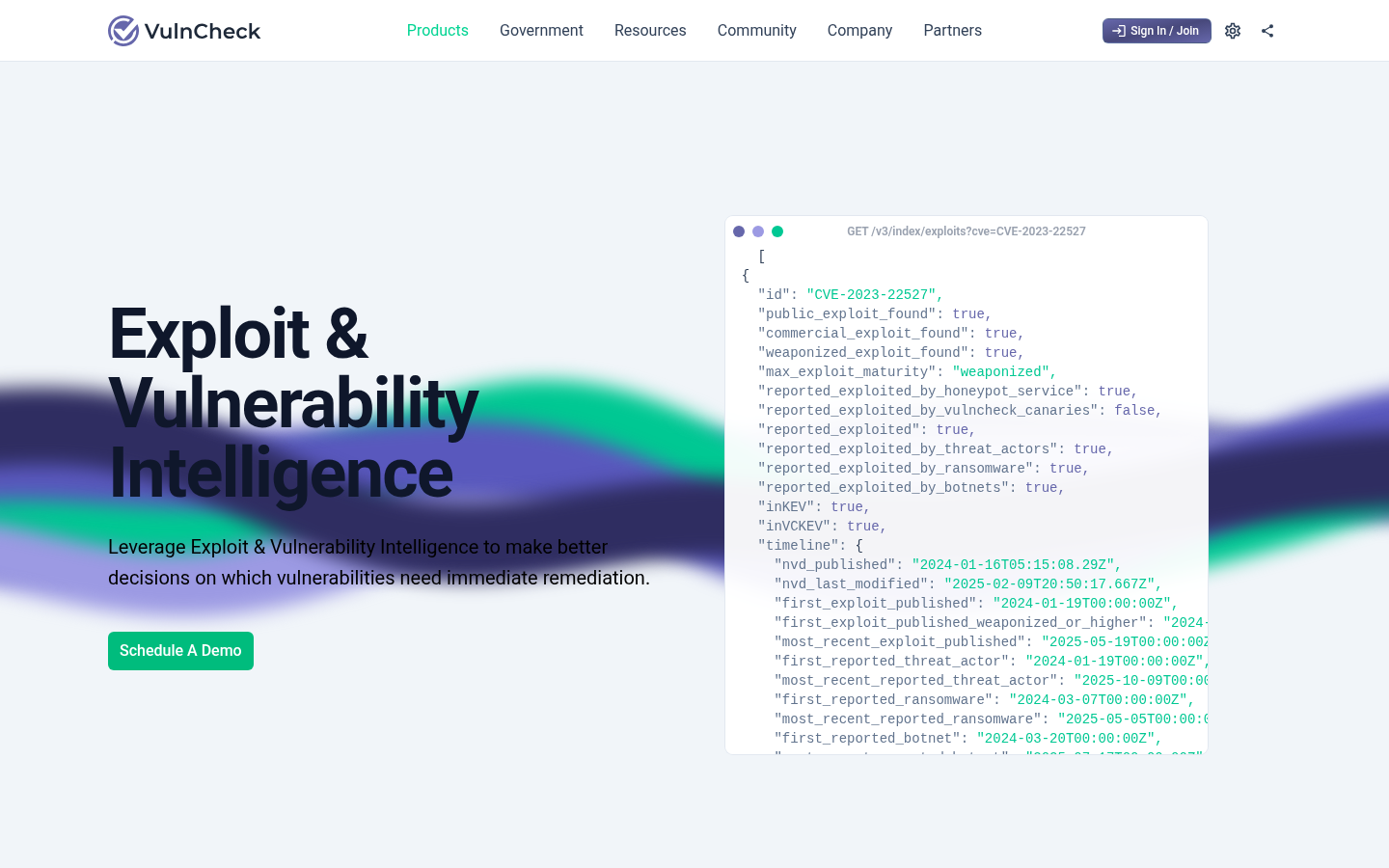
VulnCheck Exploit & Vulnerability Intelligence attaches an exploitation timeline and maturity flags to a CVE: public, commercial, or weaponized exploit code, plus reports of use by threat actors, ransomware groups, or botnets, and whether the CVE is in CISA KEV or VulnCheck KEV.
VulnCheck KEV is a free community catalog. VulnCheck’s KEV pages state earlier and broader coverage than CISA KEV, with citations for why a CVE is listed. The commercial product, which VulnCheck says is a much larger set of exploit and vulnerability intelligence, is sold separately.
Key features:
- Exploitation timeline from disclosure to in-the-wild use
- Exploit maturity and availability flags
- Threat actor, ransomware, and botnet mappings
- Free VulnCheck KEV catalog, with a paid intelligence product
Why we like it:
The timeline and maturity flags show whether a CVE has moved from a proof of concept to weaponized use.
Limits:
It is an intelligence product, not a scanner or a model of your assets. An environment-specific likelihood score is not documented.
License or pricing: VulnCheck KEV is free, with attribution to VulnCheck. Exploit & Vulnerability Intelligence is sold as a separate commercial product. No public list price with a defined unit is cited here.
Tenable
Best for threat-informed priority inside a Tenable install base
Tenable Predictive Prioritization produces a Vulnerability Priority Rating (VPR) from technical impact and a threat component that Tenable documents as including proof-of-concept research, exploit kits, dark-web and forum reports, and malware hashes in the wild.
In Tenable Exposure Management, a Node Exposure Score (NES) measures an asset’s blast-radius exposure using VPR plus relationships such as installed software, subnets, and internet exposure. Tenable One also combines VPR with a per-asset Asset Criticality Rating to produce Asset Exposure Score and Cyber Exposure Score values.
Key features:
- Predictive Prioritization and VPR on vulnerabilities
- Node Exposure Score for blast-radius context
- Asset Criticality Rating, AES, and CES
- Tenable One Foundation and Advanced packages
Why we like it:
VPR and NES give a team that already runs Tenable a threat-informed priority without a separate intelligence console.
Limits:
VPR is a global threat score until you combine it with asset criticality or NES. A model trained only on your own telemetry is not documented.
License or pricing: Tenable One Foundation and Advanced are quote-based and licensed per asset. Tenable’s licensing guide documents a 100-asset minimum for Foundation and a 300-asset minimum for Advanced.
Recorded Future
Best for a live Risk Score and a weaponization lifecycle matched to your stack
Recorded Future is a Mastercard company. Its Vulnerability Intelligence module publishes a dynamic Risk Score for each vulnerability and tracks a weaponization lifecycle with four stages: Disclosure, Proof of Concept, Exploit Likely, and Exploited.
The product pages say the score can take your technology stack into account, including through automatic watch lists from vulnerability scanners, without a new agent. Recorded Future also documents real-time exploitation signals, threat-actor activity, and ransomware associations.
Key features:
- Dynamic Risk Score on each vulnerability
- Four-stage weaponization lifecycle
- Tech-stack matching and scanner watch lists
- Alerts when a CVE’s lifecycle stage changes
Why we like it:
The Risk Score and lifecycle stages tell a patching team why a CVE moved, including when it starts to match the stack they actually run.
Limits:
This is a threat-intelligence module, not a vulnerability scanner. Package boundaries and add-on capacity are set on the quote.
License or pricing: Recorded Future’s pricing page says most packages use organization size, measured by unique workforce credentials, as the primary metric, plus the package and any add-ons. No public dollar list with a defined unit is cited here.
Google Threat Intelligence
Best for connecting a CVE to confirmed exploitation, threat actors, and malware
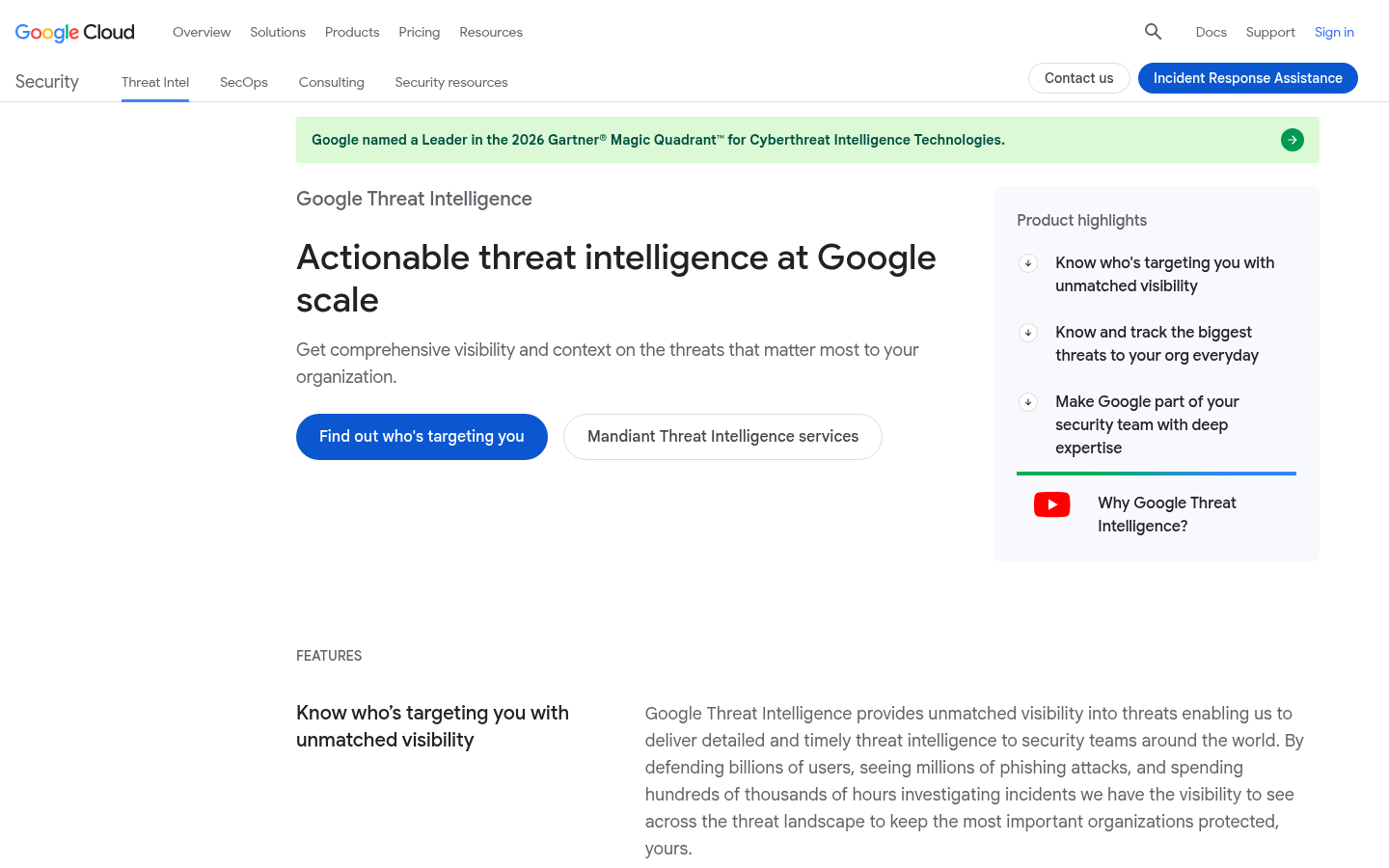
Google Threat Intelligence includes Mandiant’s vulnerability intelligence. Its Vulnerability Intelligence tab lets a team search and filter CVEs, including by risk rating and by exploitation state, such as Confirmed, and open a report on how a vulnerability is being used.
Google’s documentation describes combining threat-actor intent, malware associations, exploitation telemetry, and exposure data so that patching decisions can go beyond static severity scores. Attack Surface Management in the same product can be used to look for vulnerabilities on internet-facing assets.
Key features:
- Vulnerability Intelligence tab with exploitation-state filters
- CVE reports that include actor and malware context
- Natural-language questions about how a flaw is used
- Optional Attack Surface Management for external assets
Why we like it:
Confirmed exploitation state plus actor and malware associations explain why a CVE belongs at the top of a queue.
Limits:
This is a threat-intelligence product, not a replacement for an internal scanner. A local likelihood model built only on your telemetry is not documented.
License or pricing: Google Threat Intelligence is sold in packages. No public list price with a defined unit is cited here.
Microsoft Security Exposure Management
Best for Defender Vulnerability Management flags and attack paths in a qualifying Microsoft license
Microsoft Security Exposure Management lives in the Defender portal and consolidates Microsoft Defender Vulnerability Management with other Microsoft posture sources. Defender Vulnerability Management documents per-CVE threat insights, including filters for when an exploit is available, when it is verified, and when it is part of an exploit kit, plus hover details on exploit kits or activity groups.
The Security Exposure Management product page applies that posture, with threat intelligence, to security gaps and attack paths that could reach critical assets. Microsoft Learn says full access is included with qualifying licenses, including Microsoft 365 E5 or A5 and several Defender products. Connectors for non-Microsoft tools are free during public preview. Microsoft says they will be billed on a consumption basis, by the number of assets in the connected tool, once generally available, with pricing announced before billing starts.
Key features:
- Defender Vulnerability Management exploit-available, verified, and exploit-kit flags per CVE
- Threat insights on exploit kits and activity groups
- Exposure graph, critical assets, and attack paths
- Included with qualifying Microsoft 365 and Defender licenses
Why we like it:
MDVM flags which CVEs already have an exploit, and Exposure Management shows whether those findings sit on a path to a critical asset.
Limits:
Third-party connector pricing at general availability is not yet published. A standalone exploit-intelligence feed outside Microsoft sources depends on those connectors.
License or pricing: Included with qualifying licenses such as Microsoft 365 E5 or A5, Microsoft 365 E3 with the E5 Security add-on, and several Microsoft Defender products, as listed on Microsoft Learn. Third-party connector pricing at general availability is not yet published.
Qualys Enterprise TruRisk
Best for a TruRisk score that combines Qualys threat research with asset criticality
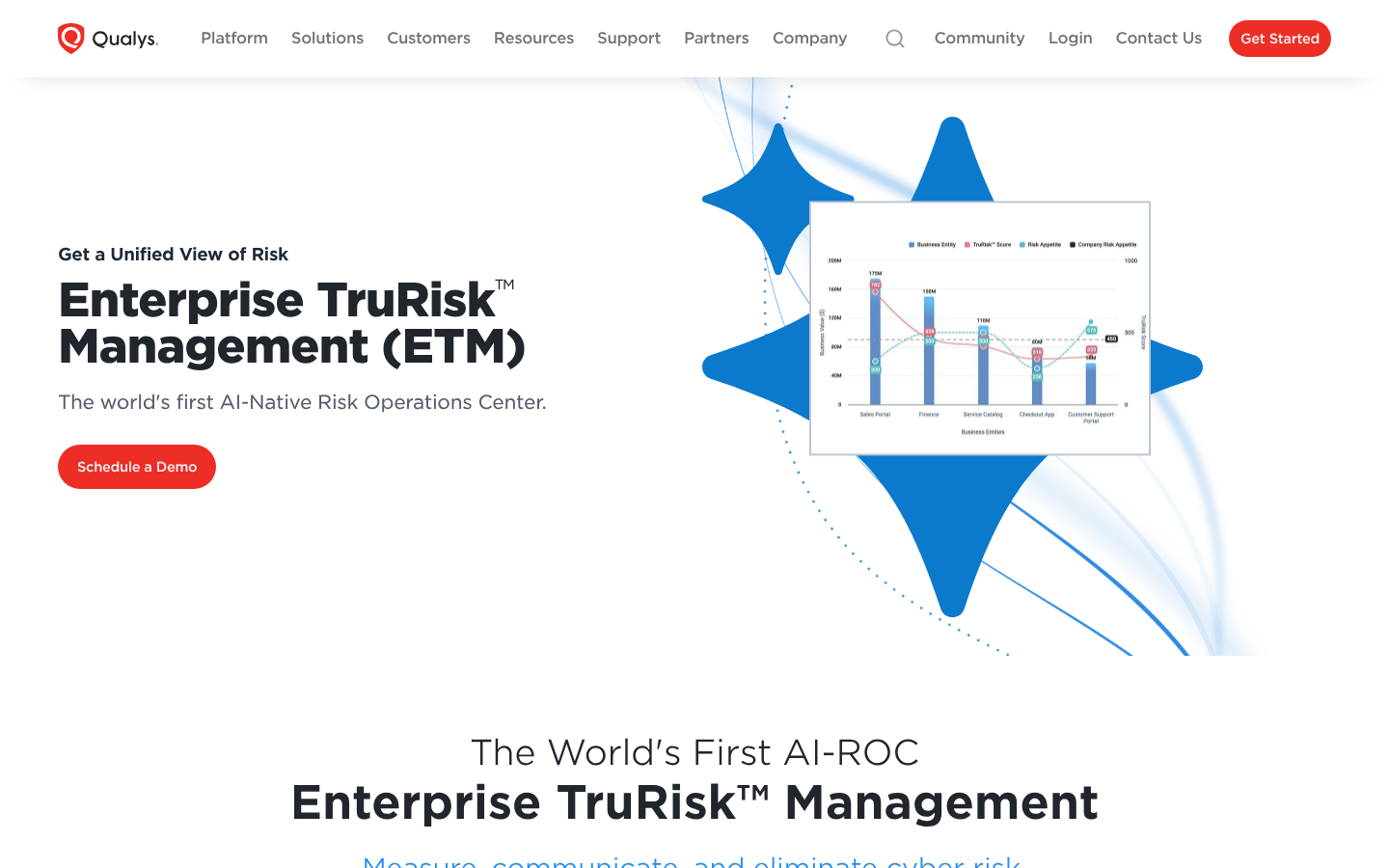
Qualys Enterprise TruRisk documents a TruRisk score that combines Qualys threat research with how important the affected asset is. Finding-level Qualys Vulnerability Score (QVS) draws on whether a working exploit exists, whether the CVE is in the CISA KEV catalog, malware or ransomware use, known threat-actor activity, and EPSS, through Qualys threat intelligence (TruLens).
Asset Criticality Score, which you assign, and exposure factors such as whether the asset is internet-facing then shape the asset-level TruRisk score, on a 0 to 1,000 scale. Qualys also documents QDS, which adjusts a finding for compensating controls on that asset.
Key features:
- TruRisk score on assets, from 0 to 1,000
- QVS from Qualys threat research and exploit inputs
- Asset Criticality Score and internet-facing exposure factors
- QDS adjustments for controls on the asset
Why we like it:
TruRisk can raise a finding on an important, internet-facing asset when current exploit evidence exists, instead of ranking only by CVSS.
Limits:
Sold by quote. A generally available attack-path model is not the center of the TruRisk scoring docs checked.
License or pricing: Qualys Enterprise TruRisk is sold by quote. No public list price with currency, unit, and period is cited from first-party Qualys pages checked on 12 Nov 2026.
Empirical Security
Best for a local exploit-probability model on findings you already have
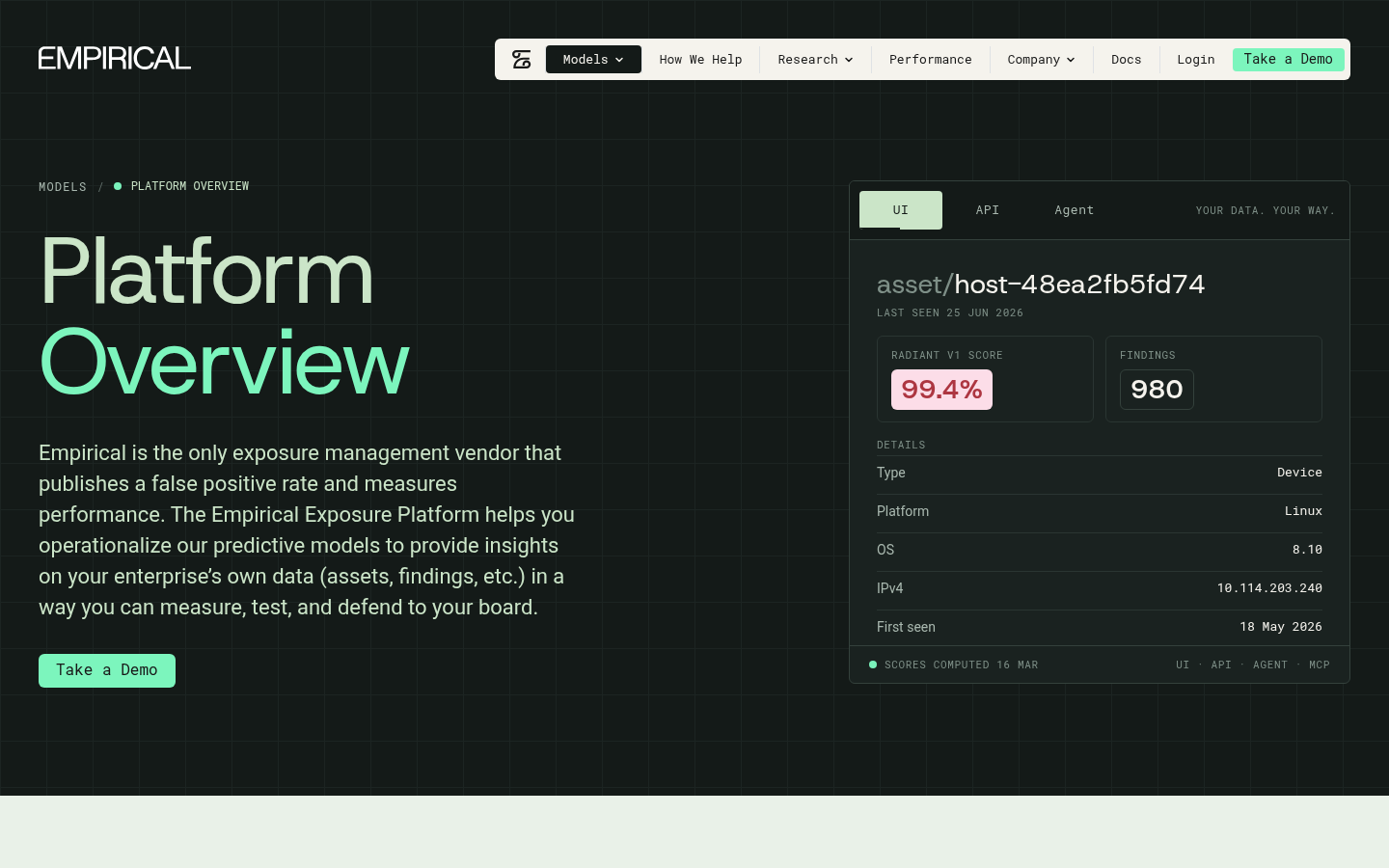
Empirical Security sells an Exposure Platform that, on its own pages, outputs a calibrated 30-day exploit probability and a Threat Score, described as the expected number of exploitations on an asset or group. Foundation is the global model. Radiant is the local model that adds the organization’s assets, configurations, and telemetry.
The product is built to score findings from tools you already run, rather than to discover assets itself.
Key features:
- Foundation global 30-day exploit probability
- Radiant local model on your assets and telemetry
- Threat Score as expected exploitations on an asset or group
- Designed to score output from existing discovery tools
Why we like it:
Radiant is the documented attempt to turn a global probability into a number that reflects your assets and telemetry.
Limits:
Independent validation is not documented.
License or pricing: No public list price with a defined unit. Sold by demo and quote.
How to choose an exploit intelligence tool
- If you need evidence on the CVE itself. VulnCheck, Google Threat Intelligence, and Recorded Future document timelines, exploitation state, or a weaponization lifecycle you can apply to a queue you already have.
- If you already run a vulnerability or exposure platform. Tenable documents VPR and NES inside Tenable One. Microsoft Security Exposure Management includes Defender Vulnerability Management exploit flags and is included with qualifying Microsoft licenses. Qualys Enterprise TruRisk documents a score from threat research, exploit inputs, and asset criticality, and is sold by quote.
- If you want a local probability on existing findings. Empirical’s Radiant model targets that job.
- Keep the public baselines. CISA KEV and FIRST EPSS are still the floor, even if you buy one of the products above.
What we left out
- Cisco Vulnerability Management (formerly Kenna): end of sale. Cisco’s bulletin sets last order at 10 Mar 2026, last renew or add at 11 Jun 2026, and last support at 30 Jun 2028, and names no replacement product.
- CISA Known Exploited Vulnerabilities catalog and FIRST EPSS: public baselines, not commercial products. They are the floor this category sits on, not entries.
- CrowdStrike Falcon Exposure Management: covered on our CTEM tools page, including exposure prioritization inside Falcon.
- Rapid7: a vulnerability and exposure platform with threat-informed scoring, closer to the scanner and CTEM lists than to a dedicated exploit-intelligence cut.
- GreyNoise: internet-wide observation of what is being exploited, useful as a signal, not a full prioritization product on this list.
- Flashpoint and similar threat-intel suites: broader intelligence platforms. They sit outside this narrower cut: exploit evidence and scores used to order a CVE queue.
What public research says about exploit scores
The argument is not whether CVSS is enough. It is how much observed exploitation, and how much of your own environment, should change the order of a queue.
Cyentia Institute, Prioritization to Prediction, Vol. 1
“Only 2% of all published vulnerabilities have actually been observed being exploited in the wild.”
The Kenna-sponsored study also found that patching by a high CVSS threshold was a weak efficiency strategy, which is the problem this category exists to address.
“CISA maintains the authoritative source of vulnerabilities that have been exploited in the wild.”
The same CISA catalog page tells organizations to use KEV as an input to their vulnerability management prioritization framework. It is a confirmed-exploitation floor, not a probability model.
“The Exploit Prediction Scoring System (EPSS) is a data-driven machine-learning model that estimates the probability that a published CVE will be exploited in the wild in the next 30 days.”
EPSS is a public, global probability. Several products on this list ingest it or sit beside it. It is not, by itself, a score of your assets.
Choose an intelligence product when you need evidence on the CVE itself, and a vulnerability or exposure platform when you need that evidence combined with asset criticality or attack paths you already own. Empirical is launch-stage: pilot it against a week of your own scanner output before you treat the scores as a remediation SLA.
FAQs
What is exploit intelligence, and how is it different from vulnerability management?
Exploit intelligence is the evidence or the score that says whether a published CVE is likely to be used, globally or on your assets. Vulnerability management finds and tracks the flaws. Some platforms on this list do both; this page compares only the exploit-evidence and scoring cut.
Are CISA KEV and EPSS enough on their own?
They are the right public starting point. KEV tells you what has already been exploited. EPSS estimates a 30-day global probability. The commercial tools here add earlier or broader evidence, a weaponization lifecycle, or a score that includes your assets.
Does an exploit-intelligence tool replace the scanner I already run?
Not by itself. VulnCheck, Recorded Future, Google Threat Intelligence, and Empirical are built to inform or score findings you already have. Tenable, Microsoft Security Exposure Management, and Qualys Enterprise TruRisk sit inside a broader platform that may already include discovery.
What happened to Kenna / Cisco VM?
Cisco Vulnerability Management, formerly Kenna, is end of sale. Cisco’s bulletin sets last order at 10 Mar 2026, last renew or add at 11 Jun 2026, and last support at 30 Jun 2028, and names no replacement product.