Best Defensive Security AI Models in 2026: 4 Tools Defenders Can Use
Four security-tuned models for triaging an alert, searching logs, and connecting weak signals, with a sharp line against AI SOC agents and Copilot-style assistants.
A single noisy alert and 20,000 log lines still have to become one decision. A defensive security AI model is a language model trained or post-trained for that defender work: triaging an alert, searching logs, or connecting weak signals that may be the same incident.
That is a different buy from an AI SOC tool that automates a queue, from Microsoft Security Copilot and other Copilot-style assistants wired into a security product, and from products such as Cisco AI Defense that protect AI applications themselves. Those jobs matter, and they are not the model shortlist below.
The four models below approach the work from different angles. We start with Cisco Foundation-Sec, an 8-billion-parameter open-weight model whose first-party pages document SOC acceleration jobs such as alert triage and incident summarization. Google Sec-Gemini is Google’s security-specialized system, now documented as a hosted harness for trusted testers. ZySec-7B is a smaller open security-tuned model. Corma, which raised USD 60 million on 10 Aug 2026, is a launch-stage vendor; capabilities below are vendor-stated.
How we evaluated
We read each vendor’s model cards, product pages, and documentation on 12 Nov 2026, and checked each one against the same questions: whether it is a security-tuned model, what defender jobs it documents, and how you can run it. Capabilities are vendor-stated unless noted.
| Tool | Best for | What to check |
|---|---|---|
| Cisco Foundation-Sec | Open-weight model for alert triage and incident summarization you can run yourself | Which current weight is generally available, and where you will run it |
| Google Sec-Gemini | Hosted security-specialized system with documented incident triage | Trusted-tester access, and how the hosted harness differs from a model you run |
| ZySec-7B | Smaller open security-tuned model for guidance across incident handling and related domains | The age of the release, and whether advisory guidance is enough for your triage workflow |
| Corma | Vendor-stated foundation models for defensive cybersecurity, used with your existing stack | What is generally available in a scoped evaluation, including on-prem and post-training |
Foundation-Sec
Sec-Gemini
ZySec-7B
Corma
Capability matrix: what the model is, and what it documents
Each cell restates what the vendor documents on the model, product, or documentation pages cited in its entry. Uncited claims are omitted; if a product does not document a capability, the cell says so in a full sentence.
| Foundation-Sec | Sec-Gemini | ZySec-7B | Corma | |
|---|---|---|---|---|
| What defender jobs it documents | SOC Acceleration uses that include automating alert triage, summarizing incidents, and drafting case notes, plus threat-defense and engineering uses | Incident triage and reporting, alongside reconnaissance and vulnerability analysis, as the official docs describe the workflows it can perform | Training across incident handling, cloud security, compliance, and related guidance domains; a documented log-search or alert-triage loop is not in the model card we reviewed | Foundation models described as generalizing across defensive cybersecurity tasks and working with the team’s existing stack; no public step-by-step triage workflow |
| How you run it | Published open-weight model you can download and run locally, in an air-gapped setting, or through a cloud inference endpoint, as the cookbook describes | A hosted platform for trusted testers, reached with an API key, not a public weight download | An open-weight 7B model you can run locally or through common local inference tools | Vendor access, with a fully on-prem option and post-training on your security data described on the public site |
| What is generally available versus gated | Foundation-Sec-8B is described as released; a reasoning variant was described as preview in the June 2025 post, so confirm the current weight | Docs are written for trusted testers who already have platform access and an API key | The SecurityLLM weights are publicly listed on the model card | Access is by request; the public site does not state a generally available self-serve tier |
| Public price | Open-weight. No USD list price on the Foundation AI pages we reviewed, checked 12 Nov 2026 | No USD list price on the public docs we reviewed, checked 12 Nov 2026 | Open-weight, Apache 2.0 shown on the model card. No USD list price, checked 12 Nov 2026 | Quote-based. No USD list price on the public site, checked 12 Nov 2026 |
Worked example: a noisy alert, 20,000 log lines, and two weak signals
An analyst has a noisy identity-and-endpoint alert, about 20,000 related log lines, and two weak signals that may be the same incident. Here is what each model’s public material says it can do with that kind of work.
None of the vendors publishes this exact scenario; the cells restate capabilities from the entries below.
| What it would do with the alert | What it says about the logs and weak signals | |
|---|---|---|
| Cisco Foundation-Sec | First-party pages document SOC Acceleration work that includes automating alert triage, summarizing incidents, and drafting case notes, and the cookbook includes an incident-investigation example | The cookbook is described as covering security use cases and incident investigation through coordinated steps such as triaging, summarizing, and recommending next actions. A guaranteed, out-of-the-box search of 20,000 of your log lines is not a published walkthrough of this incident |
| Google Sec-Gemini | Official docs list incident triage and reporting among the end-to-end security operations the system can perform | The docs describe a harness that orchestrates reasoning, tool execution, and data retrieval, including near-real-time data. They do not publish this exact two-signal correlation on a 20,000-line log set |
| ZySec-7B | The model card includes security incident handling among the domains it was trained on, so the realistic output is guidance on how to handle an incident, not a documented auto-triage path | Public material does not document a log-search or weak-signal correlation loop. You would still have to supply the logs and judge the answer |
| Corma | Public pages say the models generalize across defensive cybersecurity tasks and work with the team’s existing stack; they do not publish an alert-triage playbook | The same pages do not publish a step-by-step log-search or weak-signal workflow. Any claim that it would find the two signals in 20,000 lines would be an evaluation you still have to run |
This is our illustration of a common defender day, not a vendor-published walkthrough of this incident.
Cisco Foundation-Sec
Best when you want an open-weight security-tuned model whose first-party pages document SOC acceleration work such as alert triage and incident summarization.
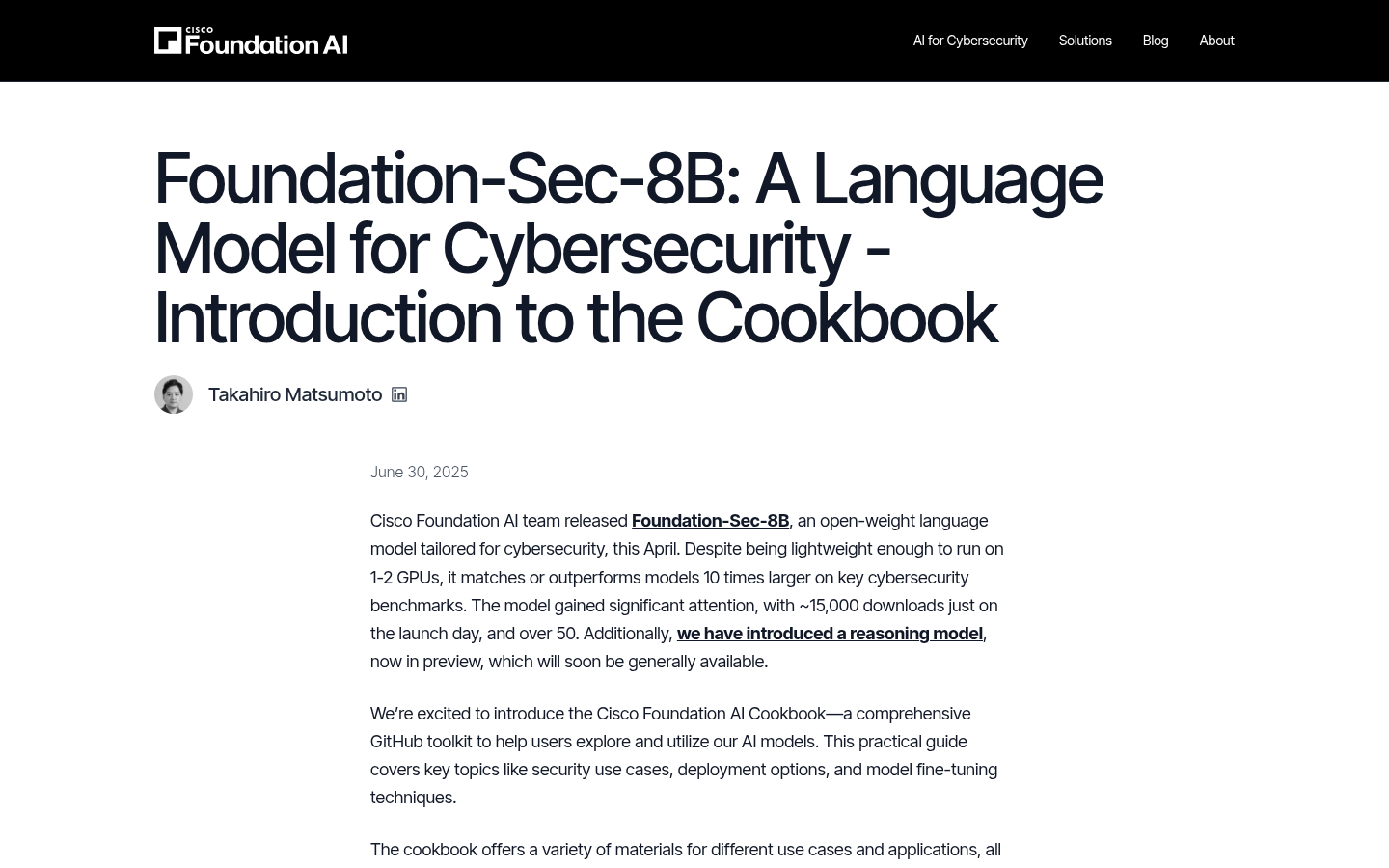
Foundation-Sec is Cisco Foundation AI’s open-weight language model family for cybersecurity. A 30 June 2025 Foundation AI post describes Foundation-Sec-8B as light enough to run on one or two GPUs, and lists SOC Acceleration uses that include automating alert triage, summarizing incidents, and drafting case notes, plus threat-defense and engineering uses such as mapping TTPs, prioritizing vulnerabilities, and reviewing configurations.
The same post introduces a cookbook of notebooks for those jobs, including an incident-investigation example, and mentions a reasoning variant that was then in preview. Confirm which current weight is generally available, and whether you will run it locally, in an air-gapped setting, or through a cloud inference endpoint, before you standardize on a version. Foundation AI has also written that the 8B model matches or outperforms much larger models on key cybersecurity benchmarks; treat that as a vendor-reported result.
Key features:
- An open-weight 8-billion-parameter model published for cybersecurity tasks
- Documented SOC Acceleration uses: alert triage, incident summarization, and case notes
- Additional documented uses in threat defense and security engineering, including TTP mapping and configuration review
- A public cookbook with quickstarts, examples, fine-tuning, quantization, and deployment guidance
- Intended to run on one or two GPUs, with quantized options described for tighter environments
Why we like it:
It is the most clearly documented open-weight model on this list for the alert-triage and incident-summarization jobs defenders actually run.
Limits:
The June 2025 post describes a reasoning variant as preview; confirm current availability rather than assuming every named variant is generally available. Benchmark comparisons are vendor-reported. You still have to wire the model into your own alerts, logs, and review workflow. Independent validation is not documented.
License or pricing: Open-weight. No USD list price is published on the Foundation AI pages we reviewed, checked 12 Nov 2026.
Google Sec-Gemini
Best when you want a hosted, security-specialized system with documented incident triage, and you can get trusted-tester access.
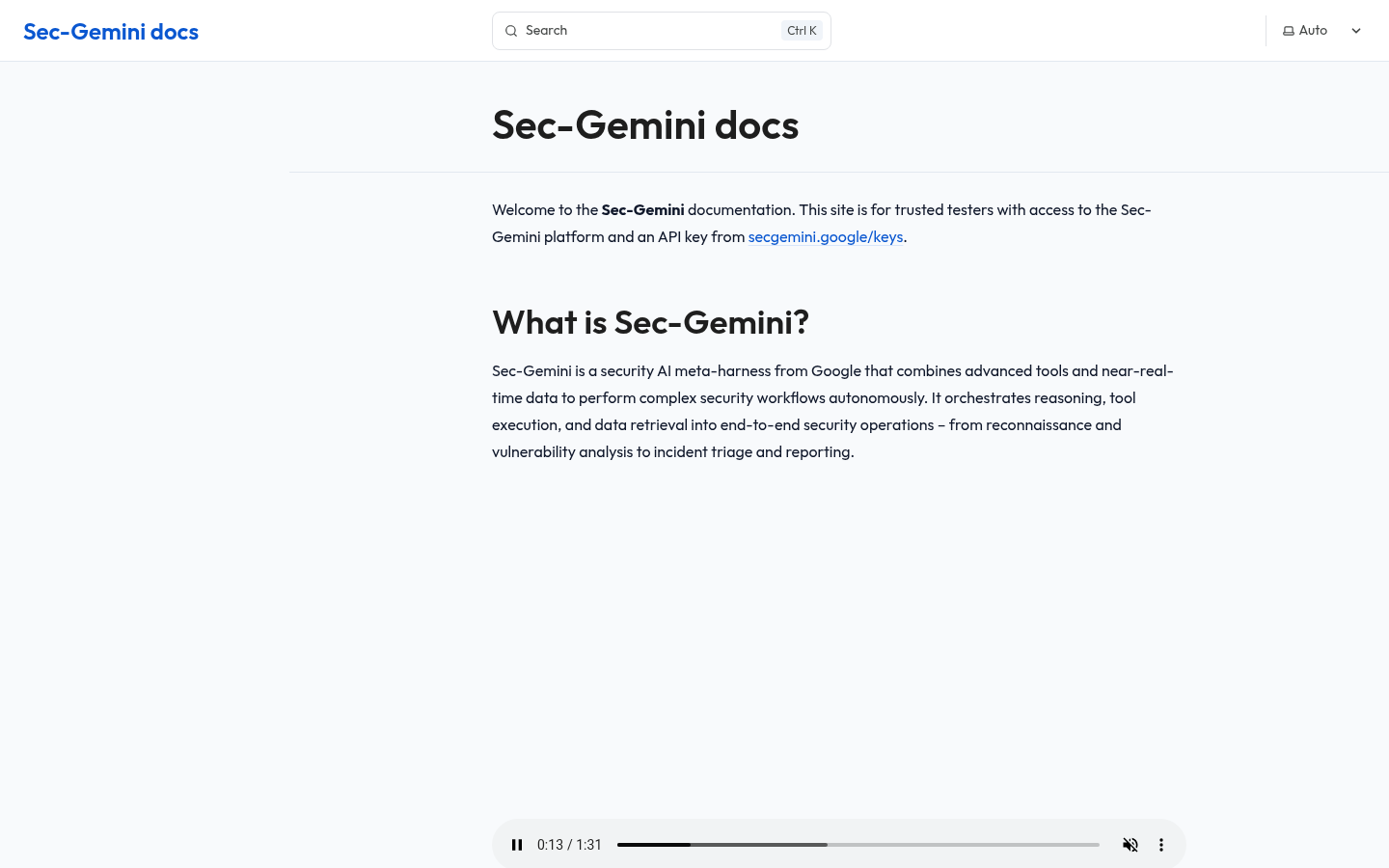
Sec-Gemini is Google’s security-specialized system. Current official docs, written for trusted testers with a platform API key, define it as a security AI meta-harness that combines tools and near-real-time data to perform complex security workflows, from reconnaissance and vulnerability analysis to incident triage and reporting.
That means you are evaluating a hosted system that can orchestrate reasoning, tool use, and data retrieval, not a public weight you download and run yourself. Access is documented as limited to trusted testers. The current description sits close to the agent line we draw elsewhere on this shortlist, so ask how much of a given triage is the model, and how much is the harness running a workflow on your behalf.
Key features:
- A named security-specialized system from Google, documented for trusted testers
- Official docs list incident triage and reporting among the security operations it can perform
- Described as combining reasoning, tool execution, and data retrieval, including near-real-time data
- Access is through the Sec-Gemini platform and an API key, not a public model download
Why we like it:
It is the best-documented hosted option here for incident triage from a major lab, as long as you can get access and are clear that the current product is a harness as well as a model.
Limits:
Public docs are written for trusted testers, so you may not be able to run a hands-on trial without that access. It is not an open-weight model you can inspect or deploy in your own cluster. Current first-party wording emphasizes autonomous workflow execution, which is adjacent to an AI SOC agent. Independent validation is not documented. No USD list price is published.
License or pricing: Access is documented as limited to trusted testers. No USD list price is published on the public docs we reviewed, checked 12 Nov 2026.
ZySec-7B
Best when you want a smaller open security-tuned model for guidance across incident handling and related domains, and you accept a thinner, older public release.
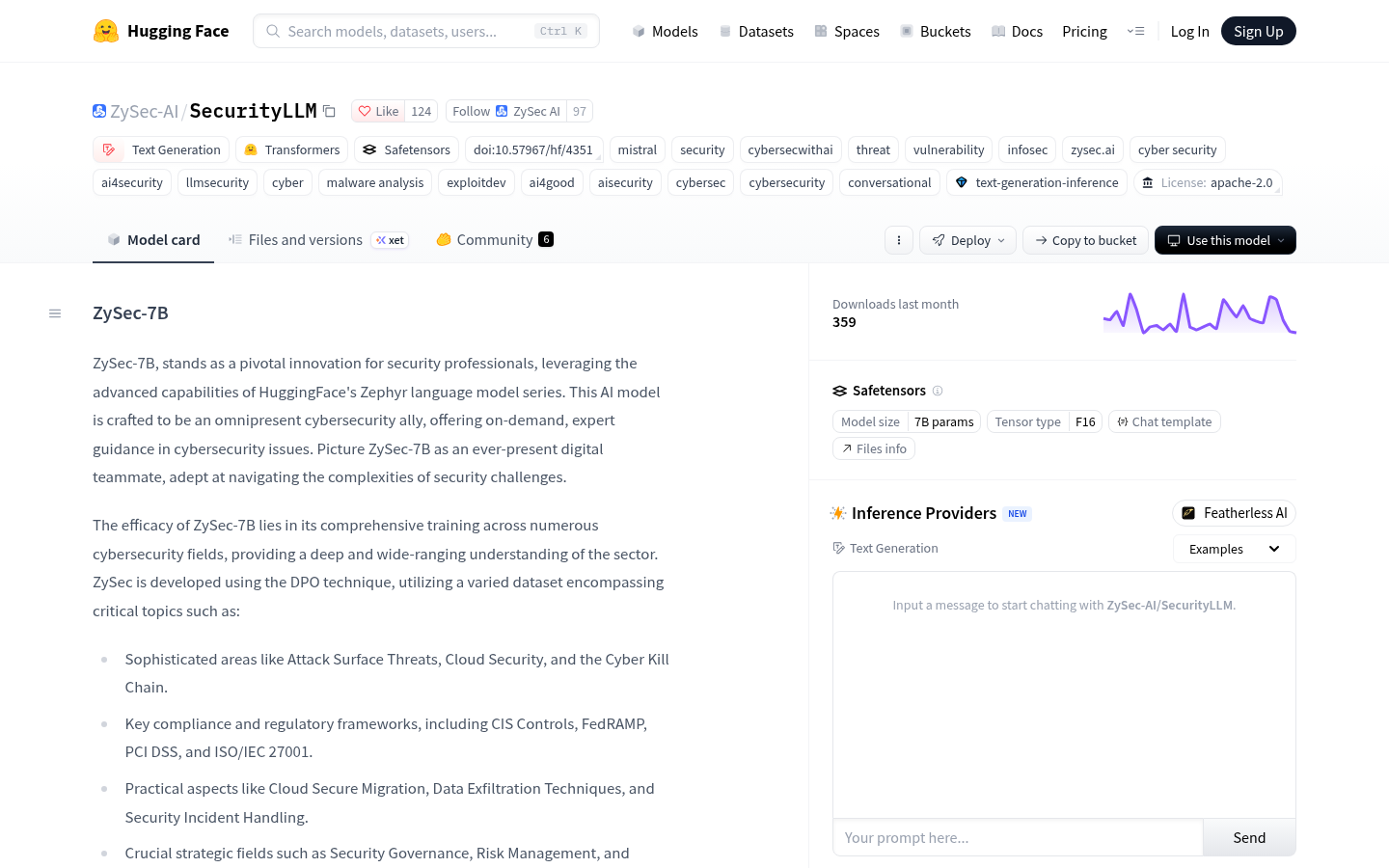
ZySec-7B is an open 7-billion-parameter model, published on Hugging Face as SecurityLLM and fine-tuned from the Zephyr series for cybersecurity guidance. The model card describes training across more than 30 domains, including security incident handling, cloud security, attack-surface threats, and compliance frameworks such as CIS Controls, PCI DSS, and ISO/IEC 27001.
Public material is stronger on expert guidance and standards exploration than on a documented loop for searching logs or connecting two weak signals in a live case. The release is also older and thinner than Foundation-Sec’s cookbook. Treat it as a smaller open option you can run yourself, not as a substitute for a model whose first-party pages show alert triage end to end.
Key features:
- An open-weight 7B model published for cybersecurity guidance, with an Apache 2.0 license shown on the model card
- Training described across 30-plus domains, including security incident handling
- Coverage of compliance and governance topics such as CIS Controls, PCI DSS, and ISO/IEC 27001
- Intended to run in a local or private setup, including through common local inference tools
Why we like it:
It is a genuine open security-tuned model you can run yourself if you want a smaller guidance model and can live with older, thinner public documentation.
Limits:
The public release is older than Foundation-Sec, and the model card does not document a comparable alert-triage or log-analysis cookbook. Independent validation is not documented. Community download volume is modest relative to a current foundation-model release.
License or pricing: Open-weight, with Apache 2.0 shown on the model card. No USD list price, checked 12 Nov 2026.
Corma
Best when you want a vendor foundation model described as built for defensive cybersecurity, and you can evaluate it against a scoped set of your own defensive tasks.
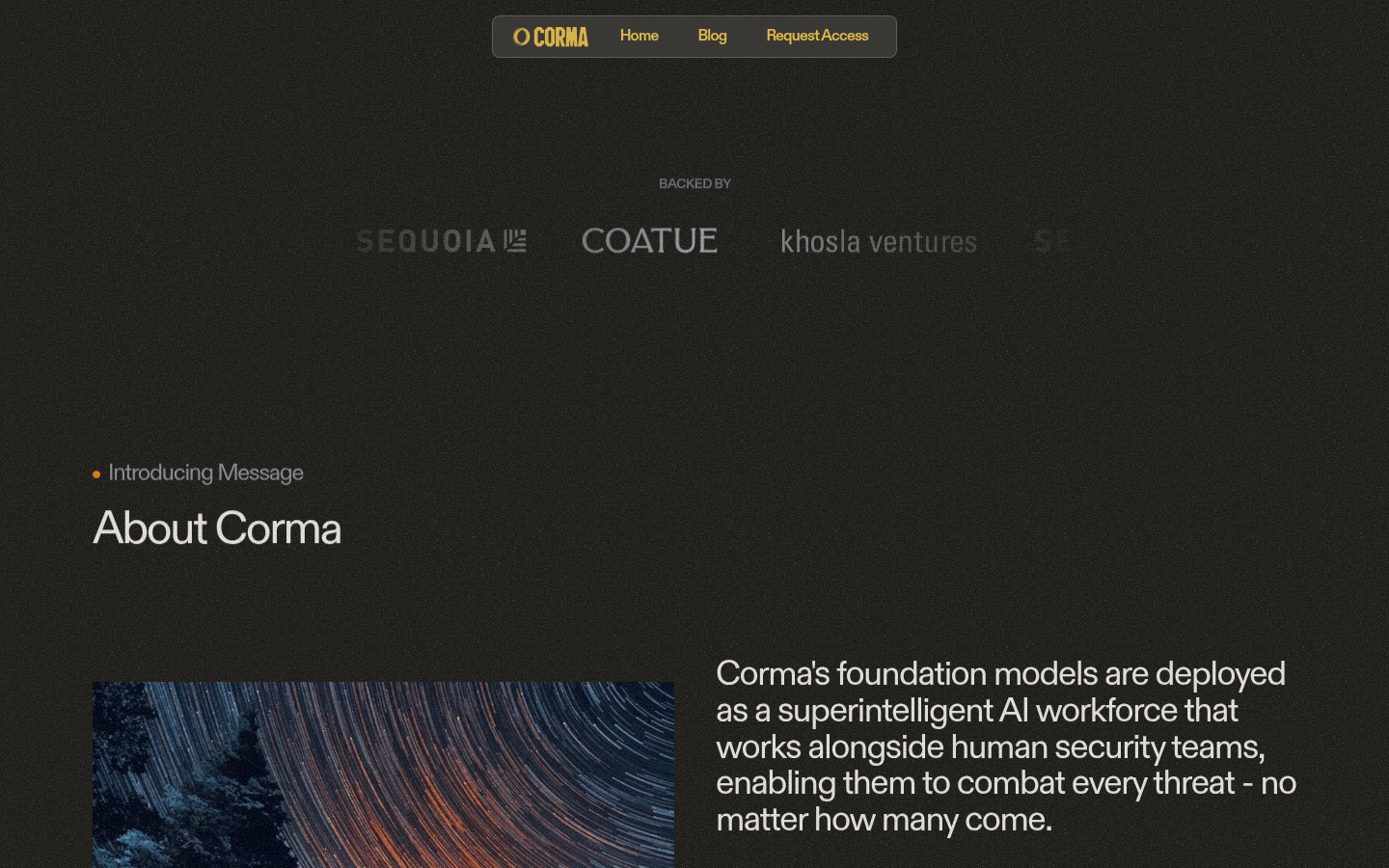
Corma’s public site describes foundation models trained for defensive cybersecurity, deployed as a workforce that works alongside human security teams and uses the team’s existing security stack. The company also states that the model can be deployed fully on-prem and post-trained on an organization’s own security data.
Public material is thinner than the Foundation-Sec cookbook or Sec-Gemini’s tester docs. The pages we reviewed do not publish a step-by-step alert-triage or log-search workflow. Claims below stay at that same depth, and they are vendor-stated.
Key features:
- Vendor-stated foundation models trained for defensive cybersecurity
- Described as generalizing across defensive tasks and working with the team’s existing security stack
- An on-prem deployment option, with post-training on the organization’s security data, as the company describes it
- Access is through a request, not a public model download
Why we like it:
It is the only vendor on this list that presents a commercial foundation model built expressly for defensive cybersecurity, if you are willing to judge that claim in a scoped evaluation.
Limits:
Public documentation is thin. Independent validation is not documented. There is no public cookbook or tester manual comparable to the other entries, and no USD list price.
License or pricing: Quote-based. The public site asks visitors to request access and does not list a USD price, checked 12 Nov 2026.
How to choose a defensive security AI model
- Start with how you want to run the model. Choose Cisco Foundation-Sec or ZySec-7B when you want published weights you can run locally or in your own cloud. Choose Sec-Gemini or Corma when a vendor-operated system is acceptable and you can obtain access.
- Then match the documented job. Choose Foundation-Sec when first-party pages need to show SOC acceleration work such as alert triage and incident summarization. Choose Sec-Gemini when you want a hosted system that documents incident triage and reporting. Choose ZySec-7B when a smaller open guidance model, including incident-handling training, is enough. Choose Corma when you want a vendor foundation model described as built for defensive tasks and will judge that against your own cases.
- Do not buy an assistant by accident. If the job is a queue product or a Copilot-style assistant inside a platform you already run, start on the AI SOC tools page or our Microsoft Security Copilot comparison, not here.
What we left out
- Microsoft Security Copilot: current Learn docs describe a security analysis tool that uses Azure OpenAI models and grounds prompts with plugins and organizational data at inference time. We left it out because it is sold as a Copilot-style assistant, not as a published security-tuned model you can run or evaluate on its own. Our Mate vs Microsoft Security Copilot page covers that assistant job.
- Gemini in Google Security Operations: official Google Cloud docs describe a production assistant in Google SecOps that generates searches and YARA-L rules, summarizes cases, and includes a Triage and Investigation Agent. We left it out because it is a Copilot-style assistant and an AI SOC capability inside Google SecOps, not the named Sec-Gemini system listed above.
- Robust Intelligence and Cisco AI Defense: Cisco’s first-party page states that Robust Intelligence was acquired in October 2024 and is at the core of Cisco AI Defense and Cisco Foundation AI. Cisco AI Defense is sold as protection for AI applications, including model validation and runtime guardrails. We left it out because that is AI security, not a defensive security-tuned model for alert triage or log analysis. The related model, Cisco Foundation-Sec, is listed above.
- CrowdStrike Charlotte AI: documented as an agentic analyst on the Falcon platform that can use models of your choice. We left it out because it is an AI SOC-style analyst product, not a published defensive model. See our AI SOC tools page.
- SentinelOne Purple AI: documented as an agentic security analyst. SentinelOne also describes proprietary Ultraviolet models inside that product, but those weights are not offered as a standalone defensive model outside the analyst product. We left it out as an AI SOC analyst. See the AI SOC tools page.
- Elastic AI Assistant for Security: official docs describe a chat assistant in Elastic Security for investigations and query help, which you connect to an LLM. We left it out because it is a product assistant, not a security-tuned model Elastic publishes.
- Splunk AI Assistant: documented as an AI assistant in Splunk Enterprise Security. We left it out because it is a product assistant, not a published defensive model.
- Deep Hat (formerly WhiteRabbitNeo): Kindo’s current first-party pages lead with an uncensored model for offensive and red-team reasoning. We left it out because that positioning is not the defensive alert-triage and log-analysis work compared here.
- OpenAI GPT-6 Cyber: documented as a cybersecurity model for authorized vulnerability discovery and exploit work. We left it out because those research and assessment jobs are not the alert-triage, log-search, and weak-signal jobs this shortlist compares.
What the internet thinks about defensive security AI models
Published commentary, quoted for the argument, not the score. Independent practitioner threads that name these exact models were thin, so the comment below comes from a news report of a vendor putting one model into a product workflow.
The Register · Simon Sharwood, 17 Dec 2025
“General-purpose models are not always tuned for the nuance and precision required for identity security and often introduce external dependencies.”
The Register was reporting Cisco’s explanation for using Foundation-Sec-1.1-8B-Instruct to help compose Duo Identity Intelligence digest emails. It is a company statement in a news article, not an independent test of alert triage or log analysis.
Choose Cisco Foundation-Sec when you want an open-weight security-tuned model whose first-party pages document SOC acceleration work such as alert triage and incident summarization, and you can run it yourself. Choose Google Sec-Gemini when a hosted security-specialized system with documented incident triage is the better fit and you can get trusted-tester access. Choose ZySec-7B when a smaller open guidance model, including incident-handling training, is enough and you accept a thinner, older release. Choose Corma when you want a vendor foundation model described as built for defensive cybersecurity and can pilot a launch-stage vendor first.
FAQs
What is a defensive security AI model?
It is a language model trained or post-trained for defender work such as triaging an alert, searching logs, or connecting weak signals. It is not, by itself, an AI SOC product that runs a queue, a Copilot-style assistant inside a security platform, or a tool whose job is to protect AI applications.
How is this different from an AI SOC tool or a Security Copilot-style assistant?
AI SOC tools automate investigation and response work across a queue. Microsoft Security Copilot and similar assistants sit in a product and help an analyst ask questions, write queries, or summarize a case, often by grounding a general model with plugins. The models here are judged on whether they are security-tuned models you can run or access, and on what defender jobs their first-party pages document.
How is this different from AI security, meaning tools that protect AI?
AI security, including products such as Cisco AI Defense, is the work of protecting models, prompts, and AI applications from abuse or leakage. A defensive security AI model is a model used by defenders on security work. One can support the other, but they are not the same shortlist.
Can these models run on your own infrastructure?
Cisco Foundation-Sec and ZySec-7B are published as open-weight models you can run locally or in your own cloud. Sec-Gemini is documented as a hosted platform for trusted testers. Corma’s public pages describe a fully on-prem option with post-training on your security data; confirm what is generally available in the offer you would use.