Best AI Agent Runtime Protection Tools in 2026: 6 Compared by Who Can Block the Action
Six tools for allowing or blocking a single agent action at execution time.
A March 2026 public red-teaming competition, reported in How Vulnerable Are AI Agents to Indirect Prompt Injections?, recorded 8,648 successful indirect prompt injection attacks against 13 frontier models, including in tool-calling settings. Runtime protection, on this page, is the job of allowing or blocking that single agent action at execution time, not reading the model’s final reply.
That is a narrower buying decision than discovering agents and their supply chain, issuing or scoping agent identity, an LLM firewall or MCP gateway that sits on a traffic path, AI-SPM posture over models and pipelines, or the coding-agent shortlist for hooks on a developer workstation.
Prisma AIRS, HiddenLayer, and Cisco AI Defense inspect prompts, responses, and tool calls in an API, SDK, gateway, or network path. Rein, WhiteMatter, and Bay sit on the device or beside the agent. Rein announced USD 25 million in Series A funding on 8 Oct 2026. Bay announced USD 50 million on 10 Nov 2026, and WhiteMatter, formerly QuilrAI, announced USD 20 million on 9 Nov 2026; Rein, WhiteMatter, and Bay are launch-stage vendors; capabilities below are vendor-stated.
How we evaluated
We read each vendor’s product pages, pricing pages, and public documentation on 12 Nov 2026, and asked the same questions: where the control is inserted, what a decision can do to a single agent action, and how the product is priced. Where public material does not cover a question, we write “not documented”. For Rein, WhiteMatter, and Bay, public technical documentation is thinner than the incumbents on this list, so those product claims are taken from their public marketing and funding pages.
| Tool | Best for | What to check |
|---|---|---|
| Palo Alto Prisma AIRS | Inspect prompts, responses, and data flows through a network firewall, an in-app API or SDK, or both | Credit-metered; no USD list price |
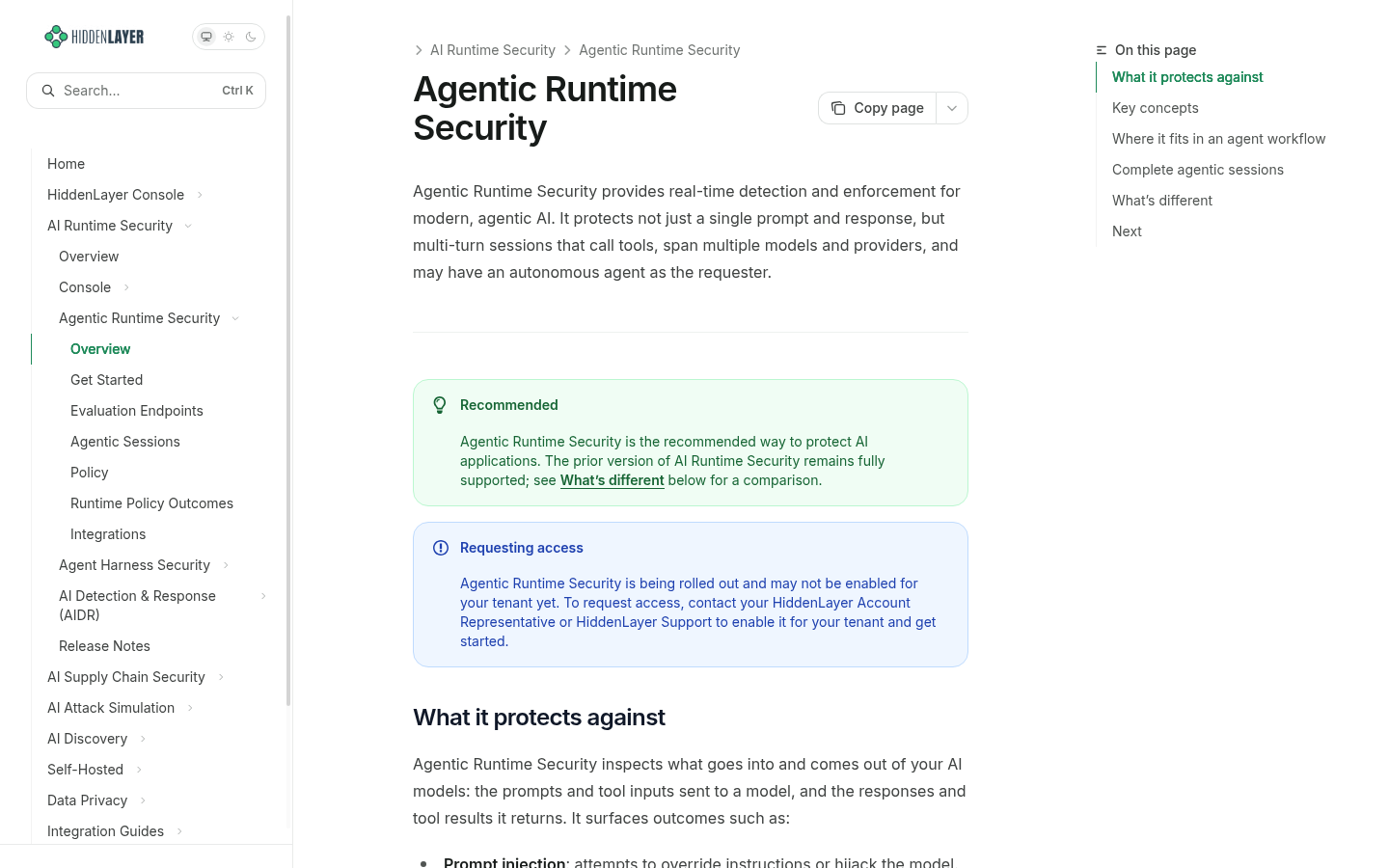
| HiddenLayer | Agentic Runtime Security that can block, detect, or redact in a framework guardrail or AI gateway | Quote |
| Cisco AI Defense | Agent Runtime Protection that inspects LLM and tool calls, then monitors or blocks in enforce mode | Quote |
| Rein Security | A sidecar that holds an agent to its role and can block a harmful action before it runs | Quote |
| WhiteMatter | A 1:1 Guardian that can allow, hold, deny, redact, or narrow each action | Quote |
| Bay | On-device allow, ask, deny, or steer in session context, without a new persistent agent | Quote |
Prisma AIRS
HiddenLayer
Cisco AI Defense
Rein
WhiteMatter
Bay
Use-case matrix: a prompt-injected tool call that would export customer data
Each cell reflects what the vendor publishes for that moment. A gap means it is not documented, not that the product cannot help.
| Scenario | Prisma AIRS | HiddenLayer | Cisco AI Defense | Rein | WhiteMatter | Bay |
|---|---|---|---|---|---|---|
| The tool call is about to run after a prompt injection in an earlier tool result | Inspects prompts, responses, and data flows on a network or in-app path, and can apply runtime policy to that traffic | Evaluates the session, including tool inputs and tool results, and can Block, Detect, or Redact under a CEL policy | Inspects the tool request before execution and the tool result after; in enforce mode a violation blocks the call | A sidecar at the execution point can block a harmful action before it runs, including a prompt-injection-driven tool call described on Rein’s platform pages | A Guardian in Action mode can allow, hold, deny, redact, or narrow the action, and the decision names its rule | Reads the whole session and can allow, ask, deny, or steer the action on the device |
| You do not want to front the model through a new gateway | The API or SDK path can be deployed in-app; a network-intercept firewall is a different insertion | You can call evaluation endpoints from the application, or use a framework guardrail, without buying a HiddenLayer gateway; a gateway integration is also documented | API mode inspects via the AI Defense API, then calls the provider directly; gateway mode is optional | The sidecar is described as working without routing data through a gateway or proxy | Guardians and an endpoint component are described on the device or node; a gateway can also run in the customer environment, which is a different insertion | Decisions are described as local on the device, with no proxy and no additional persistent endpoint agent |
| You need more than a binary block | Public runtime pages emphasize inspection, policy, and blocking on the traffic path; an ask or steer decision is not documented there | Policies can Block, Detect, or Redact, which can remove sensitive content rather than only stopping the call | Public pages document monitor versus enforce, not an ask, hold, or steer decision | Public pages document blocking a harmful action; an ask, hold, or steer decision is not documented | Action mode includes hold, redact, and narrow, in addition to allow and deny | The documented decisions are allow, ask, deny, or steer in session context |
Sources: Prisma AIRS AI Runtime Security and platform architecture, HiddenLayer Agentic Runtime Security, Cisco AI Defense Agent Runtime Protection, Rein platform, WhiteMatter Guardian Agent, and Bay runtime enforcement.
Palo Alto Prisma AIRS
Best for inspecting prompts, responses, and data flows in a network path or an in-app API
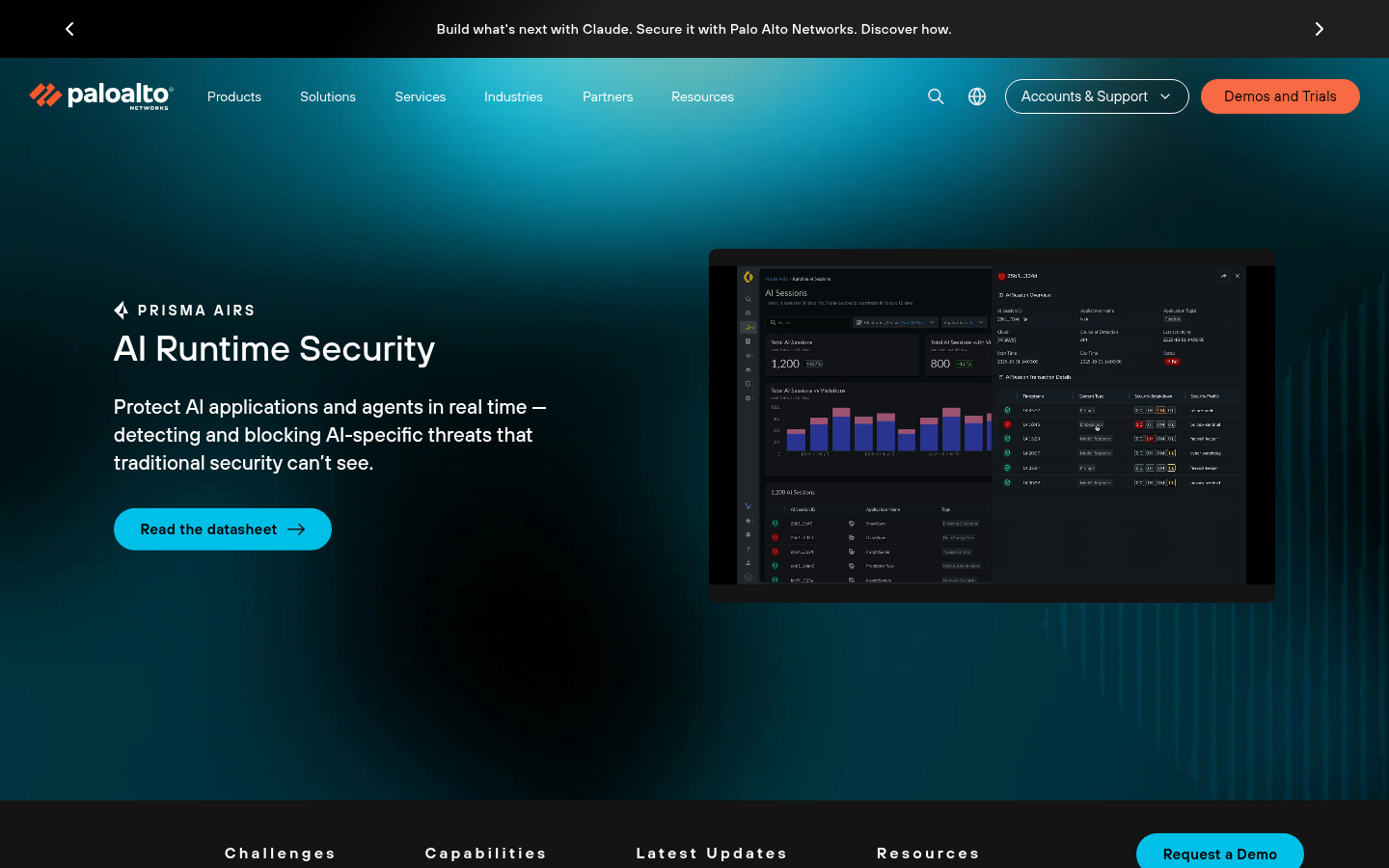
Prisma AIRS AI Runtime Security, part of Palo Alto Networks’ Prisma AIRS platform, inspects prompts, responses, and data flows for AI applications and agents. Enforcement can run as a network-intercept firewall, as an in-app API or SDK, or as both. Prisma AIRS AI Runtime Security can be bought separately from Prisma AIRS supply-chain, red-teaming, and gateway pillars.
This shortlist uses Prisma AIRS AI Runtime Security for the allow-or-block job, not the Cortex Agentic Endpoint Security integration that the coding-agent shortlist already covers for developer workstations. Public docs describe inspection of prompts, responses, and tool traffic, with policy and session views, rather than an on-device allow, ask, deny, or steer decision. On API intercept, those docs also describe in-line data redaction for sensitive data, not only an allow or block verdict.
Key features:
- AI Runtime Security as a network-intercept firewall, an in-app API or SDK, or both
- Inspection of prompts, responses, and data flows for applications and agents
- A separate purchasable pillar from Prisma AIRS supply-chain, red-teaming, and gateway products
- Token-based metering for the API intercept path
Why we like it:
A network or in-app inspection path can block a dangerous prompt or tool payload before it lands, which solves a runtime gap that an agent inventory will not close.
Limits:
This is traffic inspection in a firewall, API, or SDK path, not a per-agent Guardian or an on-device allow, ask, deny, or steer model. The coding-agent endpoint integration is a different shortlist.
License or pricing: Prisma AIRS AI Runtime Security (API) is listed at 182.61 Software NGFW Credits per billion tokens per month on Palo Alto’s October 2026 NGFW credits estimator, checked 12 Nov 2026. The estimator is for planning and does not publish a USD list price. Other Prisma AIRS pillars have separate credit rates that are not used here.
Cisco AI Defense
Best for inspecting LLM and tool calls in a SDK or gateway, then monitoring or blocking in enforce mode
Cisco AI Defense includes Agent Runtime Protection, which inspects LLM and MCP traffic for prompt injection, sensitive data, harmful content, and unsafe tool use. In API mode, a software development kit can rewrite client libraries at runtime so requests and responses are inspected before and after the provider or tool call, in monitor, enforce, or off mode. In gateway mode, the same inspection can run through a Cisco AI Defense Gateway.
In enforce mode, a blocked call raises a policy error and does not proceed. Public material documents inspection of MCP tools, prompts, and resources on both request and response, and integrations with agent frameworks such as Google’s Agent Development Kit. This is an inspection path in your application or gateway, not an on-device session decision that can steer an agent back on course.
Key features:
- Agent Runtime Protection for LLM and MCP requests and responses
- Monitor, enforce, or off modes in the API path, and on or off in gateway mode
- Inspection of MCP tools, prompts, and resources
- Framework integrations, including Google Agent Development Kit
Why we like it:
Enforce mode can block a tool call before it runs, which solves a runtime gap that a model-only filter will leave open at the tool boundary.
Limits:
Public pages describe allow-or-block and monitor behavior, not an allow, ask, deny, or steer model on the device. The SDK path is documented for Python agent stacks. List pricing is not published.
License or pricing: Quote. Cisco does not publish a list unit price for AI Defense Agent Runtime Protection on the product pages reviewed for this shortlist.
Rein Security
Best for a sidecar that blocks a harmful agent action without routing traffic through a gateway
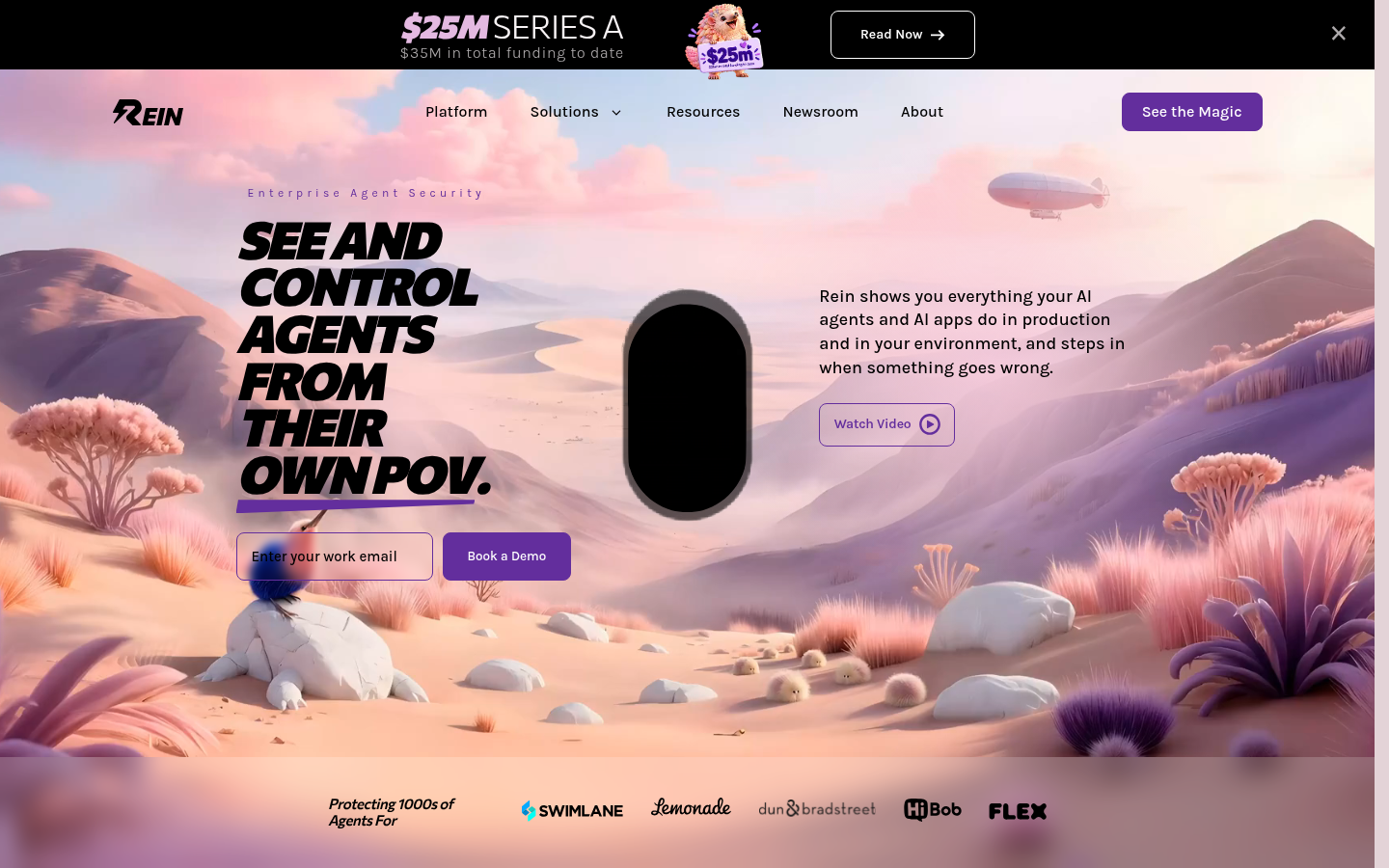
Rein is built as a sidecar that operates at the point an enterprise agent executes an action. Public product and funding pages say it traces each action back to the code that triggered it, holds the agent to a defined role, and can block a harmful action before it runs, including cases where no patch exists yet. Rein also says this happens without routing company or customer data through a gateway or proxy.
That puts Rein beside the agent rather than on a network inspection path. Public technical documentation is thinner than HiddenLayer or Prisma AIRS, so those capabilities are taken from Rein’s public marketing and funding pages. Rein also talks about supply-chain security and generated fixes, which are adjacent jobs, not the allow-or-block decision this shortlist is built around.
Key features:
- A sidecar at the point an agent executes an action, without a gateway or proxy
- Role-based governance that can block a harmful action before it runs
- Tracing from an action back to the triggering code
- Adjacent supply-chain and fix-generation features that are not the allow-or-block job this shortlist is built around
Why we like it:
A sidecar can block the action without fronting the model through a new gateway, which solves a runtime gap for teams that will not reroute agent traffic.
Limits:
Public technical documentation is thinner than the incumbents on this list, and independent validation is not documented. Enforcement is described as blocking harmful actions, not as an allow, ask, deny, or steer decision in session context. List pricing is not published.
License or pricing: Quote. Rein does not publish a list price.
WhiteMatter
Best for a 1:1 Guardian that can allow, hold, deny, redact, or narrow each action

WhiteMatter describes a Guardian as the policy for one agent: it is generated from a blueprint of that agent, signed by a named owner, and can run in Monitor mode before Action mode. In Action mode the Guardian can allow, hold, deny, redact, or narrow an action, and each decision names its rule. Every agent and sub-agent is supposed to get its own Guardian and owner.
Sensors can run on endpoints, clouds, pipelines, SaaS, gateways, and the identity provider, and a Guardian Endpoint is described for macOS, Windows, and Linux, plus cloud instances and Kubernetes nodes. There is no public technical documentation site, so these capabilities are taken from WhiteMatter’s public product pages. Discovery, catalog, and spend features exist around the Guardian; they are not the execution-time decision this shortlist is for.
Key features:
- A 1:1 Guardian per agent and sub-agent, with a named owner
- Allow, hold, deny, redact, or narrow decisions, each tied to a named rule
- Monitor mode before Action mode
- An endpoint component for workstations and cloud or Kubernetes nodes
Why we like it:
A per-agent Guardian can hold or narrow one action without shutting the whole agent down, which solves a runtime gap that a binary block on a gateway may not cover.
Limits:
Public technical documentation is not available, and independent validation is not documented. Capabilities are vendor-stated on the marketing site. List pricing is not published.
License or pricing: Quote. WhiteMatter does not publish a list price with a defined billing unit. Fees are described as following an order form, billed in advance, monthly or annually.
Bay
Best for on-device allow, ask, deny, or steer in session context, without a new persistent agent
Bay’s runtime enforcement page says it reads the whole session, then allows, asks, denies, or steers each proposed action locally on the device, in milliseconds, with no cloud round-trip and no proxy. Policies can be simulated first. Deployment is described through an existing MDM or EDR, without an additional persistent endpoint agent, kernel driver, or network proxy.
The same allow, ask, deny, or steer model is also described for browsers and cloud workspaces. Bay also sells discovery, posture, and investigation around that runtime control; those are adjacent jobs. There is no public technical documentation site, so these capabilities are taken from Bay’s public product pages.
Key features:
- Session-aware allow, ask, deny, or steer decisions made on the device
- No additional persistent endpoint agent, kernel driver, or network proxy
- Deployment through an existing MDM or EDR, with policy simulation first
- The same decision model described for browsers and cloud workspaces
Why we like it:
An on-device allow, ask, deny, or steer decision can stop or redirect one action in session context, which solves a runtime gap for teams that will not put a proxy in front of the agent.
Limits:
Public technical documentation is not available, and independent validation is not documented. Capabilities are vendor-stated on the marketing site. List pricing is not published.
License or pricing: Quote. Bay does not publish a list price, and there is no public pricing or documentation site with a defined unit.
How to choose an AI agent runtime protection tool
- Decide where the control has to sit. If you want inspection in an API, SDK, gateway, or network path, start with Prisma AIRS, HiddenLayer, or Cisco AI Defense. If you want the control on the device or beside the agent, without fronting a new gateway, start with Rein, WhiteMatter, or Bay.
- Decide what a decision is allowed to do. If you need to hold, ask, or reshape an action, not only block it, HiddenLayer can block, detect, or redact; WhiteMatter can allow, hold, deny, redact, or narrow; Bay can allow, ask, deny, or steer. If you want allow-or-block and monitoring, start with Prisma AIRS, Cisco AI Defense, or Rein; Prisma AIRS also documents in-line data redaction on API intercept.
- Do not buy this list as a substitute for authorization, AI-SPM, or coding-agent security. Identity and policy still live on the authorization shortlist. Model and pipeline posture live on the AI-SPM shortlist. Developer-workstation hooks live on the coding-agent shortlist. An LLM firewall or MCP gateway is a traffic path, not this execution-time job.
- Read the unit on any public price. Only one tool on this list publishes a meter, and it is not a USD list price. A quote still needs the same clarity: what is counted, and which actions are actually blocked or reshaped.
What we left out
- Protect AI is not sold as a standalone product. Palo Alto Networks completed the acquisition in July 2025; the current purchasable product is Prisma AIRS, listed above.
- Robust Intelligence is not sold as a standalone product. Cisco’s first-party page says it was acquired in October 2024 and is now part of Cisco AI Defense, listed above.
- AIR is already on the coding-agent shortlist, and in AIR vs Zenity, because it starts by vetting skills, plugins, and MCP servers before install. We left it off this page so the shortlist stays on allowing or blocking a general agent action at execution time, not pre-install vetting for coding agents.
- Zenity Runtime Boundaries can evaluate an action and let it through, block it, or shut the agent down, but Zenity is a broader agent and copilot governance platform, already covered on the coding-agent shortlist and in WhiteMatter vs Zenity. Shortlist Zenity if you want inventory, posture, and runtime boundaries together, not only the execution-time control this shortlist compares.
- Lakera Guard (Check Point): Check Point closed the acquisition of Lakera on 22 Oct 2025. Lakera Guard is now sold inside Check Point, so evaluate it with that platform.
- Prompt Security (SentinelOne): now sold inside SentinelOne, so evaluate it with that platform.
- Outerlimit is an MCP gateway and credential broker: first-party pages describe an in-tenant MCP gateway and enforcement-point credential injection so agents do not hold secrets. We left it out because that job belongs with agent authorization tools and MCP gateways.
What practitioners argue about runtime controls
The recurring argument is not which logo watches the model. It is whether a dangerous tool call is actually stopped, and where that decision runs.
Mateusz Dziemian, Maxwell Lin, Xiaohan Fu, Micha Nowak et al., 16 Mar 2026
“Since users tend to observe only an agent’s final response, an attack can conceal its existence by presenting no clue of compromise in the final user facing response while successfully executing harmful actions.”
The finding is about the job this shortlist starts from, stopping the action, not about reading the model’s final reply, and it is not a review of a vendor on this list.
If you want inspection in an API, SDK, gateway, or network path, start with Prisma AIRS or Cisco AI Defense when the next step is to allow or block the call, and with HiddenLayer when you also want a redact decision in a framework guardrail or gateway. If you want the control on the device or beside the agent, Rein can block a harmful action from a sidecar, WhiteMatter can allow, hold, deny, redact, or narrow it through a per-agent Guardian, and Bay can allow, ask, deny, or steer it on the device. Rein, WhiteMatter, and Bay are launch-stage, so run a pilot before you depend on them to allow or block production agent actions.
FAQs
Is an AI agent runtime tool the same as an LLM firewall?
No. An LLM firewall inspects model prompts and outputs on a traffic path. Runtime protection, here, is whether a single agent action can be allowed or blocked at execution time. Prisma AIRS, HiddenLayer, and Cisco AI Defense may inspect that traffic as part of the job; Rein, WhiteMatter, and Bay sit on the device or beside the agent instead.
How is this different from AI agent authorization?
Authorization decides what identity and policy an agent is issued before it runs. Runtime protection asks whether a specific action is allowed, blocked, held, or reshaped as it happens. You can need both: a scoped identity still leaves a tool call that has to be stopped or narrowed at execution time.
If we already secure coding agents, do we still need this shortlist?
Only if you also have agents that are not a developer coding assistant. The coding-agent shortlist is about hooks on a workstation and pre-install vetting. The shortlist here is the narrower allow-or-block job for agent actions at execution time, including customer-facing and internal enterprise agents.
If a tool inspects a prompt, has it blocked the action?
Not by itself. Prisma AIRS and Cisco AI Defense can inspect and, in the documented enforcement path, block a call. Prisma AIRS can also mask sensitive data on the API intercept path, which its docs describe as in-line redaction. HiddenLayer can block, detect, or redact. Rein can block from a sidecar. WhiteMatter can hold, deny, redact, or narrow, and Bay can ask, deny, or steer, on the device or beside the agent. Prevention, on this page, is the decision at execution time, not the inspection log.