Vulnerability Management
Best BAS Tools for Breach and Attack Simulation in 2026
A green scanner does not prove the EDR rule will fire.
Vulnerability scanners can return 0 critical CVEs while an endpoint still fails to detect a living-off-the-land technique. Security control validation exists to measure what prevention and detection controls actually block, catch, or miss.
Breach and Attack Simulation safely emulates adversary techniques against live defenses. Platforms differ: some optimize continuous multi-vector testing and remediation packs; others deepen purple-team emulation; open atomics let you self-test ATT&CK techniques without a SaaS console.
If you need internet-facing asset discovery, use attack surface management. If the queue is CVE prioritization, see vulnerability management platforms.
How we evaluated
We read first-party BAS, adversary emulation, and control-validation product pages and packaging notes on 17 Sep 2026. We asked whether the product runs safe simulations against live controls, whether ATT&CK mapping is first-class, whether remediation or re-test loops exist, and whether an open self-run path is available. Marketing scenario counts are claims, not bake-off proof.
| Tool | Best for | What to check |
|---|---|---|
| Cymulate | Continuous multi-vector BAS | Commercial · remediation focus |
| AttackIQ | ATT&CK adversary emulation | Commercial · Flex/enterprise |
| SafeBreach | Enterprise continuous simulation | Commercial · program-scale |
| Picus Security | Control validation + mitigations | Commercial · SCV framing |
| SCYTHE | Purple-team adversary emulation | Commercial · campaign depth |
| Atomic Red Team | Open ATT&CK atomics | Open tests · you operate |
Cymulate
Best for broad continuous BAS with remediation-oriented output
Cymulate runs multi-vector breach and attack simulations and emphasizes finding which controls fail, then pushing remediation guidance into the security stack.
It is a category leader on this list, not the only BAS option. Judge PoC results against AttackIQ, SafeBreach, and Picus on your own controls.
Key features:
- Continuous simulation across email, endpoint, network, and cloud modules they list
- MITRE ATT&CK mapping for scenarios
- Remediation guidance aimed at SIEM/EDR rules
- Exposure and baselining workflows in their product story
Why we like it:
Security programs that need a single BAS console with fast scenario updates get a mature commercial option without pretending one vendor owns the category.
Limits:
Commercial quote. Breadth can outrun staffing if every failed control becomes a ticket. Confirm which modules are in year one.
License or pricing: Commercial. No public list price on 17 Sep 2026.
AttackIQ
Best for ATT&CK-aligned adversary emulation with Flex testing options
AttackIQ centers MITRE ATT&CK aligned testing and adversary emulation, including lighter Flex-style testing paths alongside enterprise programs.
Pick it when the purple team wants rigorous ATT&CK coverage more than a marketing heat map.
Key features:
- ATT&CK-aligned adversary emulation libraries
- Flex and enterprise testing options they publish
- Control validation reporting for detection engineering
- Ready / managed offerings for teams that need help operating tests
Why we like it:
Detection engineers who map every rule to ATT&CK get a testing partner that speaks the same matrix language.
Limits:
Commercial. Operating emulation well still needs purple-team time. Confirm agent vs agentless paths for sensitive segments.
License or pricing: Commercial. Flex and enterprise packaging vary; confirm on 17 Sep 2026.
SafeBreach
Best for enterprise-scale continuous simulation and attack-path context
SafeBreach runs continuous breach simulations at enterprise scale and ties results to attack-path style context so failures are not orphaned alerts.
It fits large programs that already staff control validation as an ongoing function.
Key features:
- Large simulation libraries and continuous execution
- Attack-path oriented reporting they emphasize
- Integrations into enterprise security stacks
- Executive and operator views for validation programs
Why we like it:
Global enterprises that treat BAS as always-on production hygiene get a platform sized for that operating model.
Limits:
Commercial enterprise motion. Heavier than a weekend Atomic run. Expect program design, not only a license key.
License or pricing: Commercial. No public list price on 17 Sep 2026.
Picus Security
Best for security control validation with vendor-specific mitigation guidance
Picus frames BAS as security control validation: safely run techniques, measure what each control blocks or misses, then ship vendor-specific fixes and re-test.
Picus documents mapping across tens of thousands of TTPs and thousands of threat scenarios on its SCV pages. Treat those as vendor claims to verify in PoC.
Key features:
- Continuous BAS against live EDR, SIEM, email, and network controls
- Automatic MITRE ATT&CK mapping they advertise
- Vendor-specific mitigation content and re-validation loops
- Reporting aimed at proving control effectiveness
Why we like it:
Teams tired of “configured” dashboards that never prove a technique was blocked get a validation-first narrative.
Limits:
Commercial. Mitigation packs are only as good as your tool stack. Confirm coverage for the controls you actually run.
License or pricing: Commercial. Trial/quote paths on site; no universal list price on 17 Sep 2026.
SCYTHE
Best for adversary emulation depth and purple-team campaign design
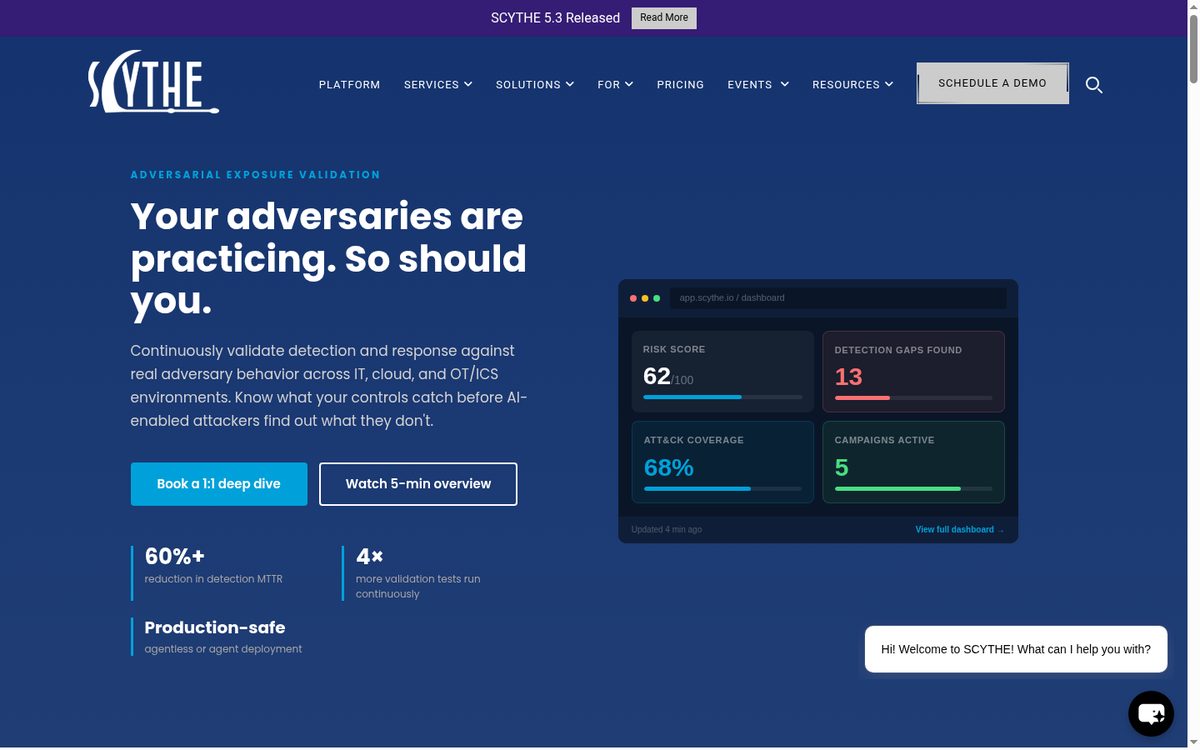
SCYTHE focuses on adversary emulation and attack campaigns that purple teams drive, closer to realistic operator behavior than a flat scenario checklist.
Choose it when emulation fidelity matters more than a turnkey executive BAS score.
Key features:
- Adversary emulation campaign building
- ATT&CK-oriented module libraries
- Purple-team collaboration workflows
- Detection validation from realistic campaigns
Why we like it:
Mature purple teams that already write detections want campaign depth, not only automated email attachment tests.
Limits:
Commercial and operator-skill heavy. Smaller teams may prefer Atomic plus a lighter BAS first.
License or pricing: Commercial. Scoping-based pricing. Checked 17 Sep 2026.
Atomic Red Team
Best for open, small, ATT&CK-mapped tests you run yourself
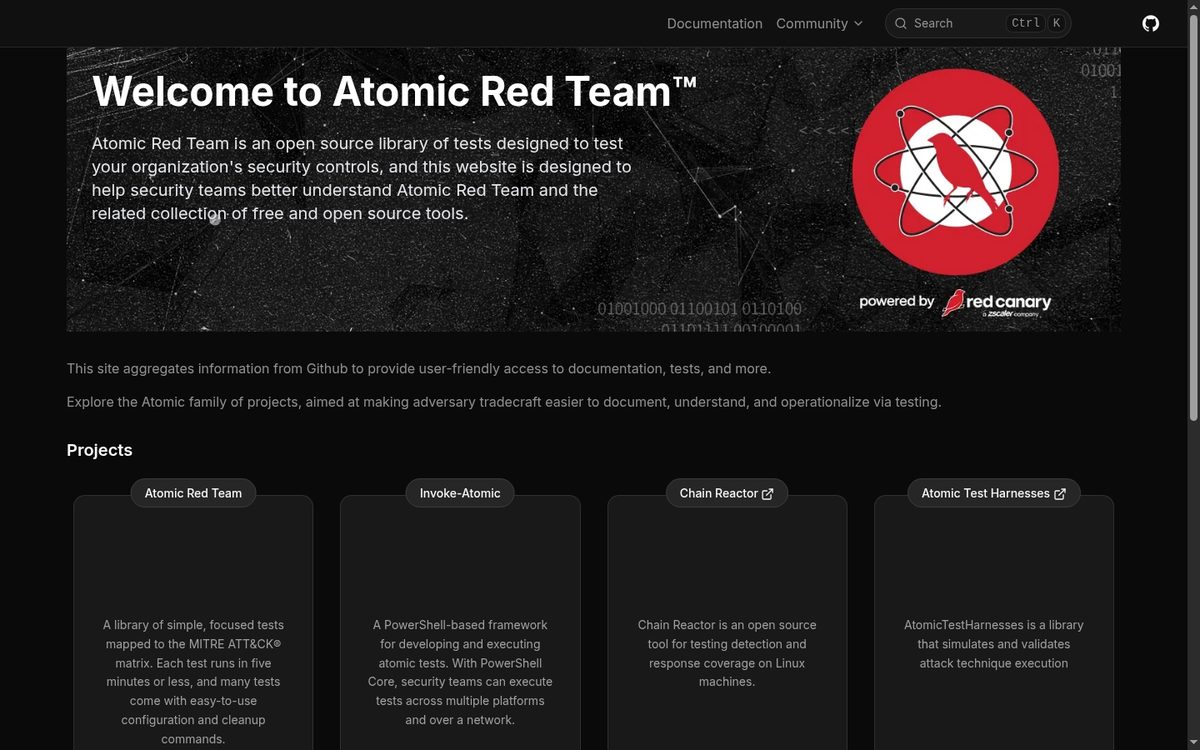
Atomic Red Team is a library of small, focused tests mapped to MITRE ATT&CK that detection engineers run to see whether controls fire.
It is open testing content, not a managed BAS SaaS. Pair it with commercial BAS when you need continuous multi-vector coverage.
Key features:
- Open ATT&CK-mapped atomic tests
- Runs on your hosts under your control
- Community contributions and Red Canary stewardship
- Invoke-Atomic and related runners in the ecosystem
Why we like it:
Detection engineers who need a cheap, honest signal before a six-figure BAS renewal start here and keep using it beside platforms.
Limits:
You operate it. No enterprise console, no multi-tenant reporting, no vendor remediation packs. Safety and blast radius are on you.
License or pricing: Open testing project. Confirm current license terms on the project site (17 Sep 2026).
How to choose a BAS tool
Four questions before the quote. Names are the shortlist, not a scored bake-off.
| Critical question | Why it matters | What to evaluate | Red flag |
|---|---|---|---|
| Do you need continuous multi-vector coverage? | Email, endpoint, and network controls fail differently. | Cymulate / SafeBreach / Picus for platform BAS. | A single atomic that never leaves the laptop. |
| Is detection engineering the buyer? | ATT&CK-mapped emulation beats executive heat maps for rule authors. | AttackIQ or SCYTHE; keep Atomic for unit tests. | A score-only report with no failed technique detail. |
| Who closes failed simulations? | Validation without owners becomes noise. | Picus-style mitigation loops if your stack matches; else staff a purple queue. | No ticket owner named in the PoC. |
| Can you run open tests first? | Cheap signal before enterprise BAS. | Atomic Red Team under change control. | Skipping atomics then blaming the platform for unknowns. |
What practitioners argue about BAS
Threads are about whether simulated attacks produce detectable logs, not about BAS brand wars. Control validation fails when offense runs and defense stays silent.
Information Security Stack Exchange
“I’m working on a lab environment for my MSc dissertation, focusing on offensive attack simulations and defensive log monitoring using Wazuh… Used to simulate attacks with tools like Mimikatz and SharpHound.”
May 2025 thread (linked in the SafeBreach entry). The pain is classic BAS: offense executed, detections missing.
Picus Security
“Rather than confirming a control is deployed, [SCV] safely runs real attack techniques against your firewalls, EDR, email gateways, and SIEM and measures what each one stops, catches, or misses.”
Security Control Validation first-party definition (same Picus SCV page linked in the opener). That measurement job is what separates BAS from scanner green.
If the next gap is still unknown internet assets, read attack surface management. If the queue is CVE debt, use vulnerability management platforms.
FAQs
Is BAS the same as ASM?
No. Attack surface management discovers exposed assets and services. BAS validates whether security controls detect or block simulated techniques.
Is BAS a pentest replacement?
No. BAS continuously tests controls with known techniques. Pentests and red teams still find novel paths and business logic issues.
Can Atomic Red Team replace a BAS platform?
It can prove individual detections cheaply. It does not replace multi-vector continuous platforms or executive validation programs.
Is this a scored bake-off?
No. Order is editorial.